

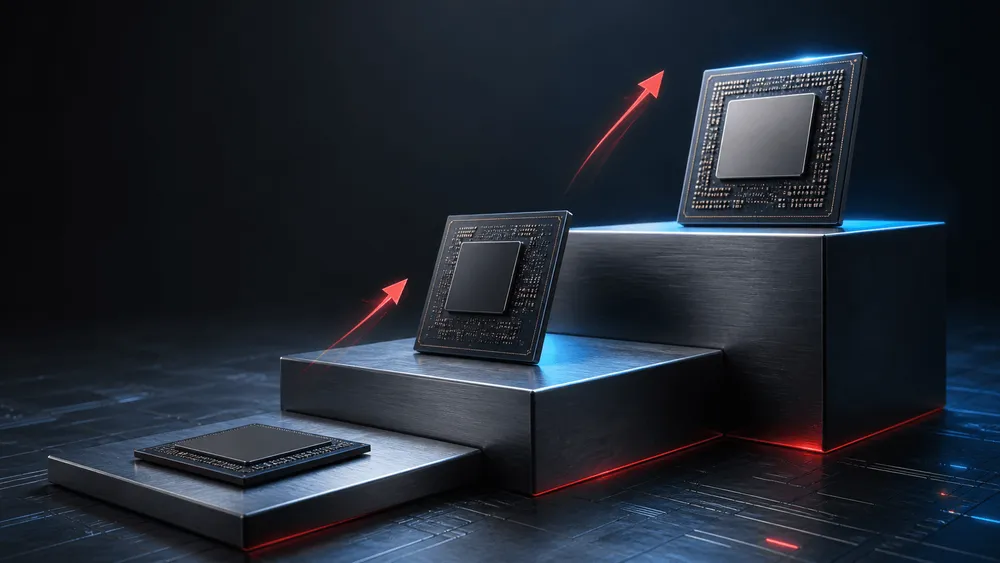
The Qualcomm chip price hike, which TechNews reported will apply to shipments from September 1 onward, may proceed with different ranges depending on product tier. On August 5, 2026, the outlet reported, citing supply chain sources, that the company is negotiating with customers targeting 10-15% for premium flagships, 5-7% for mainstream, and 0-2% for low-end. Qualcomm officially acknowledged double-digit price revisions spanning multiple end markets during its earnings call on July 29, but did not disclose tier-specific figures.
What has now come into view is not a uniform hike rate, but a price differential that grows larger toward the flagship tier. However, the chip's rate of increase is not the same as the rate applied to a smartphone's overall manufacturing cost. Without accounting for memory prices, individual contracts, and whether manufacturers absorb the cost through reduced margins or through spec changes, the impact on retail prices cannot be read directly.
A three-tier structure: 10-15%, 5-7%, and 0-2%
The negotiation targets reported by TechNews are as follows.
| Qualcomm product tier | Reported target price increase |
|---|---|
| Premium flagship | 10-15% |
| Mainstream | 5-7% |
| Low-end | 0-2% |
These figures reportedly represent the ranges being targeted in negotiations with customers, not an official price list published by Qualcomm. Differences by customer or region, and exceptions in individual contracts, have not been disclosed. This means it has not been confirmed that all flagship chips will rise by the same rate.
The cutoff for application appears to be based on shipment date rather than order date. According to TechNews, the new pricing applies to products shipped on or after September 1, 2026, and even orders placed before that date may be subject to re-quoting or changes in purchase terms. Device makers and module companies will need to reassess not only new procurement going forward but also the profitability of production plans already in place.
Not a flat double-digit hike, but a phased rollout shaped by contracts and product cycles
Qualcomm's official statements and the figures reported by TechNews cover different scopes. CFO Akash Palkhiwala said during the July 29 earnings call that the price revisions are being implemented broadly across different end markets and that the scale of the revisions sought is double-digit. However, he did not go so far as to say that all products would see a uniform double-digit increase. The supply chain information putting the low-end figure at 0-2% suggests that negotiations are underway to establish price differentials across the product lineup as a whole.
Nor is it certain that the price hike will take full effect uniformly on September 1. Palkhiwala explained that because of existing contracts and product cycles, the price changes will be reflected gradually over time. Qualcomm expects the effects to show up in gross margin over the coming several quarters, eventually returning to previous levels. Even with the shipment date as the cutoff, the timing of revisions will not be uniform across contracts.
Customers have already begun changing their product choices. According to Palkhiwala, in response to rising memory prices, some OEMs are adopting different chips within the premium tier or opting for previous-generation products. If procurement prices for the Premium tier rise by 10-15%, the decision of whether to extend the latest generation across all models or to narrow down which models adopt it becomes even more consequential.
QCT's EBT margin falls 4 points, while memory costs balloon through a separate channel
In Qualcomm's fiscal 2026 third quarter, revenue for the QCT semiconductor segment was $8,504 million, down 5% year over year, with EBT margin falling 4 percentage points from 30% to 26%. Handsets revenue fell 20%, from $6,328 million to $5,086 million. The 10-Q cites, as a primary factor, that some major OEMs lowered their production plans in order to reduce inventory in response to memory supply constraints and price increases.
Qualcomm's own costs have also risen. According to the company, costs from wafer fabrication through assembly and testing have increased, and the burden of advanced packaging has grown heavier as well. Input costs, including memory and other materials, are rising broadly. CEO Cristiano Amon characterized the current double-digit price increase, during the earnings call, as a pass-through of input costs and wafer prices, and suggested it is small compared to the increase in memory BOM costs that device makers are bearing.
Memory costs on the device side are ballooning through a channel separate from Qualcomm's product price revisions. According to TrendForce estimates, contract prices for memory in an 8GB+256GB configuration rose approximately 200% year over year in the January-March quarter of 2026. Memory's share of smartphone BOM, which used to be 10-15%, has expanded to 30-40%. The firm forecasts global smartphone production in 2026 to fall 10% year over year to approximately 1.135 billion units, with a bear case scenario seeing a decline of 15% or more.
The Qualcomm product price hikes are being layered on top of this. Even with the low-end target range at 0-2%, this does not mean the profitability of budget devices will ease. This is because the rise in cost of non-chip components and consumer price sensitivity remain factors. Conversely, even though the Premium tier's nominal rate of increase is the largest, it does not necessarily follow that the entire device will rise in price at the same rate.
Will it show up in device prices, or in SoC choices and specs?
The 10-15% chip price increase cannot be directly applied to smartphone retail prices. Qualcomm has not disclosed baseline prices for individual chips, and the share of the device BOM they represent varies by model. Manufacturers will have to choose between absorbing the increase through margins, passing it on to retail prices, or switching the SoC they adopt.
Specs and promotions could also serve as adjustment levers. Conceivable responses include limiting memory or storage capacity, changing the configuration of other components such as cameras, or scaling back sales discounts. However, the figures reported by TechNews represent targets still under negotiation, and no manufacturer has announced concrete measures. What Qualcomm has officially acknowledged is a broad double-digit price increase, with the timing of its implementation varying by contract and product cycle.
The first pieces of evidence to watch will be the finalized quotes presented to customers and which terms apply to existing orders shipping on or after September 1. After that, tracking which models adopt the latest SoC, memory capacities, and where retail prices move will reveal where manufacturers ended up absorbing the increase. On Qualcomm's side, whether QCT's gross margin returns to its previous level over the coming several quarters will be the number that measures how deeply the price hike has taken hold.