

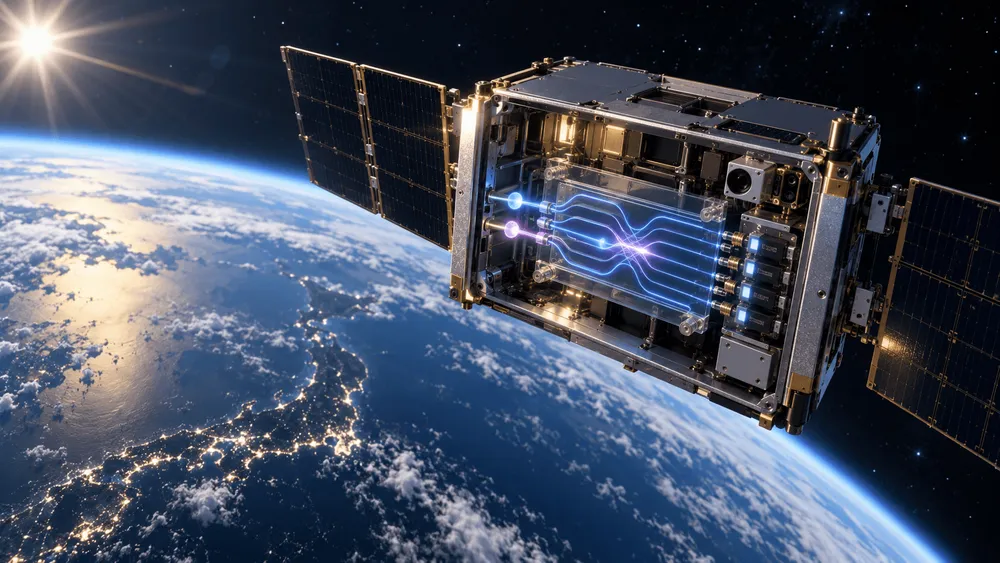
Photonic quantum experiments in ground-based physics laboratories are typically built by arranging numerous optical components on a large optical bench. Vibration isolation systems suppress minute vibrations, and air conditioning systems finely control room temperature, all so that a small number of photons with matched wavelengths and arrival times can be made to interfere. Miniaturizing such equipment—sensitive even to slight vibrations or temperature changes—loading it onto a rocket, and launching it into space is no easy task.
In September 2026, a research team led by Professor Philip Walther at the University of Vienna published a preprint on the arXiv server (DOI: 10.48550/arXiv.2609.25248) reporting that they operated a programmable photonic quantum processor inside a small spacecraft and confirmed basic quantum optical operations in orbit.
Previous efforts have included attempts such as China's quantum communication satellite Micius, which sends entangled photon pairs from space to the ground for quantum key distribution and fundamental physics experiments. In contrast, this new study generated photons inside the spacecraft itself, manipulated them through a programmable waveguide circuit, and detected the results on board—executing the entire process as a single integrated system. The research team states that this is the first demonstration of programmable photonic quantum processing in orbit.
However, it would not be accurate to interpret this as "successful practical quantum computation in space." What was confirmed was Hong-Ou-Mandel (HOM) interference—a phenomenon that appears when two photons become quantum mechanically indistinguishable—and measurement of the output distribution from a preset optical circuit.
The team did not process actual satellite observation data, nor did they demonstrate computational performance exceeding that of conventional electronic computers. Rather, the significance of this experiment lies in confirming the basic operation of a photonic quantum circuit in orbit, even as the device's performance was severely degraded by launch vibrations, radiation, and the vacuum environment. As of this writing, the results remain at the preprint stage, prior to publication in a peer-reviewed journal.
Packing an Entire Photonic Quantum Circuit into a Shoebox-Sized Device
The device was designed with an eye toward future applications addressing the data communication bottleneck faced by Earth observation satellites.
Modern optical sensors and synthetic aperture radar generate enormous volumes of raw data, yet the bandwidth and available time for transmission to ground stations remain limited. If data could be processed on board the satellite and only the necessary information extracted, the volume of data sent to the ground could potentially be reduced. The research team envisions using small photonic quantum circuits—capable of operating within the constraints of limited power and weight—for this kind of onboard processing in the future.
The experimental payload was launched into space on June 23, 2025, aboard a SpaceX Falcon 9 rideshare mission called Transporter-14, launched from Vandenberg Space Force Base in California.
The photonic quantum processor was mounted on "Passionate Paula," an orbital transfer vehicle operated by the Italian space company D-Orbit under its ION Satellite Carrier program, and placed into low Earth orbit.
Regarding the orbit, the paper states an altitude of approximately 510 kilometers and an orbital inclination of 97.5 degrees in a sun-synchronous orbit. Meanwhile, the University of Vienna's public press materials cite an altitude of approximately 550 kilometers—a discrepancy between the two figures. This article uses the figure reported in the primary source, the paper itself, as the reference.
The payload was designed for installation in a small spacecraft, with external dimensions of 15 × 15 × 45.3 centimeters and a weight of 9.8 kilograms. Average power consumption was kept to about 10 watts. The university's press release describes it as "shoebox-sized, weighing about 9.5 kilograms," but the paper lists the measured value as 9.8 kilograms.
The optical system is designed to complete photon generation, manipulation, and detection all within a single device.
First, in the light source section, a continuous-wave semiconductor laser with a wavelength of 405 nanometers illuminates a periodically poled potassium titanyl phosphate (ppKTP) crystal. Inside the crystal, a nonlinear optical phenomenon called Type-II spontaneous parametric down-conversion (SPDC) occurs, generating photon pairs with a wavelength of approximately 810 nanometers.
Because the two photons have mutually orthogonal polarizations, they are separated into two paths using a fiber polarization beam splitter. Delay lines are then used to adjust arrival times before the photons are sent into an integrated photonic chip.
The chip consists of waveguides directly written into a glass substrate using a femtosecond laser, providing six optical paths, or six modes. The waveguides feature microscopic heaters that exploit the thermo-optic effect. By locally altering temperature and refractive index through electrical current, the light paths and phases can be adjusted, allowing various unitary transformations to be configured.
Each of the six outputs is connected to a single-photon avalanche diode (SPAD), which records as an electrical signal which output a photon emerged from.
The temperature of the ppKTP crystal is maintained within 0.1 kelvin using a Peltier element and PID control, adjusting the frequency conditions of the generated photon pairs. A multi-channel current driver controls the waveguide heaters, and an onboard computer manages the entire experimental procedure.
Anticipating future applications in Earth observation, a camera from the German Aerospace Center (DLR) was also connected to the system. After the mission concludes, the spacecraft is planned to re-enter the atmosphere within a few years.
Launch and Orbital Environment Damaged the Device
Vibrations and shocks during rocket launch pose a major challenge for precision optical devices. Even a positional shift of a few micrometers can reduce coupling efficiency with optical fibers or waveguides.
To withstand the space environment, the research team implemented several reinforcement measures. Optical components were secured to a high-rigidity titanium base plate, and free-space optical elements were bonded to dedicated mounts. The connections between optical fibers and the glass waveguide chip were also reinforced using V-groove substrates and epoxy resin.
Before launch, the team conducted tests simulating the vibrations and shocks expected during rocket flight, as well as vacuum-baking to remove outgassing contaminants.
Even so, a major problem emerged once the device was activated in orbit.
Of the six silicon SPAD channels installed, only three—C0, C1, and C5—functioned normally. Channels C2, C3, and C4 did not work properly.
With half the detectors lost, it became impossible to conduct the originally planned measurements using all six modes. With only three usable detectors, observations were effectively limited to a three-mode subspace.
The research team therefore reconfigured the entire 6×6 optical circuit, rerouting the optical paths so that photons would be directed to the three available detectors. This allowed the experiment to continue, albeit with reduced functionality.
Regarding the cause of the detector failures, the paper considers several possibilities, including mechanical damage during launch as well as displacement damage from cosmic radiation and an increase in dark count rate.
Three Problems: Sunlight, Cosmic Radiation, and the Vacuum Environment
Even as measurements continued with the remaining three detectors, new problems emerged.
The first was stray light from the sun.
Because SPADs can detect extremely faint light, even small amounts of scattered light entering the device create significant background noise. During sunlit periods, background counts increased, making it impossible to measure coincidence counts of photon pairs with sufficient precision.
The research team therefore switched to an operational approach focused on measurements during "eclipse" periods, when the spacecraft passes through Earth's shadow.
The orbital period was approximately 90 to 92 minutes, of which about 30 minutes per orbit were spent in Earth's shadow.
| Orbital Environment | Approximate Duration | Optical Conditions | Experiment |
|---|---|---|---|
| Sunlit period | ~60 minutes | High stray light from sunlight | SPAD-based measurement difficult |
| Earth's shadow (eclipse) | ~30 minutes | Background light greatly reduced | Single-photon measurement possible |
As a result, the time available for experiments in each orbit was limited. The final measurement results were obtained by combining data collected across multiple eclipse periods.
The second problem was degradation of components due to cosmic radiation.
The device was shielded with 1-centimeter-thick aerospace-grade aluminum alloy. While effective at reducing electrons and the resulting bremsstrahlung radiation, this shielding could not completely block high-energy protons.
Fifty-two days after launch, the dark count rate of the SPADs—false detection signals that occur even without incoming light—had increased. The research team believes this was caused in part by displacement damage, in which high-energy particles create defects in the silicon crystal.
Radiation-induced attenuation also progressed in the optical fibers, as radiation formed defects that reduced transmittance. This too contributed to a reduction in photon detection counts.
An even bigger problem turned out to be outgassing in the vacuum environment.
When the device was placed in the vacuum environment, some adhesives released volatile compounds. The research team's analysis suggests that these vaporized organic molecules migrated within the device and deposited onto the surfaces of nearby optical components, including the Volume Bragg Grating, collimation lenses, and polarization beam splitters.
Contamination of these optical surfaces reduced their transmittance, and the output of the laser light source system also dropped significantly.
By the time this problem was discovered, the experimental apparatus had already been integrated into the Falcon 9 launch preparations, making it impossible to replace or clean the affected components.
In additional ground-based tests that recreated the vacuum environment, the laser's effective output—originally 20 milliwatts—dropped to about 4 milliwatts within approximately one week under conditions of roughly . This represents a decrease of about 80 percent.
- Ground, atmospheric pressure (rated)
- Ground, vacuum test (after degradation)
データを表で見る
| Ground, atmospheric pressure (rated) (Measured values) | Ground, vacuum test (after degradation) (Measured values) | |
|---|---|---|
| Laser Output (mW) | 20 | 4 |
| Coincidence Rate (Hz) | 220 | 50 |
Under ground atmospheric conditions, the photon-pair coincidence rate at rated output was approximately 220 Hz. In the vacuum-simulating test, however, this dropped to about 50 Hz as laser output declined.
In orbit, this problem was compounded by the constraint that only three of the six SPADs were usable.
To obtain more signal, the research team adjusted measurement conditions by increasing the SPAD overvoltage to 12 V and integrating each measurement over 60 seconds. Orbital measurements of quantum interference were carried out under these constrained conditions.
HOM Interference Confirmed at 32.5 Degrees
The central phenomenon the research team sought to confirm in orbit was Hong-Ou-Mandel (HOM) interference.
HOM interference is a representative two-photon interference effect that appears when two photons become quantum mechanically indistinguishable.
Two photons matched in wavelength, polarization, spatial mode, and arrival time are simultaneously injected into the two inputs of a beam splitter.
When the two photons can be treated as distinguishable, independent particles, there is a certain probability that each will emerge from a different output. However, when the two photons become completely indistinguishable quantum mechanically, the quantum probability amplitudes corresponding to "the two photons exiting from separate outputs" cancel each other out.
As a result, the two photons are more likely to emerge from the same output—a phenomenon known as photon bunching.
When detectors placed at the two outputs measure the frequency of simultaneous photon detection, the coincidence rate decreases under conditions where the two photons become indistinguishable. This dip is known as the "HOM dip."
In an ideal classical model, HOM visibility cannot exceed 50 percent. Therefore, obtaining a visibility above 0.5 with sufficient statistical confidence serves as evidence of non-classical two-photon interference.
In this experiment, the temperature of the ppKTP crystal was varied to match the properties of the two photons. Changing the crystal temperature also changes the central frequency of the generated photon pairs.
Ground tests had confirmed that setting the crystal temperature to 32.5 degrees resulted in matching central frequencies for the two photons.
When the crystal temperature was varied during orbital measurements as well, a HOM dip—where the coincidence rate decreased—appeared near 32.5 degrees.
The resulting HOM interference visibility was:
This exceeds the classical limit of 0.5 by 2.14 standard deviations (). While the statistical significance is not particularly high and the uncertainty is substantial, this result is consistent with—though not extremely strong evidence for—non-classical two-photon interference having occurred in orbit.
To verify that the observed dip was not simply due to instrumental noise, the research team also conducted a control measurement.
When the internal phase of the on-chip Mach-Zehnder interferometer (MZI6) was set to using its heater, no similar HOM dip appeared even when the crystal temperature was set to 32.5 degrees.
The HOM dip was confirmed across two separate days of measurement, and the weighted average of that data yields the visibility of 0.908 reported above.
Nine Programmed Optical Circuit Configurations Also Measured
The research team next confirmed that the integrated photonic circuit was indeed programmable.
With the two photons placed in a distinguishable state, nine different unitary transformations combining the three available spatial modes were programmed into the heaters, and the coincidence count distributions at each output were measured.
The classical fidelity $F$, which represents the degree of agreement between the theoretically predicted distribution and the measured values, averaged across all nine configurations was:
Among the nine settings, two showed large deviations believed to stem from miscalibration of the optical circuit. Excluding these two, the fidelity rose to:
The paper reports both the average across all nine settings, including outliers, and the value excluding the two problematic settings.
| Parameter | Ground / Pre-Launch | In Orbit or Ground Retest | Main Constraint |
|---|---|---|---|
| Functional SPADs | 6 of 6 | 3 of 6 (C0, C1, C5) | Measurable outputs limited to 3 modes |
| Effective laser output | 20 mW | ~4 mW (ground vacuum retest) | ~80% reduction due to outgassing contamination of optics |
| Photon-pair coincidence rate | ~220 Hz | ~50 Hz (ground vacuum retest) | 12 V overvoltage, 60-second integration used in orbit |
| HOM interference visibility $V$ | Interference confirmed on ground | Exceeds classical limit of 0.5 by | |
| Average unitary transformation fidelity $F$ | Circuit designed and calibrated in advance | excluding 2 settings | |
| Orbital altitude | ~550 km (university press materials) | ~510 km (paper) | Sun-synchronous orbit, 97.5° inclination |
A First Step Toward Quantum Information Processing in Space
When assessing this achievement, it is important to distinguish clearly between what has been demonstrated and what has not.
What was demonstrated is that photon pairs can be generated inside a small orbiting spacecraft, manipulated using a programmable integrated photonic circuit, and used to detect quantum interference and output distributions. This shows that the basic functions underlying quantum information processing can operate even in the space environment.
On the other hand, the team did not compress or classify images captured by an Earth observation satellite using a quantum algorithm, nor did they demonstrate any computational advantage over conventional onboard computers.
The research team's stated future goal is to connect the quantum processor to observation sensors, such as satellite cameras.
One envisioned approach, for example, would convert data obtained from an Earth observation camera into settings for the optical circuit, then use programmable unitary transformations to perform processing such as feature extraction or inference. If realized, this could lead to "onboard quantum machine learning," incorporating quantum circuits into satellite data processing pipelines.
However, numerous engineering challenges remain before that becomes possible.
In this experiment, photon-pair detection rates dropped substantially due to increased SPAD dark count rates from cosmic radiation, reduced optical fiber transmittance, and contamination of the optical system from outgassing in the vacuum environment.
Under conditions requiring tens of seconds or more of integration time per measurement to obtain sufficient statistics, direct application to Earth observation use cases—which require continuous imaging and real-time processing—remains difficult.
Moving toward practical applications will require the development of radiation-hardened photodetectors and optical circuits, thorough use of low-outgassing materials, prevention of optical component contamination in vacuum environments, and light-shielding designs capable of suppressing stray light even during sunlit periods.
Furthermore, a question remains as to whether current photonic quantum processors—lacking full quantum error correction—can offer practical advantages over high-performance ground-based GPUs or satellite-grade edge computers.
This mission was a proof of concept using a small payload, and its results remain at the pre-peer-review stage. Nevertheless, the significance of sending a photonic quantum circuit—which normally requires precise environmental control on the ground—into space, and confirming two-photon interference and programmable optical circuit operation even as part of the device failed and performance degraded, should not be underestimated.
What has been achieved here is not the completion of a "space quantum computer," but rather an early demonstration that the fundamental building blocks required for photonic quantum information processing can indeed operate in orbit.