


Information is recorded, and it travels back up the river of time. For thousands of years, humanity has fixed and preserved static "states"—carving characters into stone tablets, burning arrangements of electrons onto magnetic disks. But in the realm of quantum mechanics, attempting to capture an "operation"—the process of change itself—and replay it at a later moment of one's choosing involves difficulties that defy intuition.
A quantum state suffers irreversible change the instant it is observed, and copying an unknown physical law's black box without damaging it is forbidden. "Storage and Retrieval" of quantum operations—holding an unknown program in memory and drawing out its execution at an arbitrary moment—is a grand technical challenge. In tackling it, a research team at the University of Tokyo led by Assistant Professor Satoshi Yoshida, Project Researcher Jio Miyazaki, and Professor Mio Murao has mathematically proven that storing information using quantum memory fundamentally surpasses conventional classical memory, opening a new horizon for the field of physics.
Freeze the Operation: The Classical Wall That Quantum Programs Have Faced
The task of storing and later reproducing an unknown operation resembles tasting an unrevealed recipe over and over to reverse-engineer how it was made, then jotting the method down in a memo to recreate it later. In information science, it has been shown—by Michael Nielsen and others in 1997—that it is impossible to perfectly reproduce any arbitrary unknown operation using finite resources; this is known as the "no-programming theorem." To work around this absolute constraint, researchers have pursued approximate and probabilistic approaches to storing operations.
In quantum information science up to now, when the target has been a "unitary operation"—a reversible operation in which the total amount of information does not change—it has been believed that this process of "tasting and taking notes" (estimation followed by recording into classical memory) is the best of all possible strategies. Concretely, this means repeatedly invoking an unknown unitary channel, observing how inputs transform into outputs, and converting the resulting matrix elements into classical bit strings (data made of 0s and 1s).
Here is where things get interesting. As long as the target is a unitary operation, no advantage over the classical estimation strategy has been found even when using state-of-the-art quantum memory to seal the operation directly within quantum entanglement—a "quantum strategy." Unitary estimation, thanks to the favorable condition of having complete access to both input and output, can achieve an extremely high rate of precision improvement known as the "Heisenberg limit (HL)." In other words, as the number of invocations increases, the error shrinks rapidly, in inverse proportion to the square of the number of calls. As a result, the effort of constructing an elaborate quantum-mechanical memory has not been seen to pay off, and a firm paradigm took hold: "classical memory is sufficient for storing unknown operations."
However, this premise was built on the narrow condition that the dimension of information never increases or decreases—a castle built on a limited foundation. In real quantum algorithms—for instance, Grover's algorithm, which rapidly searches for a specific solution, or quantum error correction, which models interactions with the external environment—ancillary qubits are often added, and information is frequently embedded into a vaster, higher-dimensional space. This kind of operation is called an "isometry operation," and it possesses geometric properties clearly distinct from those of unitary operations. Is the classical notepad truly omnipotent even against this broader class of operations that cross the dimensional barrier?
The Abyss of Isometry and the Absolute Chains of the Standard Quantum Limit
An isometry operation is akin to seamlessly and undistorted incorporating a small canvas painting as part of a vast mural. This seemingly simple act of expanding the output dimension while preserving the properties of the input quantum state creates a fatal darkness in the task of estimating the operation.
According to the "Stinespring representation theorem" in quantum information theory, any general quantum operation involving noise or information loss (a quantum channel) can be reinterpreted as a pure isometry operation on a larger virtual system, one that hypothetically includes a huge environmental space to account for the lost information. In other words, mastering the behavior of isometries is equivalent to mastering every quantum operation, including those with noise.
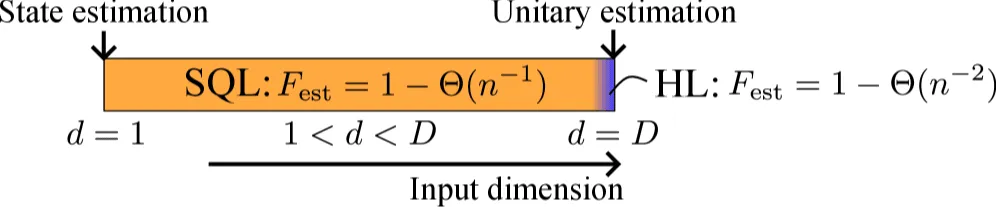
Professor Yoshida's team dissected, with the scalpel of mathematics, the limits of classically estimating this isometry operation. According to Theorem 1 that they derived, the estimation fidelity of an isometry operation (an indicator $F$ of estimation accuracy) is governed by the formula . Here, $n$ is the number of times the operation is invoked (query complexity), $d$ is the input dimension, and $D$ is the output dimension.
The reality this formula forces upon us is unforgiving. To reduce the error, precision improves only in inverse proportion to the number of invocations $n$. This is the physical wall known as the "standard quantum limit (SQL)," which shows that no matter how many times you taste the dish, the resolution of your palate improves only sluggishly.
In stark contrast to unitary estimation, which benefits from the Heisenberg limit, the moment the added condition arises that the output dimension $D$ exceeds the input dimension $d$ in isometry operations, the unknown subspace within the output space becomes a hidden blind spot, and the efficiency of estimation sharply stalls. The research team fully unraveled this chain of the standard quantum limit, making it clear for the first time that strategies based on estimation and storage into classical memory carry a fundamental limitation.
The Mechanism Behind the Quadratic Leap Opened by Entanglement
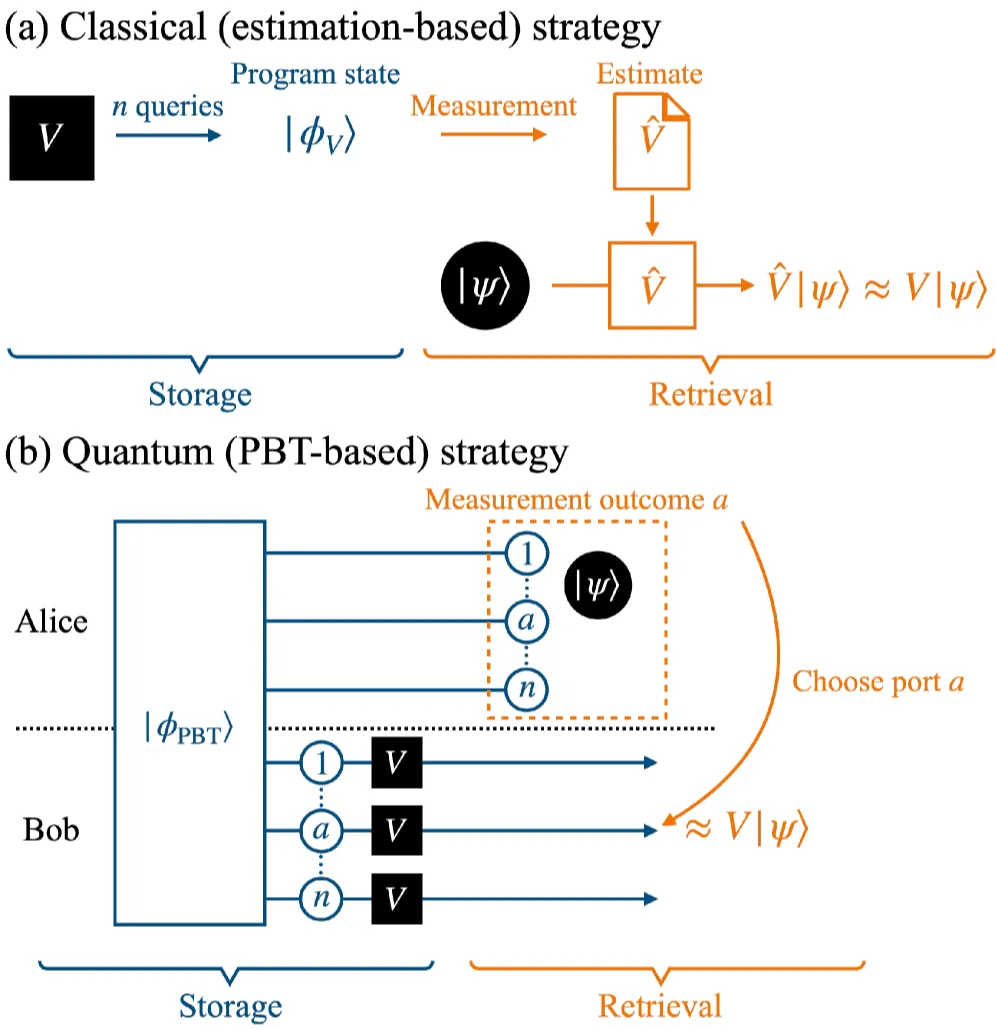
If the classical notepad has reached its limit, how then should we optimize the storage of information? This is where "port-based teleportation (PBT)"—a strategy applying quantum entanglement, one of the most mysterious bonds in the universe—enters the picture.
PBT is a technique in which a sender (Alice) and a receiver (Bob) pre-share a group of entangled pairs serving as multiple "ports," and by performing a joint measurement together with the target unknown operation, transfer the operation itself into a remote location or into a future memory. The greatest value of this approach lies in the fact that it makes no attempt to understand the contents of the unknown operation. Rather than trying to guess a recipe, it is more like sealing the entire kitchen in a time capsule and sending it into the future.
The research team derived that, when using this PBT-based quantum strategy, the number of operation invocations $n$ required to achieve a desired approximation error (diamond norm error ) is . Achieving the same error with a classical strategy requires invocations.
This difference in formulas produces an overwhelming difference in reality. For example, if one wishes to reduce the approximation error to one-hundredth of its original value, the classical strategy requires 100 times as many invocations, whereas the quantum strategy can reach the same target with merely 10 times the effort. This is precisely the rigorous proof of the long-awaited "advantage of quantum memory." In the storage and retrieval of isometry operations, quantum memory achieves a quadratic (square-root) improvement in efficiency over classical memory, establishing a structural advantage that shatters the wall imposed by the number of operations.
Structural Impact on the Quantum Cloud of the Real World
The impact of this theoretical breakthrough on society and academia extends far beyond the confines of the laboratory. In today's technology industry, architectures in which advanced computational resources are shared over the cloud have become mainstream. In future quantum cloud computing environments, software developers will likely wish to offer their own quantum algorithms as black boxes, and users will want to apply them to their own confidential data.
If a classical strategy were used to store the operation, users could repeatedly invoke the provided operation countless times, estimate the algorithm's full structure, and effectively strip it bare—posing a real risk. With a quantum strategy using PBT, however, the operation can be stored purely as a quantum state and replayed asynchronously, without ever solving the mystery of what the operation actually is. This provides a decisive security foundation for realizing "blind quantum computation," which protects software intellectual property while safely offering advanced computational power.
Furthermore, the research team extended this method to the universal programming of the most general class of quantum operations (CPTP maps). Regarding the size of the quantum state needed to store a program (the program cost), while prior work by Gschwendtner et al. required resources on the order of , the new method reduces this to —achieving an overwhelming efficiency gain of up to roughly 75 percent. The ability to hold complex quantum circuits with fewer qubits carries extremely practical value for near-term noisy quantum devices (NISQ) and the hardware generations that will follow.
At present, port-based teleportation and quantum memory capable of maintaining coherence over long periods remain at the stage of basic proof-of-concept demonstrations using a small number of qubits. This is not a technology that will be deployed in data centers tomorrow. However, given the pace of progress in quantum error correction and hardware scale-up, it seems highly likely that, within the next five to ten years, small-scale blind quantum computation networks specialized for particular algorithms will begin operating on the cloud. This theoretical proof serves as a rigorous blueprint for determining how much quantum resource to invest and which strategy to adopt when building that as-yet-unexplored architecture.
Unresolved Frontiers and Remaining Questions
This study, which proved the moment when quantum memory clearly surpasses classical memory, simultaneously presents us with new, uncharted territory. The subject of this research was the single-copy task of replaying an unknown channel exactly "once." But in the subroutines of real, complex algorithms, there will inevitably be demands to invoke a stored operation multiple times in succession.
Data stored in classical memory poses no problem no matter how many times it is copied and used. But under the rule of quantum mechanics, physical law forbids the complete duplication of an unknown quantum state (the no-cloning theorem). In the task of replaying multiple copies, how will the reusability of classical strategies intersect with the entanglement consumption of quantum strategies, and which will ultimately hold the advantage? Furthermore, the complete proof of the predicted optimal program cost when restricted to classical strategies alone (Conjecture S9, presented within this study) is left to future researchers.
Crystallizing the dynamic change that is an operation, and sending it into the future—this difficult and beautiful challenge is deeply etched as a new page in the grand history of humanity taming the true power of quantum mechanics and building the information infrastructure of the next generation.