


Google, which has led the field in superconducting qubits for more than a decade, launched a research team dedicated to a different approach—neutral atoms—in March 2026. Two months later, the U.S. Department of Commerce announced it had signed preliminary memoranda of terms totaling $2.013 billion with nine quantum companies under CHIPS Act funding, and the lineup of those nine companies spanned six distinct technological approaches. If any single technology were clearly destined to win, neither the company leading the pack nor a nation crafting industrial policy would have reason to spread its bets this way. Behind both decisions lies a simple reality: strengths remain split across two separate axes—space (the number of qubits) and time (circuit depth)—with no single approach dominating both.
Two Seemingly Unrelated Decisions, March and May 2026
On March 24, 2026, Google Quantum AI revealed in an official blog post that it had begun developing a neutral-atom quantum computer. An organization that had poured more than a decade into superconducting qubits was now placing a new team of roughly ten people in Boulder, Colorado. Leading the effort is Adam Kaufman, a fellow at JILA, a research institute jointly operated by the National Institute of Standards and Technology (NIST) and the University of Colorado Boulder (CU Boulder). Superconducting development continues in parallel. This is a decision to run a second line, with different properties, alongside a main line built on ten years of accumulated work.
Two months later, on May 21, the U.S. Department of Commerce announced it had signed preliminary memoranda of terms worth a combined $2.013 billion with nine quantum companies, funded through the CHIPS and Science Act, whose stated purpose is to bolster the semiconductor industry. The bulk of the money went to IBM ($1 billion) and GlobalFoundries ($375 million), while the remaining seven companies each received between $38 million and $100 million. The technologies represented by these nine companies span six modalities, from superconducting to neutral atoms to topological qubits. In exchange for the funding, the federal government attached a condition: it would acquire non-controlling minority equity stakes in each company.
The 2019 Sycamore processor, which claimed quantum supremacy, has long been cited as evidence of Google's lead in superconducting qubits. Using 53 superconducting qubits, Google reported completing in roughly 200 seconds a task that would have taken a supercomputer of the era 10,000 years. That same company has now built a team for a different modality—and two months later, a national government split funding across nine companies and six approaches. The very premise of narrowing the field down to one winner is collapsing, on both the corporate and governmental sides.
Switching modalities is not as simple as redrawing a qubit blueprint. With superconducting qubits, you need dilution refrigerators and cryogenic control electronics; with neutral atoms, laser optics and vacuum chambers. The entire lower half of the apparatus gets swapped out. Calibration procedures, error-correction implementations, and the software layered on top all have to be rewritten. That is precisely why it matters that an organization which invested more than a decade in one approach has stood up a second one. If the technological outlook hadn't changed, this dual investment would be hard to explain.
Moreover, Google was not entirely new to the world of neutral atoms. The company had already called QuEra Computing—founded in 2018 by researchers from Harvard and MIT—a "portfolio company," and when QuEra announced a Series B round of over $230 million in February 2025, Google Quantum AI joined as a new investor. A company that had already placed a foot on the neutral-atom side as an investor has now built its own experimental team.
The Refrigerator Where Wiring Eats 80% of the Cost, and the Optical Tweezers That Rearrange Atoms
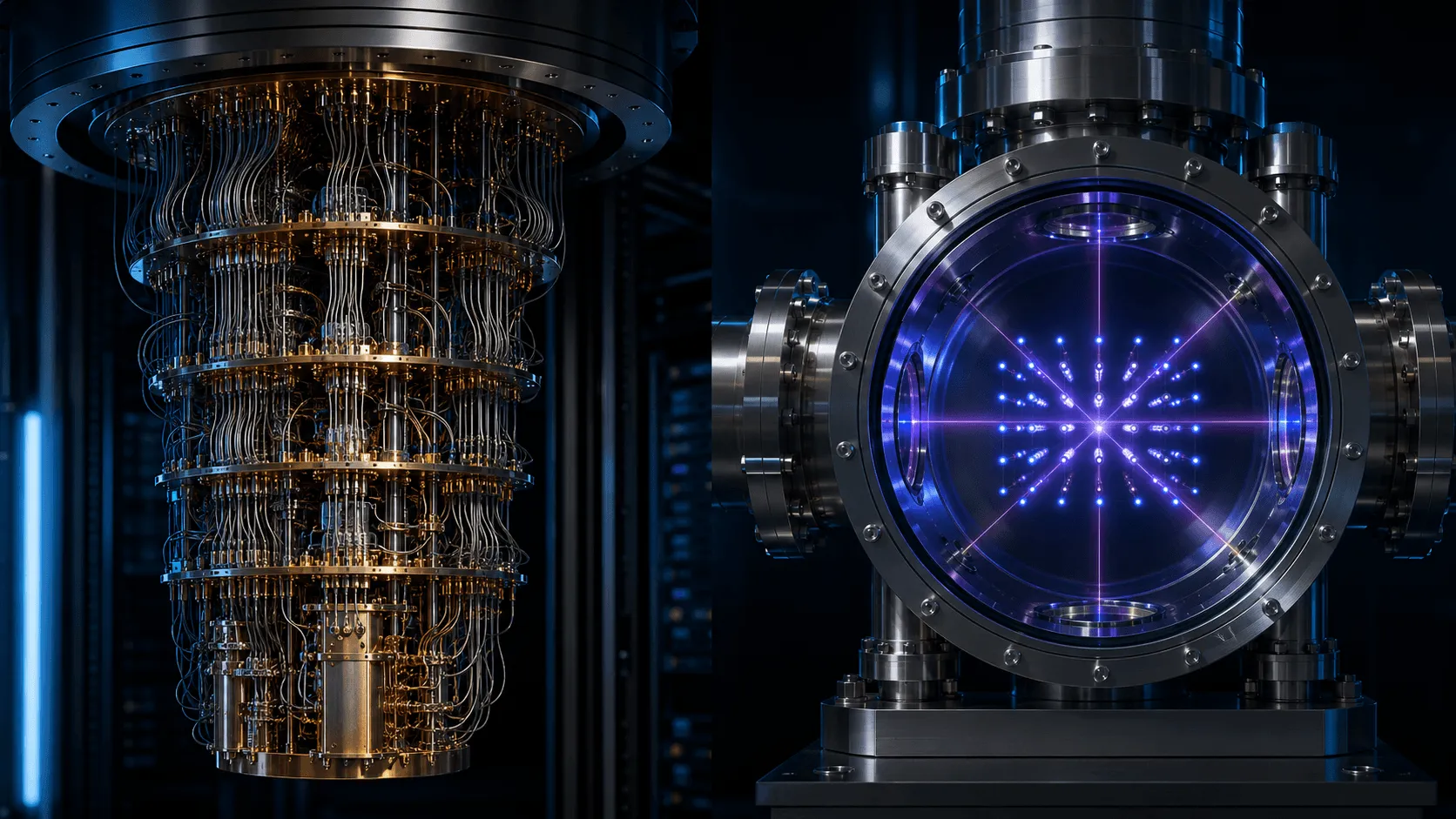
The burden of the superconducting approach shows up clearly in refrigerator cost estimates. The preprint "How to Build a Quantum Supercomputer" estimates a full dilution refrigerator setup for a 150-qubit processor at $5 million, and notes that $4 million of that—80% of the total—goes to coaxial cable wiring. It's a pre-peer-review figure, but the breakdown captures the character of the approach well: the wiring connecting the cryogenic interior to room-temperature control equipment costs more than the qubits themselves.
As the wire count rises, obstacles other than price hit first. FormFactor, which makes semiconductor test equipment, explains that conventional rigid coaxial cabling works fine at the scale of 10 to 20 qubits, but as scale increases, cable volume crowds the space inside the refrigerator, heat leakage exceeds cooling capacity, and physical installation itself becomes difficult. The company's LF600 lab refrigerator tops out at 50 channels with conventional wiring, and even with new flexible wiring, it reaches only 500 channels—equivalent to roughly 100 qubits at most, the company says. These are figures from a vendor selling a competing technology, but they convey a sense of the order of magnitude.
Neutral atoms have no such wiring problem. Inside a vacuum chamber, laser-generated wells of light capture atoms one at a time, and moving those wells rearranges the atoms. This makes it possible to place any two atoms next to each other, enabling all-to-all connectivity. Compared with superconducting qubits fixed in a plane and bound to nearest-neighbor coupling, the underlying philosophy of connectivity is fundamentally different.
In exchange, neutral atoms are slow. According to Google's official blog, a superconducting processor's cycle takes just one microsecond, and circuits have already reached millions of gates and measurements. Neutral-atom cycle times, by contrast, are measured in milliseconds—roughly a thousandfold difference. On the other hand, neutral atoms have already scaled to arrays of about 10,000 qubits, a scale superconducting qubits have yet to reach.
Google Quantum AI frames this gap as follows: superconducting scales more easily along the time axis (circuit depth), while neutral atoms scale more easily along the space axis (qubit count). The remaining challenges mirror each other neatly. For neutral atoms, the task is demonstrating many cycles of deep circuits; for superconducting, it's demonstrating an architecture at the scale of tens of thousands of qubits.
Even in how long they can retain quantum information, the two approaches point in opposite directions. Superconducting qubit coherence times generally remain in the microsecond-to-millisecond range. Neutral atoms that encode information in nuclear spin have reported coherence times ranging from seconds to tens of minutes, and Atom Computing has announced roughly 40 seconds for its own nuclear-spin qubits. However, because a single gate operation also takes longer with neutral atoms, academic surveys point out that comparisons should be made not in absolute time but in the number of two-qubit gates executable within the coherence window.
The two approaches are not simply ahead or behind on the same performance metric. One has claimed space first, the other has claimed time first.
Why One Town, Boulder, Keeps Producing the Neutral-Atom Camp
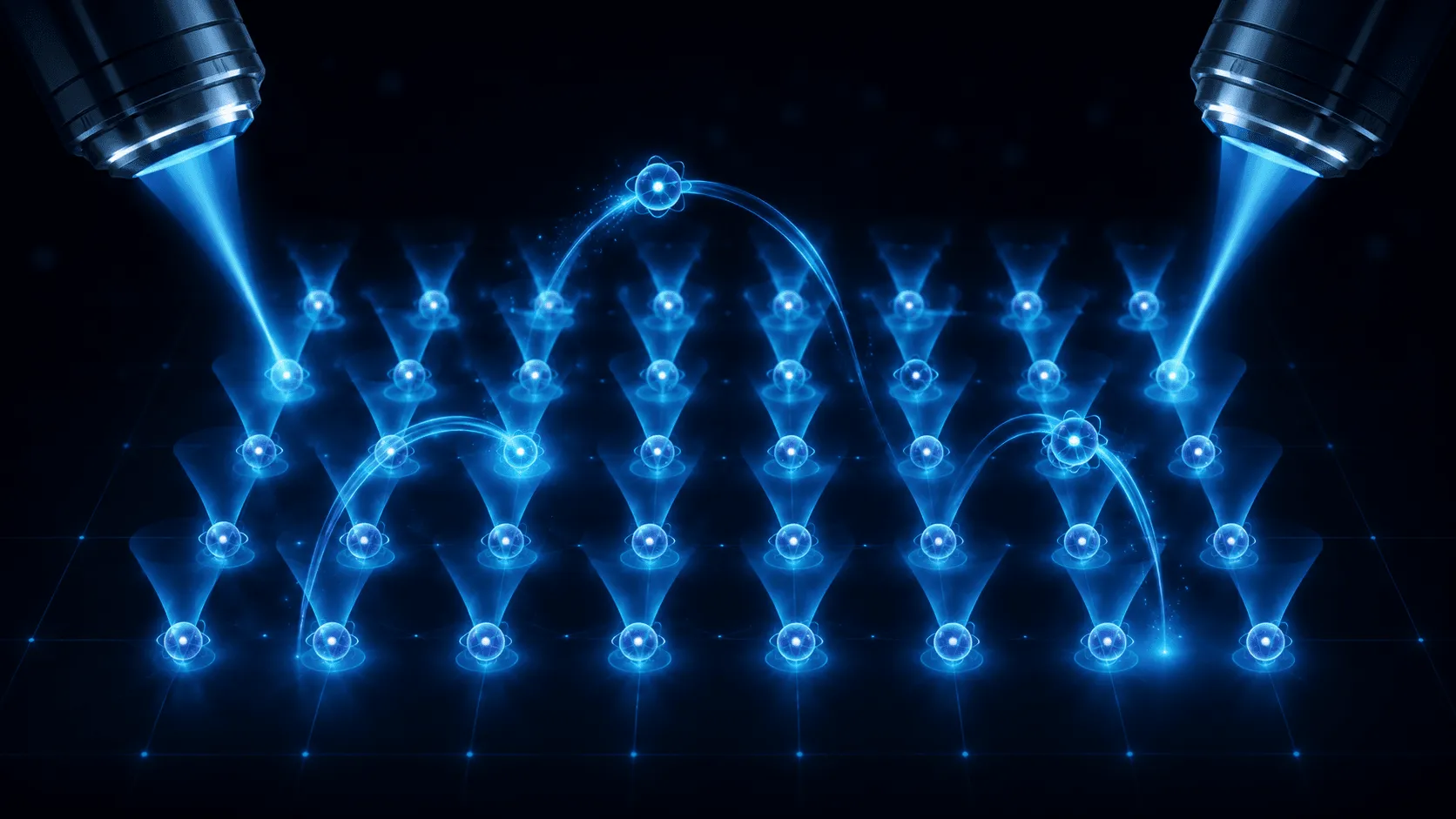
The career of Adam Kaufman, the researcher who now leads Google's team, reads like a genealogy of neutral-atom research itself. He graduated from Amherst College in 2009 and earned his doctorate at JILA, CU Boulder, under Cindy Regal. His doctoral research focused on quantum control of single atoms trapped in optical tweezers. In 2014, he reported in Science observing an atomic analog of the Hong-Ou-Mandel effect between atoms held in two tunnel-coupled optical tweezers.
What came next deepens the significance of this hire. From 2015 to 2017, Kaufman held a postdoctoral position in Markus Greiner's lab at Harvard University. Greiner is a co-founder of QuEra Computing, the very company Google has invested in. In other words, the researcher Google recruited had trained under the physicist who went on to co-found the company Google backs as an investor.
Boulder carries an older layer of history as well. The 2012 Nobel Prize in Physics was awarded to David Wineland and Serge Haroche for developing methods to measure and manipulate individual quantum systems without destroying them—work the Nobel Committee described as an early, small step toward building a quantum computer. Wineland's laboratory, where he trapped and controlled ions with light, was located at NIST's Boulder, Colorado facility. JILA, where Kaufman holds his fellowship, sits in the same town, jointly operated by that same NIST.
Neutral-atom companies themselves trace back to the same ecosystem. Ben Bloom, who founded Atom Computing in 2018, earned his physics doctorate at CU Boulder and worked on atomic clock research. Infleqtion (formerly ColdQuanta) was founded in 2007 by Dana Anderson, a CU Boulder professor and JILA fellow, building on his research in laser cooling and atom trapping. The company went public on the New York Stock Exchange on February 17, 2026, through a business combination with Churchill Capital Corp X, becoming the first publicly listed neutral-atom quantum technology company.
Both atomic clocks and neutral-atom qubits work the same way at their core: laser-cool atoms to a standstill, hold them in place with the force of light, and read and write internal states using light. Because the hardware overlaps so thoroughly, researchers who came up in atomic clock labs can move into qubit work without having to relearn the apparatus. The frequency stabilization and single-atom detection techniques that the atomic clock field spent decades refining directly translate into qubit control precision. Where superconducting qubits sit downstream of semiconductor microfabrication, neutral atoms sit downstream of precision measurement physics.
The experimental turning point came in 2016. According to a Physics Today explainer, the Browaeys team at France's Institut d'Optique and the Endres team, then at Harvard, independently reported methods for producing defect-free arrays of atoms. The theoretical groundwork traces back to a 2005 feasibility analysis by Saffman and Walker and a 2010 review. QuEra was founded two years after that breakthrough, in 2018, with Harvard's Mikhail Lukin and Markus Greiner and MIT's Vladan Vuletić and Dirk Englund among its founders; the company emerged from stealth in November 2021 after raising $17 million from investors including Rakuten.
Mapping Six Modalities onto the Axes of Space and Time
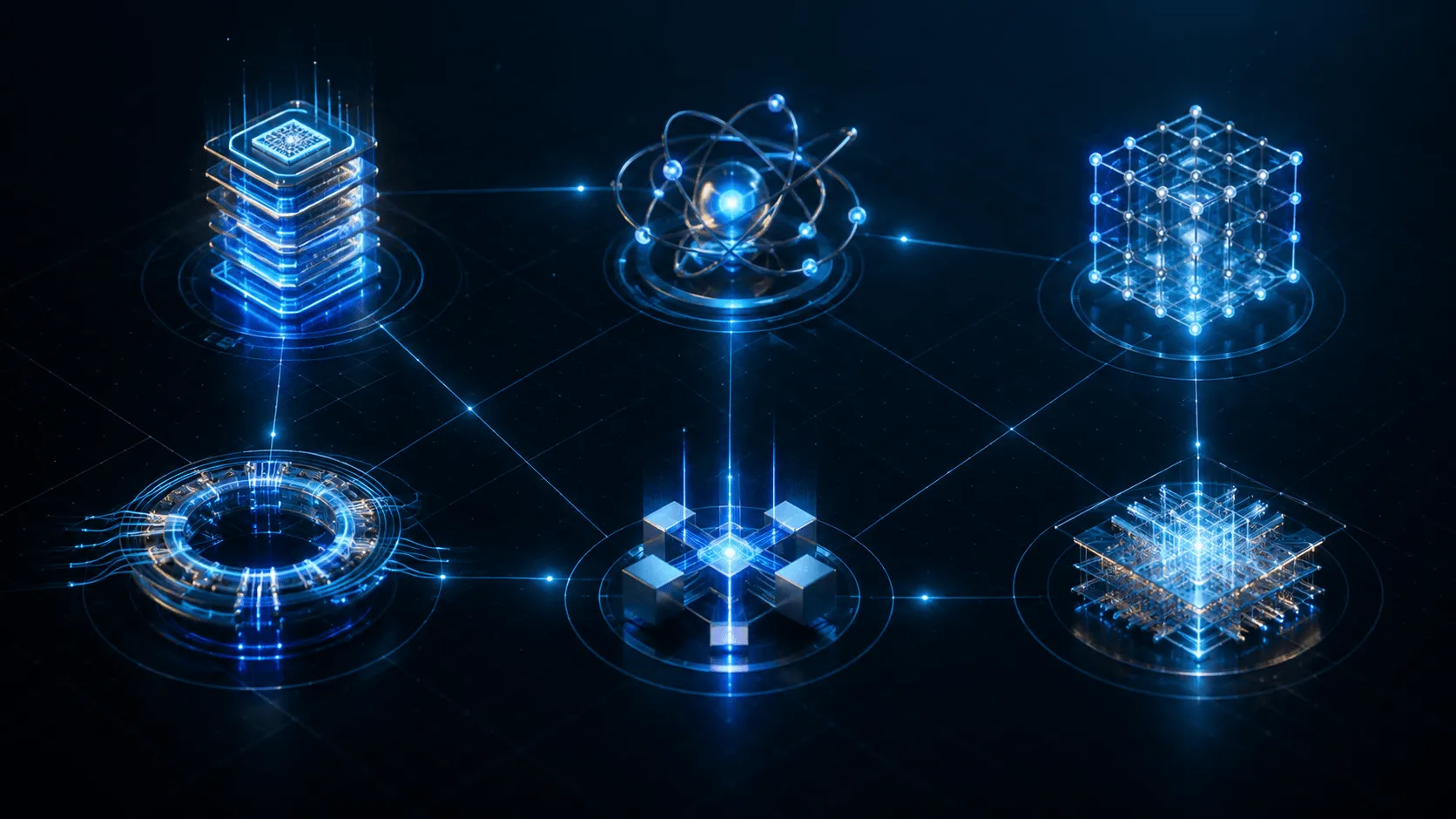
Quantum bit implementations are broadly classified into six categories, from superconducting to neutral atoms to topological. All aim at the same computational model, but as of 2026, each has reached a different point. Placing them on two coordinates—the space axis (qubit count and connectivity) and the time axis (circuit depth and fidelity)—captures most of that difference.
| Modality | Major players | Status as of 2026 | Leading axis |
|---|---|---|---|
| Superconducting | Google, IBM, Rigetti, D-Wave | Roughly 1 microsecond per cycle; circuits reaching millions of cycles | Time |
| Neutral atoms | QuEra, Atom Computing, Infleqtion, Pasqal | Arrays of roughly 10,000 qubits; all-to-all connectivity | Space |
| Trapped ion | Quantinuum, IonQ | 98 physical qubits down to 48 logical qubits; 99.921% fidelity | Time (fidelity) |
| Photonic | PsiQuantum, Xanadu | Most optical components operate at room temperature, though single-photon detectors typically require cooling; strong in networked connectivity; fault-tolerant demonstrations still in progress | Space (connectivity) |
| Silicon spin | Diraq, Intel | Compatibility with existing CMOS processes; potential for mass production on 300mm wafers | Different axis (manufacturing base) |
| Topological | Microsoft | Qubit lifetime of 20 seconds with Majorana 2; demonstration of error-corrected computation still to come | Different axis (intrinsic fault tolerance) |
No single modality in this table claims both axes at once. But even the two-axis framing only accounts for four of the six modalities. While superconducting and trapped ion lead on time, and neutral atoms and photonic lead on space, silicon spin bets on manufacturing ease and topological bets on intrinsic fault tolerance—different playing fields altogether. So the judgment of "just pick whichever modality is strongest right now" doesn't even hold up within the four modalities competing on space and time. The only real choice is which axis to claim first, and when and how to fill in the missing one.
Right now, the leading edge of the time axis belongs to trapped ions. Quantinuum's Helios, announced in November 2025, uses barium-137 ions to build 48 logical qubits out of 98 physical qubits, demonstrating 99.921% fidelity across all-pairs two-qubit gates. A ratio of two physical qubits per logical qubit is remarkably efficient by the standards of error correction. The company's roadmap places Sol, at roughly 192 qubits, in 2027, and Apollo, at thousands of qubits, in 2029.
The remaining modalities are each making their own separate bets. Photonic-approach PsiQuantum raised $1 billion in a Series E round in September 2025, reaching a valuation of roughly $7 billion, while Xanadu listed on Nasdaq on March 27, 2026, with a shareholder value of roughly $3.6 billion. Silicon-spin company Diraq split off in 2022 from the atomically-precise placement approach led by Michelle Simmons at UNSW Sydney, with Andrew Dzurak founding it as a standard-CMOS-compatible chip venture. Microsoft, the sole player in topological qubits, announced Majorana 2 in June 2026, reporting a qubit lifetime of 20 seconds—more than 1,000 times longer than Majorana 1.
Differences in corporate strategy also show up in how companies choose their modality. Microsoft develops its own topological approach in-house while also offering hardware from IonQ, Quantinuum, and Pasqal on Azure Quantum—a design that keeps its customer relationships intact regardless of which modality ultimately wins, a very different bet from Google's, which is narrowing to two in-house approaches. Pasqal, on the neutral-atom side, also announced plans in March 2026 to go public via a special-purpose acquisition company (SPAC) at a valuation of roughly $2 billion; all these enterprise-value figures are snapshots from a given moment.
This framework has its limits. Within any given modality, the level of demonstrated performance varies from company to company, and no single representative example speaks for the whole approach. The classification of "space axis" versus "time axis" is also qualitative, drawn from company announcements and specialist-media reporting rather than a standardized, unified benchmark. The topological approach in particular has not yet demonstrated error-corrected computation at all, putting it at a fundamentally different stage of maturity than the others.
Re-sorting $2 Billion by Modality Puts Neutral Atoms on Par with Superconducting
The Commerce Department's $2.013 billion was not distributed evenly across the nine companies. Just two awards—IBM's $1 billion and GlobalFoundries' $375 million—account for roughly 68% of the total. Both of these are investments in quantum foundries, that is, in the manufacturing base for producing the wafers that host qubits. IBM reportedly plans to establish a new company, Anderon, in Albany, New York, to produce superconducting qubits and control electronics on 300mm wafers.
The heavy weighting toward manufacturing infrastructure makes sense precisely because it's decoupled from which modality ultimately wins. The common platform GlobalFoundries is building supports multiple modalities—from superconducting to trapped ion to silicon spin—and the official announcement lists topological and photonic approaches as targets as well. Whichever modality survives to the end, the 300mm wafer process and control ASICs will still be usable. The government put two-thirds of its funding into a layer insulated from the outcome of the modality race, and bet the rest on the technologies themselves.
Adding up the remaining $638 million across the seven other companies by modality changes the picture. A center of gravity invisible in the company-by-company list emerges in a different place once counted by modality.
| Modality | Companies and amounts | Total |
|---|---|---|
| Neutral atoms | Atom Computing ($100 million), Infleqtion ($100 million) | $200 million |
| Superconducting | D-Wave ($100 million), Rigetti (up to $100 million) | $200 million |
| Photonic | PsiQuantum ($100 million) | $100 million |
| Trapped ion | Quantinuum ($100 million) | $100 million |
| Silicon spin | Diraq (up to $38 million) | $38 million |
Neutral atoms and superconducting end up tied at $200 million each. An approach that, a decade ago, was confined to university labs now receives the same amount, in federal industrial policy, as the approach that claimed quantum supremacy. This tally is simply a sum of the publicly disclosed company-level figures, with no proration or weighting applied.
The figures come with caveats. The $2.013 billion total is a projected amount based on preliminary term sheets, not a finalized contract value. Diraq's $38 million and Rigetti's $100 million are described as ceilings, not fixed amounts. GlobalFoundries' $375 million supports a shared multi-modality platform, so it is excluded from this tally as a foundry category rather than assigned to a single modality. The equity stake ratios have also not been disclosed, except for a reported 1% stake in GlobalFoundries' quantum subsidiary.
Why Government Money Matters So Much Here
Quantum computers have not yet become products that generate profit by volume sales. Company revenue currently comes from three streams: government and defense contracts, cloud-based pay-as-you-go usage, and enterprise proof-of-concept contracts. IonQ reported second-quarter 2026 revenue of $80.1 million, up 287% year over year, raised its full-year guidance to $280–290 million, and reported a backlog of unfulfilled contracts totaling $485 million. The company has also been selected for the U.S. Missile Defense Agency's SHIELD contract.
Market-size estimates, meanwhile, are far from settled on a single reliable number. McKinsey's Quantum Technology Monitor 2026, as reported secondhand, predicts global quantum computing company revenue surpassed $1 billion in 2025 and will reach $4.4 billion by 2028. Meanwhile, private research firms' estimates for 2026 vary by more than tenfold—from Market Data Forecast's $480 million to Research and Markets' $5.59 billion—largely because definitions differ on whether to count hardware alone or include software and services as well. At this stage of the industry, the dollar figures written into a government's preliminary term sheets are actually more reliable than market-size projections.
Japan's ¥100.4 Billion Plan, and Three Modalities Running Side by Side
According to JETRO's summary, the Japanese government secured ¥100.4 billion in supplementary budget for quantum technology heading into fiscal 2026—roughly double the previous year's figure (with targets of 10 million domestic users of quantum technology, ¥50 trillion in production value attributable to quantum technology, and the creation of unicorn companies in the quantum field, all by 2030). This differs from the U.S. Commerce Department's $2.013 billion allocation to nine companies in both time frame and budget category, so a simple dollar-for-dollar comparison isn't meaningful. But regardless of scale, Japan shares with the United States the same basic approach of not betting on a single modality.
Within Japan, three distinct modalities are moving forward in parallel. RIKEN and Fujitsu announced in April 2025 that they had completed development of a 256-qubit-class superconducting quantum computer, and planned to begin offering it that same fiscal year. They have also indicated plans to install and unveil a third-generation, 1,000-qubit-class machine at Fujitsu's Kawasaki Technology Park during fiscal 2026. NTT and the University of Tokyo's Akira Furusawa laboratory brought a general-purpose, photonics-based quantum computing platform online in November 2024. And in August 2026, Japan's first full-stack neutral-atom quantum computer, "Shunkai," began operating.
Shunkai is the product of a Moonshot-type R&D program bringing together the Institute for Molecular Science, Hitachi, and Infleqtion. It began operation with roughly 50 qubits and aims to scale to about 10,000 physical qubits by March 2031. Here the names converge: Infleqtion is one of the seven companies that received a $100 million preliminary term sheet from the U.S. Commerce Department in May 2026, and it is also a neutral-atom company that traces back to CU Boulder. Japan's first neutral-atom machine is connected to both the Boulder ecosystem and U.S. industrial policy.
There is already a precedent of Japanese money flowing into overseas neutral-atom players. When QuEra emerged from stealth in November 2021 with a $17 million raise, Rakuten was among the investors. Domestic Japanese research institutions are simultaneously running superconducting, photonic, and neutral-atom programs, while a Japanese company invests in an overseas neutral-atom company. If the word "portfolio" sounds like something that only applies overseas, that's only because Japan's own domestic landscape hasn't been counted yet.
The timeline set out in Moonshot Goal 6 assumes this kind of parallel development from the start. The Cabinet Office's stated goal comes in two stages: achieving a small-scale or partially fault-tolerant quantum computer by 2030, and fully realizing a fault-tolerant, general-purpose quantum computer by 2050. The plan is to test multiple modalities in the first half and then nurture whichever one survives in the second half. Shunkai's own target of 10,000 qubits by March 2031 falls just after that first-half milestone year.
Targets Converging on 2029, and Japan's 2050 Marker
Lining up each company's stated targets reveals a convergence on a single year. In its March 2026 official blog post, Google indicated that commercial-grade superconducting quantum computers would become available "by the end of this decade"—that is, by the end of 2029. Quantinuum has placed Apollo, its thousands-of-physical-qubit fault-tolerant general-purpose machine, at 2029. Microsoft, too, stated in June 2026 that, having halved its development timeline following the Majorana 2 results, it now expects to achieve a scalable quantum computer by 2029.
Japan's Moonshot Goal 6 splits the same phrase into two separate target years. Partial fault tolerance is set for 2030, while full realization of a fault-tolerant general-purpose quantum computer is set for 2050. That 20-year gap does not, by itself, indicate a corresponding gap in technological level. Each company's 2029 figure is a self-declared target, not a number certified by a third-party body, nor one measured against a shared, standardized definition of fault tolerance.
That's because the term "fault tolerance" itself means different things to different players. Quantinuum states an explicit number of logical qubits; Google speaks in terms of "commercial-grade"; and Japan's Moonshot program splits the concept into "partial" and "complete" stages. Even one industry trade publication's own outlook splits into an optimistic scenario of 2028–2030 and a conservative one of 2032–2035. This range, too, is just one outlet's own assessment—there is no single authoritative forecast that everyone agrees on.
Verifiable benchmarks exist on both axes. On the neutral-atom side, the test is whether deep circuits can be run reliably. Atom Computing announced in June 2026 that it had demonstrated, for the first time among neutral-atom approaches, multiple rounds of error correction using a toric code, and reported observing error rates that decreased as qubit count increased. The company describes itself as only the second in the industry to demonstrate sustained error correction.
On the superconducting side, the test is whether an architecture at the scale of tens of thousands of qubits can actually be built. Industry analysts have projected that the four custom ASICs IBM's Anderon is developing will reach manufacturing maturity around 2029, which will reveal whether mass production of control circuitry and algorithmic demonstration converge in that same year. Meanwhile, Google's neutral-atom team has just gotten off the ground with roughly ten people, and no general-availability date has been given. No target specifically for the commercial timeline of the neutral-atom approach has yet been announced.
Google stood up a second line in March; the U.S. Commerce Department split funding across nine companies and six modalities in May; and Japan is running three modalities in parallel. Judging from the publicly announced plans, all three parties are deferring the decision of which single modality will ultimately win. Where Google and Japan have placed multiple bets on the contest between space and time, the U.S. government has added two further bets on top of that—manufacturing infrastructure and intrinsic fault tolerance.
The conditions for this design to pay off are already clear. Neutral atoms need to demonstrate that they can run deep circuits; superconducting qubits need to solve the wiring problem at tens of thousands of qubits; and both need to converge on the same software and error-correction frameworks. Once all three conditions are met, quantum computers will stop being devices defined by the name of their modality, and start being devices defined by the name of the problems they can solve.