

Inside a solar cell, sunlight excites electrons and holes, which are then sent to their respective electrodes. If the crystal framework is even slightly distorted, or if lattice defects (vacancies where atoms should be) are present, the charges are trapped along the way and dissipated as heat. In perovskite solar cells, the leading contender among next-generation photovoltaics, which are moving rapidly toward practical use, the biggest dilemma with today's mainstream materials is the toxicity of lead (Pb). Driven by environmental regulations such as the EU's RoHS Directive, efforts are under way around the world to replace toxic lead with tin (Sn), a less harmful element from the same group of the periodic table.
Tin, however, is chemically far less stable than lead. On contact with oxygen in the air, the divalent tin ions (Sn²⁺) that generate power readily lose electrons and oxidize to tetravalent tin ions (Sn⁴⁺). This oxidation produces an excess of holes inside the crystal, pushing the device into a self-doped state in which it loses its photovoltage. In addition, halogen ions moving through the crystal diffuse toward the electrodes and damage the film interfaces. How to stop these overlapping degradation processes has been a major barrier to the practical use of tin-based perovskites.
On May 27, 2026, a research group led by Professor Yuko Takeoka of Sophia University's Faculty of Science and Technology, Jorim Okoth Obila (Special Researcher, now at Northwestern University), and Yasuhiro Shirai (Group Leader) and Masatoshi Yanagida (Senior Researcher) of the National Institute for Materials Science (NIMS) published a paper in the German journal Solar RRL (DOI: 10.1002/solr.70388). The team introduced a small nitrogen- and sulfur-containing molecule, 2-aminobenzothiazole (2-ABZ), as an additive in tin-based perovskite with a quasi-two-dimensional structure, in which organic and inorganic layers alternate. As a result, the photoelectric conversion efficiency rose about 1.4-fold, from 6.60% to 9.07%, and the unencapsulated devices retained about 85% of their initial performance after 100 days of storage in air.
The core of the study's design philosophy is that a single additive addresses three independent problems at once: controlling crystal growth, blocking ion migration and suppressing oxidation.
Avoiding toxicity has cost efficiency: the structural trap facing tin perovskites
Perovskite solar cells have attracted attention as lightweight, flexible power sources for the next generation because they absorb visible light extremely well and can be formed into crystalline films simply by coating a solution and heating it at low temperature. The cells currently achieving efficiencies above 25%, approaching the theoretical limit of silicon solar cells, use three-dimensional lead perovskites based on compounds such as lead iodide as the light-absorbing layer. But lead is a heavy metal that dissolves easily in water and accumulates in living organisms. For devices to be deployed in large numbers in everyday living spaces, such as on rooftops, walls and inside IoT equipment, the presence of lead has always raised concerns about social acceptance and disposal.
Tin, which sits directly above lead in the periodic table, has therefore been studied as a substitute. Three-dimensional tin perovskites have a narrow band gap that allows them to absorb light well into the near-infrared, and their theoretical power-generation limit rivals that of lead-based materials. Indeed, improvements in crystal quality have led to reported conversion efficiencies in the 16–17% range for three-dimensional tin-based devices. But they have a fatal weakness: the extremely fast oxidation of Sn²⁺ to Sn⁴⁺ described above. Degradation begins the moment they are exposed to trace amounts of oxygen and moisture in the air, and once they are taken out of an inert-gas glovebox, they lose their power-generating performance within hours to days.
データを表で見る
| 光電変換効率(PCE) (%) | |
|---|---|
| 三次元鉛系 | 26.1 |
| 擬二次元鉛系 | 22.8 |
| 三次元スズ系 | 17.1 |
| 本研究(擬二次元スズ系) | 9.1 |
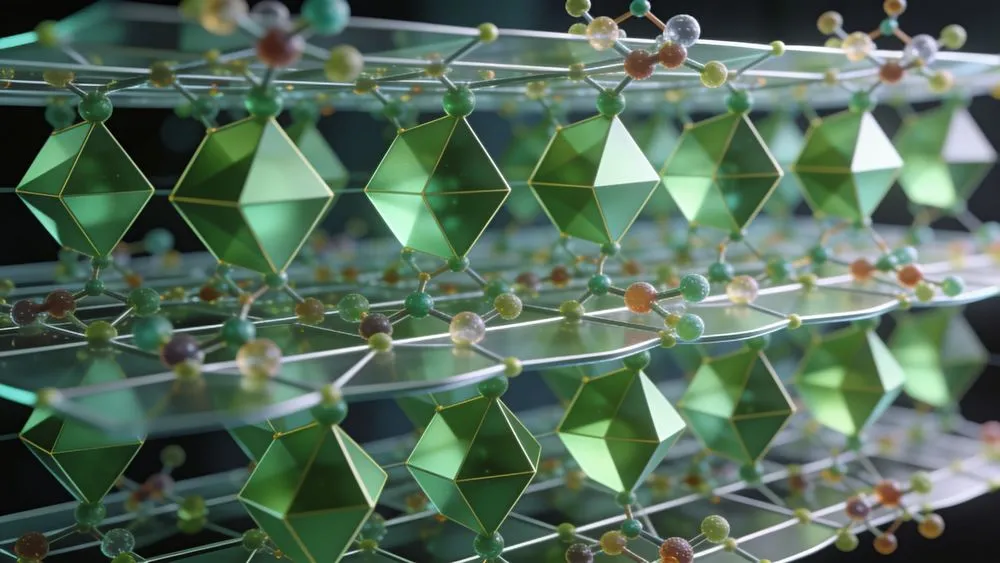
To physically block this onslaught of oxidation, researchers devised the introduction of a "quasi-two-dimensional (quasi-2D)" structure, typified by the Ruddlesden–Popper phase. In a quasi-2D structure, bulky, hydrophobic organic ammonium cations are sandwiched as spacers (layers that maintain the gaps) between sheets of inorganic tin–halogen octahedra. This organic layer acts as a sturdy barrier, blocking the paths by which water and oxygen molecules would penetrate the inorganic framework. As a result, environmental stability improves dramatically compared with three-dimensional structures.
But the price paid for that stability was high. Because the organic spacer layers are insulators, hopping conduction, in which electrons jump between inorganic layers, is severely hindered. Moreover, if the layers end up lying flat relative to the substrate as the film crystallizes from solution, the charge-transport pathway in the thickness direction, from the substrate to the top electrode, is completely cut off. In addition, energy-level mismatches readily arise between the light-absorbing layer and the adjacent charge-transport layers (hole-transport and electron-transport layers), causing voltage losses when excited electrons and holes cross the interface.
The photoelectric conversion efficiencies reported so far for quasi-2D tin-based perovskites have lagged far behind those of three-dimensional tin-based and lead-based devices, topping out at around 10%. Giving the material armor that withstands harsh air exposure meant losing the ability to extract the electricity that matters. Overcoming this trade-off has been the structural trap that lead-free solar cells have faced for years.
One molecule blocks three degradation pathways: the chemistry of heteroatoms
To break this deadlock, the research group at Sophia University and NIMS chose to add an additive molecule to the precursor solution used to form the light-absorbing layer. The perovskite composition studied is an n=5 quasi-2D system expressed as (PEA₀.₈₅EA₀.₁₅)₂FA₄Sn₅I₁₄.₃Br₁.₇ (PEA is phenylethylammonium, EA is ethylammonium, and FA is formamidinium). It has a periodic structure in which an organic spacer layer is inserted after every five inorganic layers.
The researchers focused on 2-aminobenzothiazole (2-ABZ), a small molecule that has both nitrogen (N) and sulfur (S) heteroatoms in its aromatic ring skeleton and carries an amino group (–NH₂) on a side chain. The experiments showed that this single organic molecule blocks degradation through three entirely different mechanisms, from the formation of the light-absorbing layer through to device operation.
The first mechanism is improved film quality through control of the crystal growth rate. Tin-based perovskites tend to crystallize much faster than lead-based ones, and as the solution is coated and the solvent evaporates, nucleation occurs chaotically. The resulting crystal grains are uneven, and fine gaps called pinholes and cracks appear throughout the film. Scanning electron microscope (SEM) observation confirmed countless pinholes on the surface of the control film without the additive. In a device, these locally short-circuit the top and bottom electrodes and cause a marked drop in voltage.
Infrared (IR) spectroscopy picked up signs that the lone electron pairs on the heteroatoms in 2-ABZ form coordination bonds with tin ions (Sn²⁺) in the precursor solution. This coordination interaction acts as a moderate brake, gently slowing the rapid crystal growth from the tin complex. As a result, a uniform, flat film with densely packed crystal grains and no gaps was obtained, and the pinholes disappeared completely.
The second mechanism is suppression of iodide ion migration. One of the main causes of degradation in perovskite solar cells is that halide ions (especially iodide ions, I⁻), which should sit in the crystal lattice, leave their lattice sites under heat or internal electric fields and move through the film. The departing iodine leaves vacancy defects in the lattice and corrodes interface materials where it ends up.
X-ray photoelectron spectroscopy (XPS) data showed that adding 2-ABZ halved the signal fraction of iodide ions and related defect species, from 27% in the control to 14.6%. At the same time, shifts were observed in the binding energies of the amino-derived nitrogen peak and the iodine peak. This indicates that strong N–H···I hydrogen bonds form between the hydrogen atoms of the 2-ABZ amino group and iodide ions. In effect, the organic molecule acts like an anchor, tethering iodide ions to the crystal framework and preventing them from escaping. Depth profiling of elements by time-of-flight secondary ion mass spectrometry (TOF-SIMS) also confirmed a sharp decrease in the amount of iodide ions leaking toward the electron-transport layer.
The third mechanism is a direct shielding effect against tin oxidation. In XPS analysis of tin oxidation states, the proportion of Sn⁴⁺, a cause of degradation, which reached 10% of all tin atoms in the film without the additive, fell to 8.5% when 2-ABZ was added. Although it did not reach zero, oxidation during film preparation and near the interfaces was suppressed to a statistically significant degree.
【The three passivation functions of 2-ABZ】
- Crystallization control through coordination bonding: exchanges electron pairs with Sn²⁺ to form a dense, pinhole-free film
- Ion fixation through hydrogen bonding: N–H···I bonds halve the outflow of iodide ions toward the electrode
- Suppression of interface oxidation: reduces the Sn⁴⁺ fraction from 10% to 8.5%
Furthermore, band-structure measurements by ultraviolet photoelectron spectroscopy (UPS) revealed an unexpected side effect. In the film with 2-ABZ added, the energy levels of the valence band maximum and conduction band minimum of the light-absorbing layer were lowered by 0.23 eV and 0.22 eV, respectively. This simultaneously reduced the energy offsets with PEDOT:PSS, the hole-transport layer, and PC₆₁BM, the electron-transport layer. A smaller energy step lowers the barrier that photoexcited carriers face when crossing an interface, directly raising the device's open-circuit voltage (V_oc).
9.07% efficiency and measured durability from unencapsulated air tests
The improved film quality and interfacial energy-level alignment were reflected directly in the electrical output parameters of the solar cell devices. Let us look at the evaluation results for the inverted-structure tin perovskite solar cells the team fabricated (ITO / PEDOT:PSS / quasi-2D tin perovskite / PC₆₁BM / BCP / Ag).
The control device without additive had an open-circuit voltage (V_oc) of 626.20 mV, a short-circuit current density (J_sc) of 15.19 mA/cm², and a fill factor (FF) of just 69.39%, giving a photoelectric conversion efficiency (PCE) of 6.60%. By contrast, the device with the optimal concentration of 2-ABZ saw its open-circuit voltage rise by about 77 mV to 702.93 mV, its short-circuit current density increase substantially to 18.35 mA/cm², and its fill factor improve to 70.29%. The resulting champion device reached a conversion efficiency of 9.07%, a performance gain of about 1.4 times over the control.
| Evaluation item | Control (no additive) | Device with 2-ABZ | Change |
|---|---|---|---|
| Open-circuit voltage (V_oc) | 626.20 mV | 702.93 mV | +76.73 mV |
| Short-circuit current density (J_sc) | 15.19 mA/cm² | 18.35 mA/cm² | +3.16 mA/cm² |
| Fill factor (FF) | 69.39% | 70.29% | +0.90% |
| Photoelectric conversion efficiency (PCE) | 6.60% | 9.07% | +2.47% (about 1.4x) |
| Efficiency retained after 100 days in air | 48.95% | 84.94% | +35.99 pt |
| Retention after 10 hours of continuous operation | About 0% (lost in about 1 hour) | 88.9% | Substantially longer operating life |
Even more significant than the performance gain are the results of the durability tests. In academic lifetime evaluations of perovskite solar cells, it is not uncommon to seal the device tightly between a glass substrate and epoxy resin to block oxygen and moisture, or to run the test in a chamber with an inert environment circulated with nitrogen gas.
In this study, however, to measure the true capability of the devices, the researchers deliberately performed long-term storage tests in open air without any glass encapsulation. The device without additive declined steadily, like rolling down a slope, through attack by oxygen and moisture in the air and internal iodine migration, degrading to 48.95% of its initial efficiency, less than half, after 100 days. The device with 2-ABZ, on the other hand, retained 84.94% of its initial efficiency (about 85% of the peak value) after the same 100 days of exposure to air.
In a harsh operating test in which the cells were continuously generating power at the maximum power point (MPP) under simulated sunlight (AM 1.5G, 1 sun), the difference between the two was equally stark. The control device lost almost all of its power-generating capability in just about an hour, while the 2-ABZ device still retained 88.9% of its initial performance after 10 hours.
This demonstrates that the three-in-one defense, namely the elimination of pinholes through coordination bonding, the binding of iodide ions through hydrogen bonding and the suppression of tin oxidation, is effective under intense light and in the presence of oxygen.
Distance from the mainstream: what 9% means academically, and the cold reality
Let us place this 9.07% figure on the overall map of the global solar cell development race. To estimate the value of the result correctly, one must avoid both overestimating and underestimating it.
First, within the very narrow group of quasi-2D tin-based perovskites, the 9.07% achieved here is a solid step forward. The highest previously reported figure in this area is about 10.36% (a system reported in 2025 in journals including Chemical Communications), and the 9.07% in this study sits at a level just below it. In low-dimensional tin systems, measured data showing both 85% retention after 100 days of unencapsulated storage in air and efficiency above 9% support the effectiveness of the material design.
| Material class | Representative peak PCE | Representative durability test | Main challenge for commercialization |
|---|---|---|---|
| 3D lead-based | Over 26% (world-record level) | Thousands of hours under encapsulation (ISOS standards) | Environmental toxicity of lead and risk of conflict with RoHS regulations |
| Quasi-2D lead-based | 22.8% (certified about 21.7%) | High robustness against humidity and heat | Still contains lead |
| 3D tin-based | 16–17% (University of Queensland, Australia, and others) | Hundreds to thousands of hours under inert gas | Extreme vulnerability to oxygen, rapid oxidation |
| 2D/3D mixed tin-based | 15.0% (reported 2025) | 87% retained after 4,000 hours under encapsulation | Complexity of interface control and difficulty of scale-up |
| This study (quasi-2D tin-based) | 9.07% | 100 days unencapsulated in air (85% retention) | Insufficient absolute efficiency; fundamental residue of Sn⁴⁺ oxidation |
But when we widen our view, the distance to commercialization remains great. Existing three-dimensional lead-based perovskite solar cells already exceed 26%, surpassing the 20–22% efficiency of residential silicon panels. Even lead-containing quasi-2D perovskites have recorded results in the high 22% range. Among lead-free tin-based devices, three-dimensional tin-based devices with a three-dimensional framework have reached the 16–17% range. In addition, a tin-based system with a "2D/3D heterostructure," in which the surface of a three-dimensional crystal is covered with an ultrathin two-dimensional layer, has been reported to achieve 15.02% efficiency while withstanding more than 4,000 hours of continuous operation (Energy & Environmental Science, 2025).
Compared with these leading rivals, the 9.07% achieved by the quasi-2D tin-only structure is still only about half the output needed for commercial power generation. By this calculation, more than 90% of the light energy is lost without being converted to electricity.
The length of the tests also calls for a sober assessment. The "100 days of storage in air" and "10 hours of continuous illumination" shown here are major progress when compared with the rapid deactivation of the control, but measured against the reliability standards for outdoor solar modules set by the International Electrotechnical Commission (IEC), which call for thousands to tens of thousands of hours of continuous operation, they remain within the realm of initial screening. This is basic research showing the degree of improvement under harsh conditions, not a demonstration of durability that can compete with commercial panels.
Residual oxidation and the scale-up barrier: open questions for real-world deployment
The approach of the team led by Professor Takeoka has established a clear molecular design guideline: "multifunctional passivation" using small heteroatom molecules containing nitrogen and sulfur. But on the path to turning this result into practical modules lie many unanswered questions and engineering barriers.
The most fundamental academic challenge is that tin oxidation has only been "suppressed," not "eradicated." As the XPS measurements show, even after adding 2-ABZ, 8.5% of the tin in the film has still turned into Sn⁴⁺, which hinders power generation. That is a decrease of only 1.5 percentage points from 10% without the additive. Tin vacancies and trace oxides generated in the crystal lattice accumulate over long-term operation of the device and remain as seeds of irreversible degradation. How this 8.5% of oxide will behave beyond 100 days, or over time spans of one year or five years, has not been determined at present.
Next are the manufacturing-science challenges that come with scaling up devices. The data evaluated in this study come from tiny devices a few millimeters square (champion cells) fabricated by spin coating in a university laboratory. Spin coating, in which the precursor solution is spun at high speed and flung off by centrifugal force, makes it easy to obtain uniform films at the laboratory scale, but it cannot be applied as is to large-area roll-to-roll printing or slot-die coating.
In quasi-2D perovskites, the orientation of the crystals is determined by self-assembly as the solvent evaporates. Whether 2-ABZ can maintain vertical crystal orientation uniformly across an entire substrate when coated onto large substrates of several square centimeters or more, and whether a homogeneous, pinhole-free film can be reproduced by continuous coating, remains completely untested.
Furthermore, this experiment was reported by a single research team, and it awaits independent replication by other institutions and verification of reproducibility across different material lots. The strength of coordination and hydrogen bonds is easily affected by slight differences in humidity during coating, drying temperature and the amount of residual solvent.
In the press release, Professor Takeoka, drawing on more than 25 years of accumulated research on perovskite compounds, expressed hopes for future real-world deployment and for applications in regions with scarce power infrastructure. There is no doubt that realizing safe thin-film solar cells free of hazardous substances is an important piece for the spread of wearable devices and building-integrated photovoltaics (BIPV).
But to bring that vision back to engineering reality, further research on crystal-interface control at a still deeper level is needed: how to push the remaining 8.5% oxidized component toward zero, and how to raise the conversion efficiency, which remains in the 9% range, to more than 15%, on par with three-dimensional materials.