

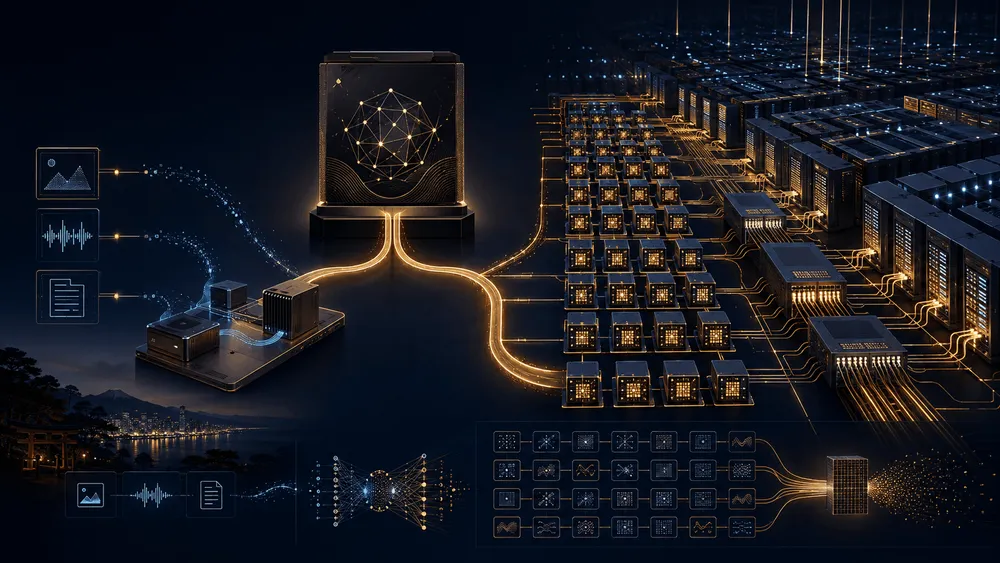
Qwen3.8 has moved from a model you could only try in the cloud to one whose weights you can take into your own environment and verify. Qwen has published four repositories on Hugging Face: Qwen3.8-27B and its FP8 variant, and Qwen3.8-2.4T-A95B and its FP8 variant. As of July 19, what could be confirmed was cloud availability via Qwen3.8-Max-Preview, a total parameter count of 2.4 trillion, and a stated policy of releasing weights "soon." Now the distribution files are in place, and the configuration, evaluation tables, and license terms can all be read directly.
However, assuming that the shared name "Qwen3.8" implies identical deployment conditions would be a mistake. The 27B is a dense model with vision input support, distributed under Apache 2.0. In contrast, the 2.4T-A95B is a text-generation MoE model governed by the Qwen3.8-Max License. Beyond model scale, one must separately examine capabilities, deployment footprint, and the conditions attached to commercial services.
From Preview to Reality: Two Released Models with Distinct Characters
The 27B's official parameter count is 27,781,427,952. It is a language model with 64 layers and a hidden dimension of 5120, combined with a vision encoder, enabling image and video input. Its hybrid architecture stacks 16 groups of a 4-layer block, where each block consists of three consecutive Gated DeltaNet+FFN layers followed by one Gated Attention+FFN layer; Multi-Token Prediction (MTP) was also used during training. The starting point for this version is that it's offered as a vision-language model capable of handling images and video locally.
The 2.4T-A95B is an MoE model with 2.4 trillion total parameters and 95 billion parameters activated per token. It has 92 layers, a hidden dimension of 8192, and routes to 10 of 512 experts plus 1 shared expert. This model also combines Gated DeltaNet, Gated Attention, and MTP, but the released repository is intended for text generation. The publicly released 2.4T weights cannot be treated as a model that directly accepts image or video input.
Context length should also be considered in two tiers. The model cards state that both models have a standard context length of 262,144 tokens, extendable via YaRN to 1,000,000 tokens for the 27B and 1,010,000 tokens for the 2.4T version. Because YaRN's fixed scaling factor can affect short-text performance in the 27B, Qwen advises enabling it only when long-context handling is actually needed. An extendable upper limit is not the same as a state where that setting is always active.
Even at 95B Active Parameters, the Official FP8 Distribution Is About 2.50TB
The MoE's "95B active" figure indicates the scale activated when processing a single token—it does not mean that the full storage and loading footprint is equivalent to 95 billion parameters. The official safetensors for 2.4T-A95B in BF16 total 4,892,365,649,336 bytes across 213 files, reaching approximately 4.89TB. Even the official FP8 version comes to 2,496,102,697,232 bytes, also across 213 files, or about 2.50TB.
This gap simultaneously illustrates both the significance of releasing weights for a Max-class model and the practical difficulty of deploying it. Being able to obtain the weights and inspect their details is not the same as being easy to handle on a typical single workstation. The GPU configuration required depends on data type and parallelization strategy. KV cache, context length, and batch size also affect memory usage, so specific GPU count or VRAM requirements cannot be derived from file size alone.
Qwen3.8-2.4T-A95B cannot disable thinking mode; reasoning effort can only be selected among xhigh, medium, and low. Services wishing to toggle thinking mode at inference time must confirm this constraint in advance. The 95B active parameter figure alone does not determine the response format or operational load in actual use.
The 27B Handles Vision Input Under Apache 2.0
The 27B series is offered under Apache 2.0. Both the 27B and 27B-FP8 repositories on Hugging Face display apache-2.0, and the LICENSE file contains the full text of the Apache License 2.0. While it permits use, modification, redistribution, and sublicensing, it does carry conditions such as including the license, providing notices, and documenting changes. It should be assumed that the same conditions do not apply to the 2.4T version.
The distribution size for the 27B is also not light. The total BF16 safetensors come to 55,563,006,776 bytes across 18 files, roughly 55.6GB. The official FP8 version spans 66 files totaling 30,866,866,928 bytes, about 30.9GB. This represents the distribution file size, not the GPU requirements—which would also need to account for KV cache, temporary memory for the vision encoder, and runtime overhead. Just because the official FP8 version is about 30.9GB doesn't mean the entire model will fit as-is on a single 24GB GPU.
On the capability side, thinking mode is enabled by default in the 27B. Reasoning effort can be selected among xhigh, medium, and low. It also supports preserve_thinking to retain prior reasoning, and thinking mode can be toggled per request. For users who need both vision input and switchable reasoning, the 27B represents a different candidate from the publicly released 2.4T model. Rather than viewing it as a scaled-down Max version, it's better understood as a model with distinct input/output capabilities and operational flexibility.
The Commercially Permissive Max License Carries Scale-Based Conditions
Both the 2.4T-A95B and its FP8 variant show "other" as the license type on Hugging Face, with the license name "qwen3.8-max." The Qwen3.8-Max License broadly permits use, modification, sale, hosting, and further training. It is not a license that uniformly bars commercial use. That said, it imposes obligations not found in Apache 2.0 once certain scale thresholds or business types are reached.
If a commercial product or service exceeds 100 million monthly active users, or monthly revenue exceeds $20 million, the model name must be prominently displayed in the product UI. Additionally, if the licensee and its affiliates operate a Model as a Service or AI Work Assistant business with combined revenue exceeding $50 million over any consecutive 12-month period, a separate license must be obtained from Qwen before commercial use.
Under the license, "Model as a Service" refers to APIs or hosted endpoints where a third party can substantively control input, parameters, or training data. "AI Work Assistant" refers to a standalone product whose primary purpose is AI coding or improving work productivity. Internal use that does not provide the model's outputs or capabilities to third parties is excluded from these additional contractual conditions. Single-purpose translation tools, support software for other domains, or in-product features whose primary purpose is not AI assistance are also cited as excluded examples under the definition. In deployment decisions, one must consider not only whether the model is being used, but also examine, against the license text, exactly what business is providing what to whom.
Benchmarks and Hosted-Version Features Should Be Verified Separately
In the 27B model card, Qwen reports scores of 73.0 on Terminal Bench 2.1, 61.7 on SWE-bench Pro, and 70.7 on CoWorkBench. For comparison, Qwen3.6-27B scores 63.4, 53.5, and 61.0 respectively, while Qwen3.7-Plus scores 64.0, 57.6, and 65.1. These figures come from Qwen's own evaluation and do not represent an independent performance ranking. Evaluation conditions are explicitly noted—for example, Vision2Web uses the Claude Code harness with gpt-5.4-2026-03-05 as judge, while SWE-MM uses the Claude Code harness.
The 2.4T model card also lists results for Terminal Bench 2.1 and SWE-bench Pro, but these include comparisons using different harnesses for different models. There is also a note that Fable 5 results may involve fallback behavior. When reading these figures, one needs to check not just the lineup of model names but also each benchmark's harness and conditions.
Furthermore, Qwen3.8-Max on Qwen Cloud builds on the public release by adding vision input, non-thinking responses, and a standard context length of 1,000,000 tokens. The 2.4T model card notes that official built-in tools are also added. Obtaining the public weights does not mean the hosted version's capabilities will be identical. For those choosing local deployment, the stage has arrived where one must verify not only how third parties measure speed, actual memory usage, and quality, but also whether the required input/output capabilities and thinking-mode behavior can be satisfied by the publicly released version.
What can be confirmed here is an open-weight release. The OSI's Open Source AI Definition 1.0 requires open source AI to provide information about training data, training and inference code, and parameters. What can be confirmed in Qwen's model cards is the trained weights, configuration, tokenizer, and inference examples—information about training data and complete training code is not provided. Not conflating the milestone of releasing weights with the separate definition of open source AI is also part of accountability going forward.