

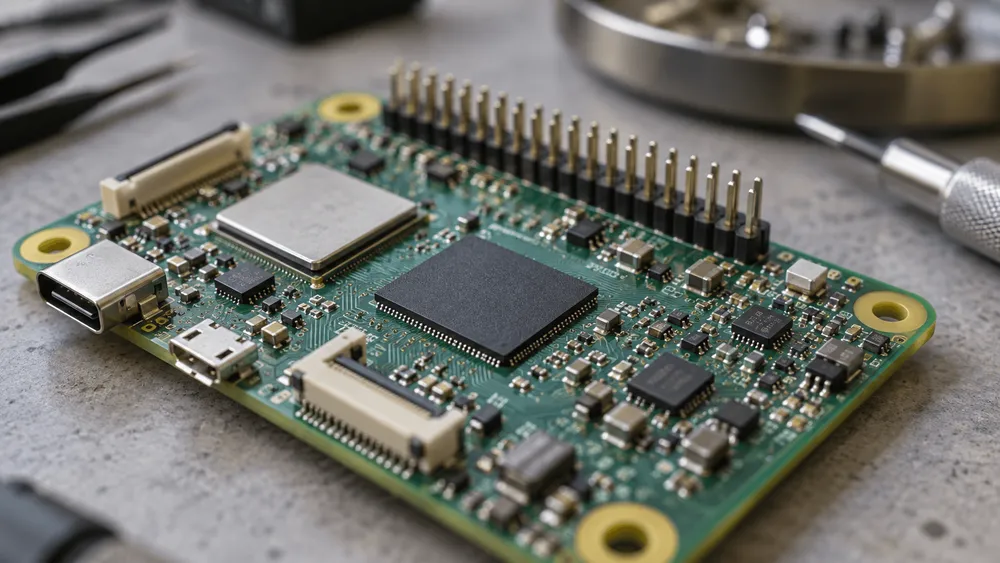
Swapping a Raspberry Pi board's onboard RAM chip for a higher-capacity one doesn't necessarily mean you'll get to use the extra capacity. A company engineer explained on the official forum that Raspberry Pi fixes the RAM capacity for each product at the time of shipment. Behind this lies concern that low-capacity models could have their RAM swapped out with unverified chips and then be sold as genuine high-capacity models.
However, it would also be incorrect to interpret this restriction as meaning "if the RAM fails, it can't be repaired by replacement." In the same forum thread, another engineer explained that as long as the part number of the replacement RAM matches the original, a sufficiently skilled technician can perform a repair by replacement.
On the other hand, RAM with the same capacity but a different part number may not work. Upgrading to higher capacity, swapping in a different part with the same capacity, and repairing with an identical part number are three distinct scenarios that need to be considered separately.
Installing 4GB on a 2GB CM5 Still Shows Up as 2GB
The issue began when a user consulted the forum about attempting to upgrade the RAM on a Compute Module 5 (CM5) from 2GB to 4GB.
According to a post dated June 25, 2026, even after replacing the chip with a 4GB RAM chip, the capacity shown by tools on the OS remained at 2GB. The result was the same even when using a RAM chip removed from a separate, properly functioning 4GB version of the CM5.
The poster wrote that they also changed resistors believed to be related to memory capacity identification, and tried swapping in a different SPI flash chip loaded with older firmware. However, this is an individual report from a single user's own work, not a verification that the same result would occur on every CM5.
The following day, PhilE, a Raspberry Pi engineer and forum moderator, explained that the company fixes products at their shipped RAM capacity.
If a low-capacity model could be fitted with high-capacity RAM of unknown origin or quality and then sold as a genuine high-capacity product, this could generate profit for whoever resells it. However, Raspberry Pi does not verify such modified configurations. If the device becomes unstable, the buyer may ultimately end up contacting Raspberry Pi for support.
PhilE cited preventing this kind of fraudulent sale and avoiding the support burden from unverified configurations as the reasons for restricting capacity changes.
However, this explanation is not a statistic showing how widely such modified products actually circulate, or how many failures or support inquiries have resulted from them. The manufacturer's stated intent—"we want to prevent products using unverified parts from being sold as genuine"—and the actual scale of fraudulent sales are two separate matters.
Also, this statement itself came from a June forum post; it does not indicate that a new restriction was introduced in September.
Fixed RAM Capacity and Replacement Part Compatibility Are Separate Issues
The restriction isn't limited to RAM capacity alone.
PhilE explained that, in order to support RAM sourced from multiple manufacturers, additional information about the chip being used is now also recorded on the product itself. Because of this, even replacing RAM with the same capacity as the original may not work properly if the part number or other details differ.
In the same thread, another Raspberry Pi engineer, timg236, stated clearly that as long as the replacement chip has the exact same part number as the original RAM, a repair by replacement is possible given sufficient technical skill.
In other words, whether a RAM chip can be physically soldered on is a separate question from whether the firmware can correctly recognize and initialize that RAM.
Depending on which RAM is being swapped in, the situation breaks down as follows:
| Replacement RAM | What the engineers' explanations tell us |
|---|---|
| Higher capacity than original | Capacity is fixed at shipment, so it cannot be increased |
| Same capacity, different part number | May not work if it doesn't match the recorded part information |
| Same part number as original | Repair by replacement is described as possible with sufficient skill |
Raspberry Pi has explained that while it restricts modifications aimed at increasing capacity, it does not prevent repairs using RAM of the identical part number. It has also noted that RAM of the same capacity but a different part number may not work.
However, this table is a summary of engineers' explanations on the official forum, not a guarantee of operation for every possible combination of board and RAM. Nor does it mean that replacement with an identical part number is covered under manufacturer warranty.
This mechanism appears to place emphasis on whether the post-replacement configuration falls within the range that Raspberry Pi has verified.
The fact that the number of RAM suppliers is increasing can also be seen in Raspberry Pi's own documentation.
The company's product change notice "PCN 46" lists multiple manufacturers' products for Pi 5 RAM—including Rayson, Winbond, CXMT, and Longsys—along with their part numbers and capacities. All of these are parts certified by Raspberry Pi.
In other words, the manufacturer itself does not rely on RAM from a single supplier alone.
PCN 46 explains that newly adopted parts are tested to confirm they have specifications and performance close to the existing parts before being used in production. Corresponding firmware is prepared as well.
There is a significant difference in the level of verification between a user swapping in different RAM based solely on capacity and packaging, and a manufacturer formally adopting a part after confirming compatibility for each component. This is the distinction from cases where users or resellers install RAM of unknown origin or operating conditions.
Reverting to Old Firmware Doesn't Necessarily Solve the Problem
Some have suggested that reverting to an older bootloader or firmware might bypass the capacity restriction.
However, a report about old EEPROM versions on Raspberry Pi's GitHub is neither a successful example of RAM replacement nor an example of bypassing the fixed capacity.
That report is a record of boot success or failure on a single unit: an 8GB Pi 5 failed to boot with EEPROM versions dated September 23, 2024 or later, but booted successfully with the September 10 version. There is no mention of RAM being replaced, and it does not serve as evidence for when the capacity restriction was introduced or whether it can be removed using older firmware.
On the other hand, in the June forum thread about actually attempting a 2GB-to-4GB upgrade on a CM5, the poster also tried a separate SPI flash chip loaded with older firmware. Even so, the device apparently was still not recognized as having the expected 4GB.
Reverting to older firmware carries another problem as well.
PCN 46 explicitly states that firmware dated May 5, 2026 or later is required for product revisions that incorporate the newly added Pi 5 RAM.
Even if a particular modified board happened to work with older firmware, applying that same firmware to a different board currently in circulation could result in failure to properly initialize the newly adopted RAM.
Therefore, the age of the firmware cannot simply be treated as a "method for bypassing the capacity restriction."
Additionally, Raspberry Pi's engineers have not disclosed exactly where or in what format the RAM-related information is stored. As such, there is no basis for concluding that this information is stored in a specific, non-rewritable area, or that the restriction can be bypassed with any and all older firmware versions.
Price Gaps by Capacity and the Impact on Repairability
The motivation to modify a low-capacity model and sell it as a high-capacity one tends to grow as the price gap between capacities widens.
In April 2026, Raspberry Pi announced a price revision citing rising memory procurement costs. For the Pi 4 and Pi 5, the price increase was $25 for the 4GB model and $50 for the 8GB model. For the CM5, it was $12.50 for the 2GB model and $50 for the 8GB model.
However, these are the price increase amounts announced at the time, not figures showing current retail prices or the profit that could be made from selling a modified product.
Nor can it be definitively stated that this price revision was the direct reason for introducing the fixed RAM capacity mechanism. One should avoid linking the price increase to the restriction without confirming the timeline of when the restriction was actually introduced.
At the same time, this mechanism does have the side effect of narrowing the range of parts available for repairs.
Even if a repair technician has RAM of the same capacity on hand for a failed board, it may not be usable if it doesn't match the part number or the information recorded on the product itself.
When attempting a repair, it's important not to judge compatibility by capacity alone, but to check the combination of the part number listed on the original RAM against the board and firmware.
If a larger RAM capacity is genuinely needed, it's more reliable to choose a genuine model that already comes with the required capacity from the start, rather than planning on swapping chips after purchase.
What Raspberry Pi has put in place is a mechanism to prevent low-capacity models from being upgraded with unverified parts and then distributed as genuine high-capacity models.
At the same time, this does not amount to a blanket ban on advanced repair-by-replacement work using parts with the identical part number as the original.
However, as the number of adopted RAM manufacturers increases, it has become harder to judge replaceability based on capacity alone. Going forward, how much Raspberry Pi discloses about the conditions for replaceable parts and methods for identifying modified products is likely to become an important point in balancing buyer protection with ease of repair.