


As 2025 draws to a close, a chill has begun to sweep through the tech industry. Behind the excitement of the generative AI boom, its "cost" is about to hit the smartphone—the device closest to our everyday lives.
A new report released by market research firm Counterpoint Research on December 16, 2025, has sent shockwaves through the industry. It states that global smartphone shipments in 2026 will decline 2.1% year-over-year, betraying earlier growth forecasts.
The chief culprit is "record-high memory prices." The overheated investment in AI servers is, ironically, squeezing the smartphone supply chain, bringing us closer to a future in which consumers are forced to buy expensive devices with downgraded specs (Japanese).
From "Growth" to "Contraction": The Shock of the Counterpoint Report
The revision to Counterpoint Research's forecast points to a complete reversal of market trends.
A Dramatic Downward Revision of Forecasts
The firm had previously held an optimistic outlook for the 2026 smartphone market, but with this revision it has cut its growth forecast by 2.6 percentage points, concluding that the market will now see negative growth of 2.1% year-over-year (a contraction).
Behind this figure lies a sharp rise in the BOM (Bill of Materials) costs involved in manufacturing smartphones. In particular, prices for DRAM, which temporarily stores data, and NAND flash memory, which stores data long-term, continue to climb without pause.
Average Selling Price (ASP) to Rise 6.9%
While shipment volumes decline, device prices are set to rise. According to the report, the average selling price (ASP) of smartphones in 2026 is projected to rise 6.9% year-over-year. This is a significant upward revision from the September forecast (a 3.9% increase).
In other words, the 2026 mobile market will be dominated by a phenomenon close to stagflation: "smartphones will sell less, while the price per unit surges."
Why Is Memory So Expensive? The "Cannibalization" Structure Born of the AI Boom
Why has memory become this expensive right now? Digging into the cause reveals a structural dilemma facing today's tech industry: the "AI paradox."
AI Servers Are Driving Out Smartphone Memory
We've covered this repeatedly on this site, but the root cause lies in the explosive construction boom of generative AI data centers.
AI servers equipped with NVIDIA GPUs require enormous amounts of memory. Major memory makers such as Samsung and SK hynix are prioritizing production of high-bandwidth memory (HBM) and enterprise SSDs for AI servers, which carry higher profit margins—squeezing the production capacity available for the relatively lower-margin general-purpose memory used in smartphones.
Cost Pressure Set to Continue Through Q2 2026
This supply shortage is severe. According to Counterpoint's data, memory prices will continue to rise, with a warning that they could increase by a further 40% by Q2 2026.
This would push smartphone component costs, already at an elevated level, up by a further 8% to over 15%. This is beyond a level that manufacturers' own efforts can absorb.
A Polarizing Survival Battle: Apple/Samsung vs. Chinese Manufacturers
This wave of cost increases will not hit all manufacturers equally. Differences in financial strength and business models will cruelly separate the winners from the losers in 2026.
Chinese OEMs (Honor, OPPO, vivo) in a Bind
The Chinese smartphone makers face the harshest outlook in this report.
The impact is especially devastating in the low-end segment priced under $200 (roughly ¥30,000).
- BOM cost increase for low-end devices: Already up 20–30% since the start of the year.
- Mid-range and high-end devices: Up 10–15%.
For Chinese manufacturers whose business model relies on thin margins and high volume, a 30% rise in component costs would wipe out profits. As Counterpoint analyst Yang Wang points out, when cost pass-through is impossible, companies are being forced to "cut parts of their portfolio" (specific models). In fact, low-end product lineups (SKUs) have already begun to be significantly reduced.
Apple and Samsung Show the "Confidence of Kings"
Apple and Samsung, meanwhile, are relatively safe. Counterpoint assesses that both companies are "best positioned" to weather the coming quarters of turbulence.
- Apple: The average selling price of the iPhone already exceeds $900, and thanks to high profit margins and powerful brand loyalty (ecosystem stickiness), it can more easily pass price increases on to users.
- Samsung: As the world's largest memory manufacturer with a vertically integrated business model, it has an overwhelming advantage over competitors in controlling procurement costs.
Still, even these two companies are expected to see shipments decline by about 2%, so they won't escape unscathed. There are even reports suggesting that next year's flagship, the "Galaxy S26," may compromise on some specs to cut costs.
2026 Smartphone Trends: Accelerating "Shrinkflation"
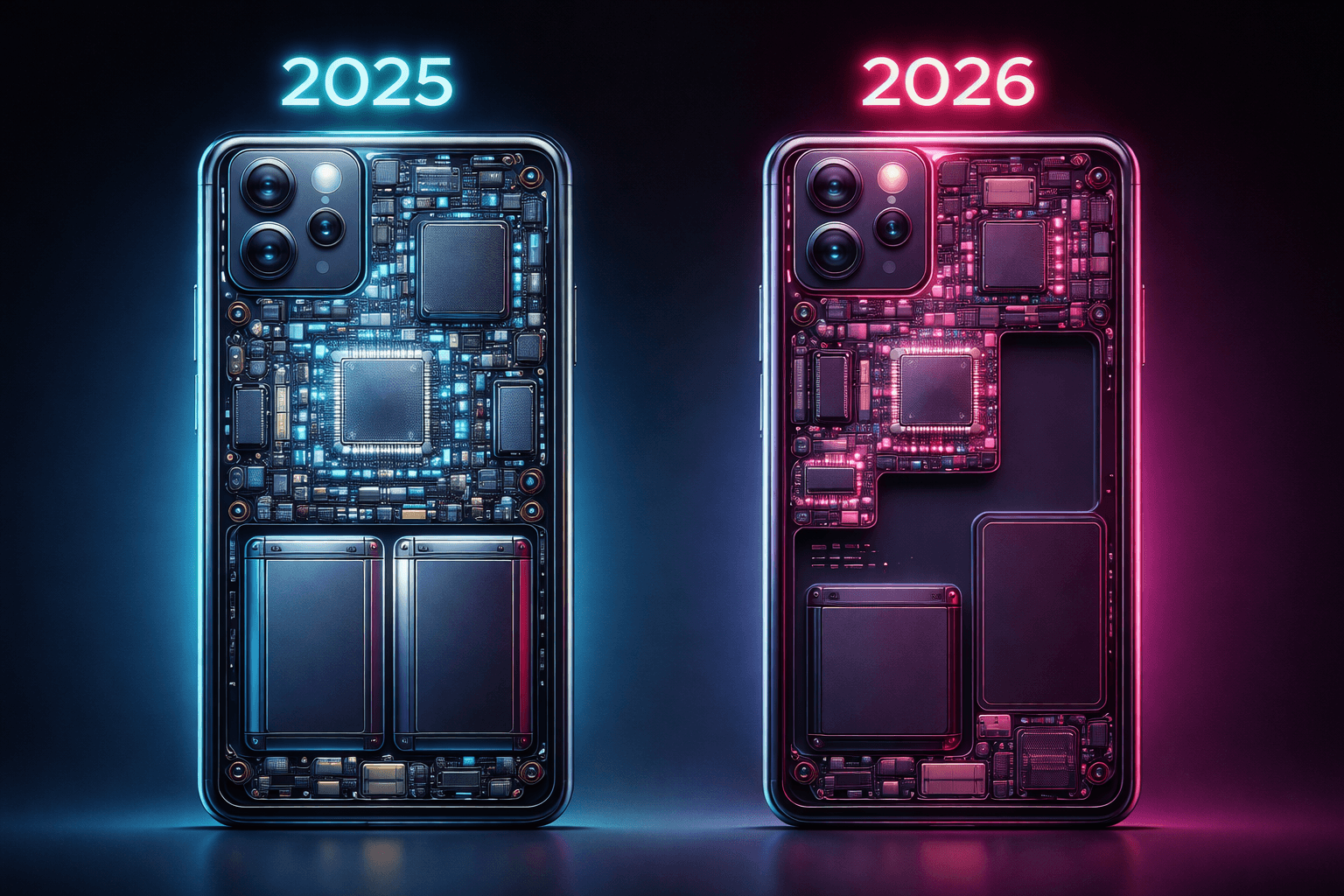
How will manufacturers respond to this crisis? What emerges from our sources is an acceleration of substantive spec downgrades—"shrinkflation"—raising prices while quietly cutting corners on the inside.
1. A Reversal in "Memory Capacity"
As a previous report suggested (Japanese), 2026 smartphones may ship with less RAM than 2024 or 2025 models.
In the high-end market, where 12GB and 16GB configurations were becoming the norm, we can expect a retreat back to 8GB or 12GB, along with an increase in 4GB models in the low-end segment, to offset rising costs. This creates the contradiction of touting AI features while cutting the memory needed to run them.
2. Component Reuse and Downgrades
Counterpoint senior analyst Shenghao Bai analyzes that manufacturers will pursue the following strategies:
- Cameras: Forgoing the latest sensors in favor of reusing previous-generation modules.
- Displays/Audio: Switching to cheaper components with reduced specs.
- SoCs: An increase in models adopting the previous generation's chip rather than the latest one.
3. Steering Users Toward "Pro" Models
The strategy of deliberately holding back the specs of standard models to push users toward pricier "Pro" or "Ultra" models will likely become even more blatant. Standard models will become "overpriced and underpowered," reinforcing a structure in which consumers have little choice but to buy expensive premium models for a satisfying experience.
A Year That Tests Consumer "Patience"
Putting all this information together, 2026 is likely to be a "winter era" for the smartphone market.
The smartphone replacement cycle has already lengthened to over 40 months. Consumers feel their current phones are "good enough" and won't loosen their wallets unless offered genuinely innovative features.
On top of that comes this double punch of "price hikes" and "spec downgrades." Manufacturers are trying to make "on-device AI" their new selling point, but if the very memory (DRAM) needed for it gets cut due to high costs, a comfortable AI experience is hardly something to expect.
Buy Now, or Wait?
If you're currently considering upgrading your smartphone, it may be wise to buy a current model (2024–2025) rather than waiting for 2026.
Right now, we're still in a "grace period" before the full impact of soaring memory prices is completely reflected in product pricing. Devices arriving next year carry a high risk of either costing more, or having their specs cut even if prices stay the same.
The "AI boom" is advancing technology on one hand, but ironically, it may temporarily halt the evolution of the devices in our own pockets. 2026 is set to be a year in which manufacturers' strategies and consumers' discernment clash more fiercely than ever before.
Sources
- Counterpoint Research: 2026 Smartphone Shipment Forecasts Revised Down as Memory Shortage Drives BoM Costs Up