

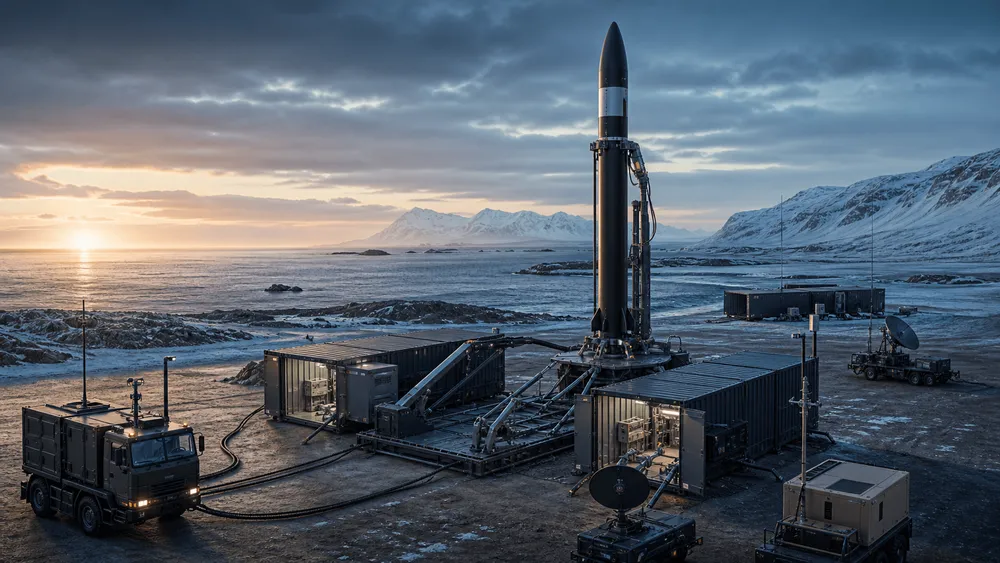
On August 10, 2026, Rocket Lab announced "GHOST," a system that transports a complete rocket and launch infrastructure package in standard shipping containers. It supports both Electron, which sends small satellites into orbit, and HASTE, the suborbital variant used for hypersonic testing. The company will deploy its first system to Kodiak Island, Alaska, with plans to begin suborbital flights from there in 2027.
In June, Rocket Lab launched an Electron just 16 hours and 42 minutes after receiving a launch notification from the US Space Force, demonstrating its ability to act quickly from a ready-made launch site. What GHOST aims to change is the location itself where that speed can be achieved. By packaging the launch pad, ground support equipment, and launch site control into a transportable unit, the concept is to move rapid-response capability to wherever the customer needs it.
Both the Rocket and the Launch Site, into Standard Containers
GHOST stands for Global Hypersonic & Orbital Spaceport Technology. Standard shipping containers house a complete rocket and launch infrastructure, along with the ground support equipment and launch site control systems. It's not designed as a transport method to move a rocket to an existing launch pad, but rather as a product that deploys Rocket Lab's proprietary ground systems as a complete package.
A notable feature is that the same ground equipment can handle two different vehicles. Electron is an 18-meter orbital rocket capable of delivering up to 300 kilograms to low Earth orbit. HASTE inherits Electron's composite structure and 3D-printed Rutherford engines but modifies the third stage for suborbital flight. It can separate payloads of up to 700 kilograms at altitudes above 80 kilometers, with separation velocities adjustable from 3 kilometers per second to over 7.5 kilometers per second.
A single GHOST unit can support different demands—orbital insertion of small satellites and flight testing of hypersonic equipment. Rocket Lab has stated that its compact, modular configuration could enable rapid launch site setup and potentially support multiple simultaneous launches. However, the company has not disclosed the number of containers required, the setup time involved, or the necessary personnel. "Rapid" and "simultaneous" remain product goals without accompanying measurements at this stage.
Taking the 16-Hour-42-Minute Responsiveness Outside Fixed Launch Sites
Even before GHOST, Rocket Lab had already demonstrated rapid-notice launch operations. For the US Space Force's VICTUS HAZE mission, the company launched an Electron just 16 hours and 42 minutes after receiving the launch notification on June 19, 2026—7 hours and 18 minutes ahead of the 24-hour deadline set by the Space Force. However, that launch used an already-established Rocket Lab launch site.
GHOST is the mechanism designed to reproduce that same speed at other locations. By reducing the construction work needed to establish fixed facilities, Rocket Lab could bring Electron and HASTE operational infrastructure to tests requiring specific flight paths, or to allied nations wanting to launch their own satellites from domestic soil. The substance behind Rocket Lab's emphasis on "launch anywhere" lies not in improved rocket performance, but in the standardization of the equipment that constitutes a launch site.
Business demand for this is already visible. On July 27, Rocket Lab secured a $266 million contract from the US Space Force's Rocket Systems Launch Program. The contract covers 12 suborbital flights plus an option for 6 additional flights, with most flights to be conducted from the Pacific Spaceport Complex-Alaska (PSCA) on Kodiak Island. The first flight under the contract is expected sometime after the end of 2026.
Two weeks after this contract announcement, the company designated PSCA as GHOST's first deployment site. However, the $266 million announcement did not specify which vehicle would be used, nor did it state that all 12 (or up to 18) flights would use GHOST. While the contract's first flight could begin as early as late 2026, GHOST's operational start is set for 2027. While it's clear that demand from Alaska is supporting this development, the extent to which the contract and the system correspond will need to await future mission announcements.
Why Was Kodiak Chosen as the First Deployment Site?
The first GHOST unit will be installed not on undeveloped land, but at PSCA, which has a track record of 35 launches dating back to 1998. According to the state-run Alaska Aerospace Corporation, which operates the spaceport, it supports year-round operations and is accessible via commercial aviation, an ice-free port, and state-maintained roads. The logistics and launch site capabilities needed to transport large equipment to a remote location and manage flight safety are already in place.
Rocket Lab has named the new PSCA site Launch Complex 4, and will establish two launch pads there to support high-frequency flight campaigns. Once operations begin with suborbital flights in 2027, the company's total operated launch pads across two hemispheres—combined with Launch Complex 1 in New Zealand and Launch Complexes 2 and 3 in Virginia—will reach six.
By choosing an existing spaceport for its first deployment, Rocket Lab can validate GHOST-specific equipment and procedures in an environment where range safety and transport routes are already established. While the company has not explicitly stated this as the reason for the selection, it makes it easier to distinguish between issues arising from inadequate site readiness and issues specific to GHOST itself. The 2027 flights won't serve as proof of "launch anywhere" capability in its complete form, but rather as the first test measuring whether the containerized ground systems operate as planned at an existing launch site.
Equipment That Can Be Transported, and Permits That Remain Local
Even if equipment is transported in containers, launch authorization and airspace coordination cannot be moved along with it. The US Federal Aviation Administration (FAA) authorizes commercial space vehicle operations and launch site operations separately. Operators launching within the United States must obtain a vehicle operator license or permit and enter into an agreement with the air traffic control authority overseeing the launch location. Establishing hazard areas and issuing Notices to Airmen (NOTAMs) also accompany each flight.
The fact that PSCA is already an established spaceport works in GHOST's favor. However, if Rocket Lab expands to other locations within the United States, it will need to establish safety reviews, airspace coordination, and launch site operational frameworks specific to each location. Outside the United States, the procedures may not mirror those of the FAA, and Rocket Lab has not disclosed how it will handle this in different countries. While hardware standardization may reduce the burden of construction and integration, safety verification for each flight path remains necessary.
The published materials do not address fuel transport and storage methods, the civil engineering work required at each site, system pricing, or international customers who might adopt the technology. What GHOST may change is not whether permits exist, but how many days it takes to set up a complete launch system package at an authorized location and prepare for the next flight. The actual pace achieved using this timeline and the two launch pads will be measured for the first time during operations at Kodiak in 2027.