


On a thin glass substrate just 175 micrometers wide, a gold film only 110 nanometers thick has been deposited. The array of microscopic slits carved into its surface may render obsolete the massive cooling apparatus that currently occupies entire laboratories.
Semiconductor technology, built on our understanding and mastery of the electronic "band structure," fundamentally shaped the modern digital society. In a similar vein, the concept of "photonic crystals," proposed roughly 40 years ago, gave rise to band structures that control the propagation of light, transforming the world of optics. In recent years, metasurface technology—which manipulates light's color (wavelength), polarization, and orbital angular momentum using nanoscale surface structures—has been advancing rapidly.
Photons, being relatively immune to thermal interference, have long been considered strong candidates for room-temperature quantum technology. However, scaling up quantum computers and quantum communication systems that boast absolute security to practical sizes requires more than just manipulating single photons. It demands control over "many-body quantum systems," where numerous photons intertwine intricately and behave collectively.
The nature of the complex interference phenomena in these multi-photon systems is determined by the "quantum statistical properties (quantum coherence)" of light. Until now, no material existed that could directly respond to and distinguish these extremely delicate statistical fluctuations. To preserve the coherence of photon ensembles without disturbing it, researchers had no choice but to rely on ultra-low temperature environments approaching absolute zero.
How, then, can one pull the quantum states woven by numerous photons out from their cryogenic shelter and manipulate them at room temperature?
The breakthrough published in Nature by a research team led by Associate Professor Omar S. Magaña-Loaiza at Louisiana State University (LSU) provides a brilliant answer to this challenging question. The team has completed the world's first room-temperature quantum material capable of directly filtering the previously overlooked statistical properties of light.
Multi-Particle Interference Woven by the Collective Behavior of Meta-Atoms
Rather than searching for ideal properties among naturally occurring materials, the research team created a new quantum material by designing their own nanoscale physical structures.
The structure of their "quantum statistical plasmonic metacrystal" was calculated with extreme precision. Using a focused ion beam, they etched 100 rectangular slits—each 400 nanometers long and 200 nanometers wide—into a gold thin film, arranged in a regular pattern with 1-micrometer spacing. Each of these minute slits functions as an artificial atom, or "meta-atom," exhibiting its own unique response to light.
When light enters this glass chip and travels along the gold surface, it generates a wave known as a "surface plasmon," in which electrons and light are coupled together. This wave connects neighboring meta-atoms, triggering complex interactions among photons. Critically, the slit openings are sufficiently smaller than the wavelength of light (sub-wavelength). This suppresses higher-order multipole oscillations, causing each slit to function as a localized oscillator with a uniform phase.
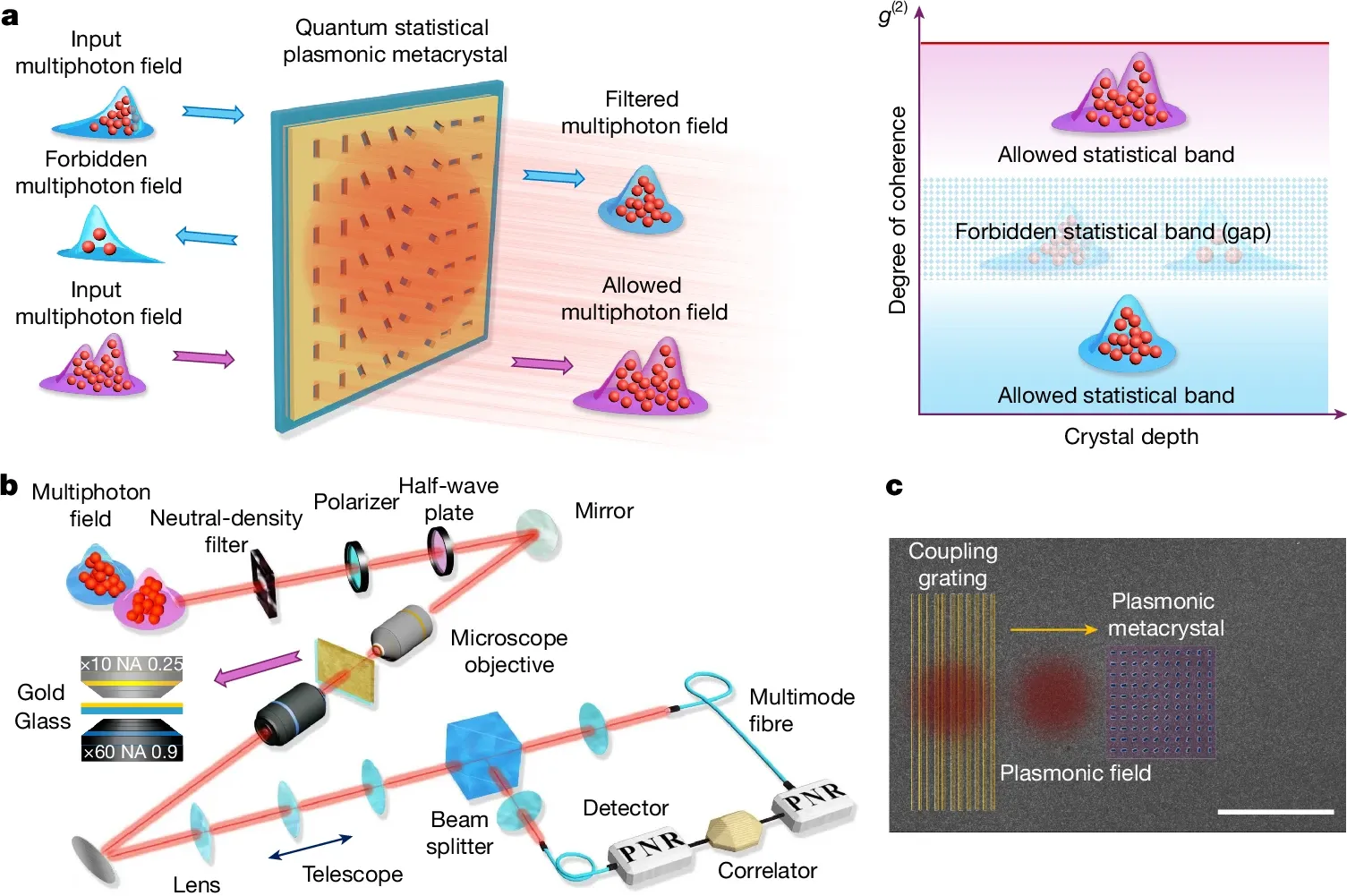
The size of the slits determines the tolerance range for individual photon coherence, while the number of slits and their relative orientation fine-tune the overall "bandwidth" of the crystal. Meta-atoms arranged in the same orientation produce indistinguishable multi-particle interference, while those arranged in different orientations produce distinguishable interference. This combination of geometric arrangements allows for deterministic control over the behavior of photon ensembles as they pass through.
Bringing Semiconductor "Bands" to the Quantum Statistics of Light
The most remarkable feature of this metacrystal can be explained through an analogy with semiconductors. Semiconductors have energy bands where electrons can move freely (allowed bands) and energy bands where electrons cannot exist (bandgaps, or forbidden bands). The research team applied this concept to the quantum statistical properties of light, successfully creating a "statistical band structure" through which only light in specific states can pass.
Physical filters that separate light by color, polarization, or direction of propagation have existed for a long time. What sets this research apart is that it directly reads how photons are distributed and how they interfere with one another.
| Characteristic | Conventional Optical Filters | This Study's Plasmonic Metacrystal |
|---|---|---|
| Selection Criterion | Wavelength (color), polarization, intensity | Statistical properties of photons (quantum coherence) |
| Operating Environment | Ultra-low temperature (when preserving quantum states) | Fully room temperature |
| Control of Multi-Photon Systems | Impossible (coherence of photon ensembles is destroyed) | Possible (controlled via allowed and forbidden bands) |
| Main Function | Blocks or attenuates specific light | Converts light in forbidden bands to the nearest allowed band |
The statistical properties of light are quantified by an indicator called the second-order correlation, .
This formula indicates how much the number of photons fluctuates (deviates) from its average value. Orderly light such as laser light (coherent light) exhibits , while thermal light such as sunlight shows , and super-thermal light with even larger fluctuations shows . The metacrystal directly identifies this value, which serves as a kind of "fingerprint" of the light source.
The research team prepared 13 different light sources with second-order correlation values ranging from 1 to 3 and directed them into the metacrystal. Light with specific statistical properties (for example, or $2$) matched the "allowed bands" and passed through the structure without any disruption to its delicate quantum state. In theory, photon density in the near-field gradually diffuses according to the Fresnel kernel as it propagates. However, it was confirmed that within the crystal depth, quantum indistinguishability is maintained, and the statistical properties inherent to non-classical multi-particle systems are preserved intact.
The true innovation lies in demonstrating that simply designing the nanostructure of a material can freely filter and manipulate the quantum states of light. When light corresponding to a "forbidden band" was directed into the crystal, the metacrystal did not merely block its transmission—it forcibly transformed the light's properties through the process of plasmon interference. Specifically, when light with was input, the output light shifted to , the nearest allowed band. Similarly, light with was converted to $1.50$.
Toward Scalable Quantum Computing and Next-Generation Solar Cells That Break Through Limits
Pulling multi-photon quantum states out from their cryogenic shelter and transporting them robustly at room temperature—this demonstration shatters a major bottleneck in the practical implementation of quantum technology.
The practical realization of photonic quantum computers requires the ability to maintain complex states using numerous photons while continuously performing operations with high fidelity. This metacrystal has the potential to serve as a building block that stably transmits specific quantum states regardless of the number of particles in the system. Its high versatility—allowing any desired statistical band to be designed simply by changing the dimensions and arrangement of the slits—promises to significantly accelerate the development of quantum communication networks and ultra-sensitive sensors.
Moreover, the next target the research team has set their sights on, one that could have an immeasurable impact on industry, is application to the energy sector, including solar power generation.
In current solar cells, a portion of the absorbed light energy is scattered by disordered structures within the material and lost as heat rather than converted into electricity. This stems from the fact that the partial coherence (statistical properties) inherent in sunlight is not controlled within the material. Mainstream silicon solar cells currently face a physical conversion efficiency wall known as the "Shockley-Queisser limit" (approximately 30-33%). This limit is calculated based on the fundamental premise of energy losses from unabsorbed light and heat dissipated during electron relaxation processes. While new materials such as perovskite solar cells have gained attention in recent years, the fundamental thermodynamic challenge of energy escaping as heat remains unresolved.
If this quantum statistical metacrystal could be integrated into the surface panels or light-absorbing layers of next-generation solar cells, the situation would change dramatically. By intentionally shaping the statistical properties of incident sunlight through "allowed bands," it would be possible to suppress unwanted conversion into thermal energy to the greatest extent possible and efficiently guide the energy toward conversion into electricity. If coherence control at the photon level were to be practically implemented in solar cell modules, it could fundamentally overturn the conventional theoretical limits on conversion efficiency that have been premised on thermal loss.
A gold nanostructure born from the pursuit of pure quantum physics holds the powerful potential not only to manipulate the behavior of light on a laboratory desk, but also to fundamentally rewrite the energy infrastructure of our society.