


On July 15, 2026, Samsung announced "Flex Titanium," a display technology for its next-generation Galaxy foldable products. An ultra-thin titanium alloy film is placed beneath the OLED panel, further supported by a titanium plate. At the fold area, the plate is patterned with fine holes, transforming a rigid metal into a structure that can bend. What's new this time is that the task of reducing the crease is no longer left solely to the hinge or the ultra-thin glass on the surface, but extended to the entire layered structure that supports the OLED from below.
Flex Titanium will be used for the first time in Samsung's next-generation Galaxy foldable lineup. Samsung has not yet revealed product names, leaving the details for Galaxy Unpacked, which begins at 22:00 Japan time on July 22. From the information released so far, it remains unclear how shallow the crease can be made, or how many open-close cycles the device can withstand. Even so, Samsung's approach to simultaneously pursuing thinness and durability has become fairly clear.
Not the First Use of Titanium—The Support Layer Now Has Two Tiers
What's new about Flex Titanium is not that titanium has been introduced into a foldable screen. The 2025 Galaxy Z Fold7 already used a titanium plate beneath the main display. At the same time, Samsung made the Ultra-Thin Glass (UTG) 50% thicker than the previous generation and redesigned the water-drop hinge into a multi-rail structure. This was a design in which the hinge distributed stress broadly during opening and closing, while the thicker UTG and the plate underneath absorbed impact.
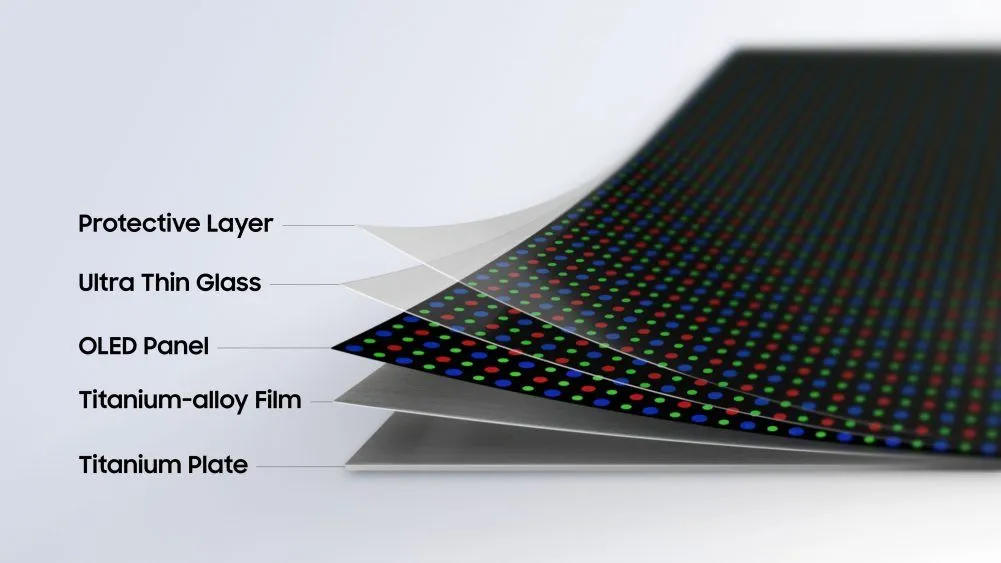
What's new this time is the titanium alloy film placed directly beneath the OLED. Below it comes a titanium plate with revised processing. Samsung uses a polymer film as the point of comparison for performance, but it has not stated explicitly that the equivalent layer in the Z Fold7 was polymer. What can be confirmed, then, is the change of newly adding a titanium alloy film and bringing to market a structure that supports the OLED with two titanium components.
| Item | Galaxy Z Fold7 (2025) | Flex Titanium (announced 2026) |
|---|---|---|
| Support film directly beneath OLED | Material not officially disclosed | Titanium alloy film. 20x the mechanical stiffness of a polymer film |
| Lower support plate | Titanium plate | Titanium plate. Micro-patterned holes at the fold area |
| Screen/hinge improvements | UTG made 50% thicker; multi-rail Armor FlexHinge adopted | UTG thickness and hinge structure of finished product not disclosed |
| Published durability test | Functioned after 500,000 folds at 25°C | Number of folds and temperature conditions not disclosed |
The Z Fold7 panel, tested by Bureau Veritas, continued to function after being folded 500,000 times over 13 days at 25 degrees Celsius—2.5 times the 200,000-cycle benchmark that Samsung Display had previously used. That result was achieved with the titanium plate as well as a highly elastic adhesive offering more than four times the recovery performance of conventional materials, and a flattening structure that distributes impact across the surface. Flex Titanium advances this existing support design into a two-layer titanium structure.
The "20x" Figure Refers to Stiffness, Not Durability Lifespan
Samsung's English announcement states that the titanium alloy film has 20 times the "mechanical stiffness" of a polymer film. The Japanese announcement translated this as "mechanical strength," but in engineering terms, stiffness and strength are different quantities. Stiffness indicates resistance to deformation under an applied force, while strength represents how much load a material can withstand before yielding or breaking. The figure of 20x does not mean that drop resistance, lifespan, or fold-cycle count has increased 20-fold.
The advantage of placing a highly rigid film directly beneath the OLED is that it can support the screen broadly while keeping it thin. When pressed by a finger or when the device is opened, a soft layered structure tends to sink locally, making surface waviness and creases more noticeable. A film that resists deformation can disperse that load to the surrounding area. Samsung states that through precision rolling, it has thinned the titanium alloy film to about one-third the average thickness of a human hair.
Thinness matters as much as the material itself. A component's bendability is determined not only by the material's elastic modulus but also significantly by its thickness and shape. By using high stiffness to support the surface when unfolded, while making the film itself ultra-thin to reduce the burden during folding, Samsung addresses both requirements. The core of what "Flex Titanium" represents lies less in the fact that hard titanium is used, and more in how processing techniques reconcile these conflicting requirements.
Samsung also explains that power consumption has been reduced through a high-resolution pixel structure and next-generation organic materials. This is an improvement on the OLED side, and does not mean that power efficiency improved because titanium was used. No improvement rate has been disclosed. It's necessary to distinguish this as a technology package in which the material and pixel structure were renewed simultaneously.
Why Can Hard Titanium Be Folded?
The answer is that the entire plate is not made uniformly rigid. Flex Titanium's titanium plate has precision micro-patterned holes arranged in the area corresponding to the crease. The areas without holes support the screen when unfolded, while the perforated areas have a reduced cross-section, making them easier to bend. Rather than determining rigidity solely through material selection, this is a design that allocates it to where it's needed.
Samsung also explains that advanced hole processing has created a structure with no air gaps between the display module and the adhesive on the plate. Reducing gaps at the bonding surface is thought to make the force supporting the OLED from below more uniform, which would also make adhesive layer delamination and surface waviness less likely to occur. However, no measured values have been disclosed showing how much delamination or waviness has actually been reduced with Flex Titanium.
A foldable OLED is a structure that stacks numerous layers, from the light-emitting portion through the UTG to the support film. The layers are bonded together with adhesive. When bent, the inner side experiences compression and the outer side tension, with a "neutral plane"—where stretching and compression are minimal—forming in between. Peer-reviewed research has shown that without jointly adjusting the thickness and Young's modulus of each layer, along with adhesive properties, the position of the neutral plane and the risk of delamination cannot be controlled. Flex Titanium, which changes both the film directly beneath the OLED and the support plate simultaneously, can be considered an improvement that shifts the stress distribution across the entire panel. However, Samsung has not disclosed stress analysis data or the position of the neutral plane.
There are also measurable figures regarding how visible a crease appears. A research team at Seoul National University reported an experiment in which 25 participants compared 17 prototypes, finding that crease depth strongly affects visibility, and that prototypes with a crease depth under 60 micrometers were rated "good" or better. This is not an industry standard but a single perceptual study; still, it offers a benchmark for translating claims of "less noticeable creases" into measured values. Samsung has not yet disclosed the crease depth for Flex Titanium.
A 500,000-Cycle Track Record, and Figures Flex Titanium Has Yet to Provide
At CES in January 2026, Samsung Display exhibited a next-generation foldable panel with a shallower crease than previous products. The company explained that the degree to which diagonal light reflects off the crease and creates shadows had been reduced. What this shares in common with the July announcement of Flex Titanium is the development goal of making the crease shallower. Whether the panel exhibited at CES used Flex Titanium, or whether the same panel will be used in mass-produced products, has not been confirmed.
There are three figures worth verifying on July 22. First, the crease depth of the new panel compared to the old one, and how much it changes after repeated opening and closing. Second, how many times the device can be folded not only at room temperature but also at low and high temperatures. Third, the thickness and weight of the finished product. Whether thinness has been maintained despite adding the titanium alloy film will reveal the actual benefit of the material change.
The scope of adoption also remains unknown. Samsung has stated only "next-generation Galaxy foldable products," without disclosing whether this will be used in both Fold and Flip form factors, or whether the structure will differ by model. The type of alloy, the absolute thickness of the film, and the dimensions and arrangement of the holes have also not been disclosed. Without the testing method behind the 20x stiffness figure and the specifications of the polymer film used for comparison, a side-by-side comparison with other companies' approaches is not possible.
The value of Flex Titanium lies less in the titanium branding and more in the concept of allocating rigidity within the screen. It broadly supports the OLED when unfolded, bends at the crease via holes, and reduces gaps at the bonding surface as well. If, on July 22, Samsung provides the crease depth, fold-cycle counts at different temperatures, and the thickness and weight of the finished product, it could take a further step toward overturning the foldable-device premise that "thinner means more fragile." But if it ends with photos and adjectives alone, the assessment will remain at the stage of an excellent design concept, and go no further.