

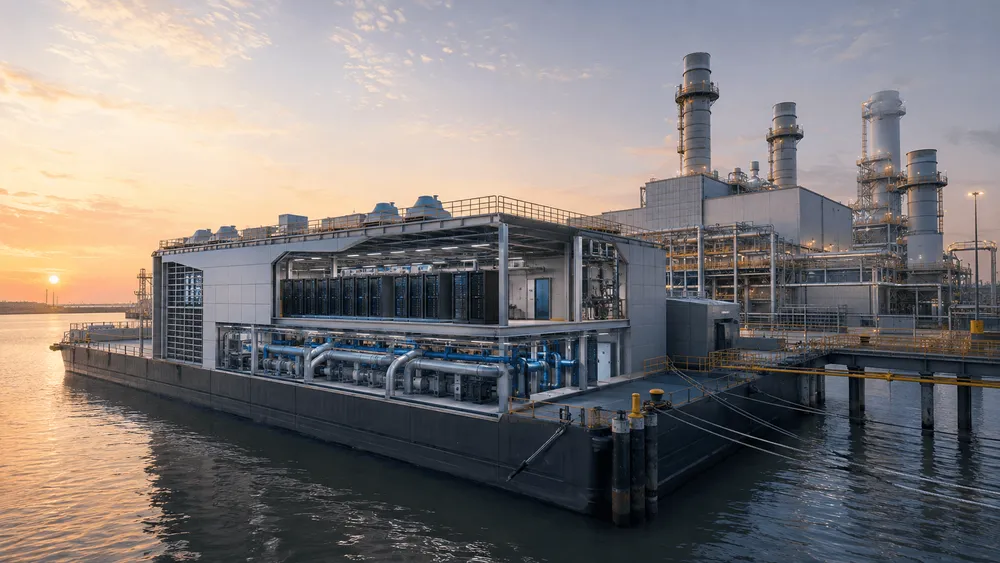
Samsung Heavy Industries (SHI) and Mousterian signed an MOU in April to develop floating data centers in the United States. On August 5, The Register reported that the two companies had signed an engineering contract for a project planned in Texas. The contract covers work from basic design through production design.
When it comes to expanding data centers, securing land, power, and cooling can shape the schedule just as much as procuring computing equipment. Whether a floating approach can shorten that schedule cannot be judged without separating the contract to move a 50MW-class design into an actual facility from Texas's grid interconnection review.
From MOU to Basic Design and Detailed Design
According to The Register, this engineering contract covers basic design, detailed engineering, and production design. It reported that this is a step toward a future EPC contract, and that classification of the waterborne facility by ABS is also anticipated.
SHI announced on April 24 that it had signed an MOU with Mousterian regarding the development of floating data centers (FDCs) in the United States. According to Mousterian's explanation published on April 27, the division of roles has Mousterian handling everything from development through project execution, while SHI provides engineering, manufacturing, and delivery capabilities for floating offshore assets.
The Register reported that IT capacity per facility is set at 50MW, and that the first Texas project will be a pilot moored adjacent to an existing combined-cycle gas turbine (CCGT) power plant in Houston. However, the contract amount and customer were not disclosed. The start date, completion date, and timing of the eventual EPC contract signing also remain undisclosed.
Site Development Beyond the Computing Equipment
What SHI is trying to replace with the floating approach is not limited to the box that houses the servers. The concept is to shift site development—including land acquisition, grid interconnection, cooling equipment, and the operating environment—toward the shipyard's own processes.
The company explains that it envisions a standardized process in which design, manufacturing, and equipment integration proceed in parallel at the shipyard, and that a self-generation power system can reduce dependence on grid electricity. In April, SHI obtained AiP (Approval in Principle) from ABS and Lloyd's Register for a 50MW-class FDC design. AiP is design approval; it does not signify completion or an operational track record.
Servers operating on water or rivers face additional challenges. In June, SHI cited vibration and tilting expected in offshore environments as issues to address. It also announced that it would validate server infrastructure in river and marine environments with Supermicro, addressing high-salinity air and rapid humidity changes. Mousterian touts a design using non-evaporative cooling via liquid-to-liquid heat exchange that does not rely on municipal water or groundwater, along with support for rack densities exceeding 200kW—but this is the company's own design description, not a measured value from actual operation.
Project Zeus's 500MW and the 50MW-Class Design Are Different Figures
On its public page, Mousterian describes a 500MW hybrid facility called "Project Zeus" adjacent to a CCGT power plant in Houston, with occupancy planned to begin in the first half of 2028. The 50MW figure is the design capacity for which SHI obtained AiP, and it is also the figure The Register reported as the IT capacity per facility.
These two figures are not the same. 500MW is the planned value for the Project Zeus campus, and this engineering contract does not indicate that the entire 500MW, or construction of a specific floating unit, has been ordered. Whether the Houston CCGT-adjacent pilot reported by The Register and Project Zeus are the same project is also not made explicit in publicly available information.
Between design approval and operation, contracts and certification still remain. For projects connecting to the grid, interconnection review is added on top of that. The 50MW-class design is still partway through this process.
Grid Interconnection Goes Through Audit and Disclosure
On August 3, the Texas Governor's office directed that for all data centers proceeding through ERCOT's interconnection process, the Public Utility Commission of Texas (PUCT) and ERCOT must conduct verification and audits, and that projects should not proceed before these are completed. Projects that fail to meet the requirements will be denied connection to the Texas power grid.
According to the Governor's office, ERCOT has received interconnection applications totaling more than 474GW, of which roughly 90% are data centers. This figure represents applications, not operational capacity or confirmed construction capacity. The audit requires disclosures concerning power and generation, water and cooling, community impact, and ownership relationships.
In June, ERCOT announced "Batch Zero," which reviews large loads of 75MW or more in a batch. It also explained treatment outside the normal interconnection process for pathways that rely partly or entirely on self-generation, or for facilities that are fully isolated. Design approaches such as power-plant adjacency, self-generation, and non-evaporative cooling may align with the explanations of power, water, and community impact that the state is confirming, but they do not signify interconnection approval or construction permits.
Moving the floating approach into implementation will require classification and an EPC contract, and—if interconnection is sought—the disclosures needed for the audit as well. Once the contract amount and number of facilities are disclosed, the scale of the project can be confirmed. If the start/completion dates and tenant are disclosed, it will be possible to track how far the 50MW-class design is actually used in the Texas plan.