

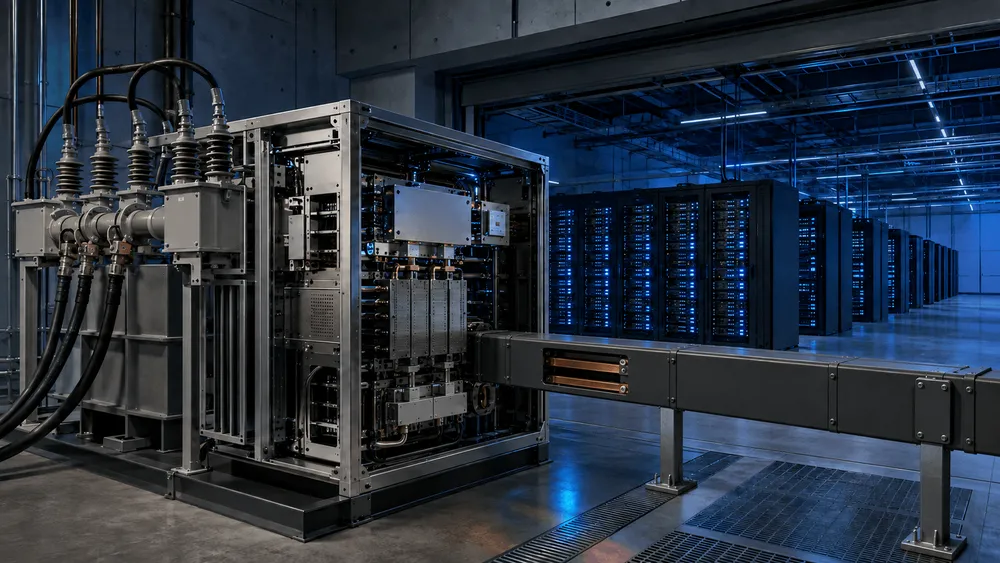
What Siemens and Germany's Reinhausen have jointly developed is a modular solid-state transformer (SST) that directly converts medium-voltage AC of up to 36kV into stable 800V DC. The two companies announced their joint development and industrialization policy on August 14. As AI data centers look toward exceeding 1MW per rack, this represents a move to extend the discussion of raising distribution voltage beyond the rack itself, out to the power receiving and substation side.
However, what has been revealed this time is a development plan. Neither the sale of finished products nor the start of mass production has been disclosed, and no customer adoption or demonstration operation has been announced. Siemens cited modularity and millisecond-level load following, and also touched on interface and protection technologies. Meanwhile, rated output and efficiency remain unknown, and dimensions, the semiconductors to be adopted, and the installation destination have not been indicated either.
800V DC is not a scheme for supplying 800V directly to GPUs or CPUs. Rather, it is a concept for reorganizing where conversion takes place and at what voltage large amounts of power are carried. To judge the SST's true capability, one must separately consider the current reduction achieved through higher voltage and the separate challenges of DC protection and large-scale reliability.
From 36kV to 800V DC: How Many Conversion Stages Can Be Eliminated?
According to Siemens' explanation, the new SST connects to grid voltages of up to 36kV and outputs stable 800V DC. The module can also be applied to lower voltages depending on grid connection conditions. An SST is a device that converts medium-voltage AC into low-voltage DC and includes galvanic isolation. The aim is to reduce the conversion stages that are interposed in conventional multi-stage AC/DC configurations.
There is a reason behind this combination of companies. Reinhausen possesses expertise in transformer voltage regulation and power quality, as well as medium-voltage power electronics and related components. Siemens handles everything from grid integration to power conversion, protection, and control. While the announcement does not specify which company is responsible for which individual module, this combination is intended to industrialize the SST not merely as a converter, but as equipment that can be connected to the grid.
The 800V DC architecture presented by NVIDIA also envisions a future in which the current multiple AC-AC conversions plus DC conversion on the rack side are shifted to a single AC-800V DC conversion combined with 800V DC distribution within the facility. What is primarily eliminated here are the intermediate stages on the facility side. Immediately before the load at the rack or board level, DC/DC conversion that steps down to the voltage required by GPUs or CPUs still remains.
In other words, the SST announcement does not replace server power supplies. It plays the role of handing over power received at medium voltage to the 800V DC trunk line. Regarding existing or under-construction AC facilities, NVIDIA has positioned MGX-compatible 800V DC power racks as a transition measure, and there is no plan to immediately replace all facilities with SSTs.
Siemens' mention of "avoiding downtime," cost reduction, and high efficiency is also a product-side claim premised on this reconsideration of where conversion takes place. Since the announcement lacks demonstration conditions or measured values, it remains unclear exactly how much benefit will be achieved with which facility configuration.
Why Higher Voltage Is Needed: 1,250A for 1MW
The reason for raising voltage to 800V is that current can be reduced for the same amount of power. Taking the 50V that OCP cites as an existing bottleneck as a baseline, and calculating with P=VI as an ideal DC circuit, carrying 1MW would require 20,000A. At 800V, only 1,250A is needed. The voltage becomes 16 times higher, and the current flowing for the same power becomes 6.25%.
This calculation is an illustrative comparison that ignores losses and conversion efficiency. How thin wiring and busbars can actually be made depends on path length and conductor cross-section. How heat dissipates is also affected by temperature conditions, and is influenced by redundant configurations and conversion efficiency as well. Even so, the starting premise—that large currents put pressure on distribution design—does not change. This is because the burden handled by connectors and circuit breakers, as well as thermal design, cannot be separated from current.
The Open Compute Project (OCP) white paper dated March 30, 2026 lays out that a 50V DC vertical bus becomes a bottleneck for racks exceeding several hundred kW, and that an 800V DC vertical bus represents the next stage toward exceeding 1MW. The shift to 800V DC is not a proprietary standard unique to NVIDIA; within OCP, it is a theme being standardized across the industry, including Microsoft, Meta, and Google.
However, Siemens' "up to 36kV" refers to the upper limit of input voltage, not a figure indicating power capacity or the number of racks that can be supported. To judge whether this qualifies as MW-class, output capacity and behavior under overload must be verified separately.
Millisecond Response and Remaining Grid Stabilization Challenges
OCP explains that in AI data centers, loads can fluctuate from 30% to 100% on a millisecond timescale. Siemens also states that the SST responds to load changes on a millisecond timescale. The ability of the converter to keep pace with rapidly changing computational loads becomes one of the necessary conditions for 800V DC distribution.
That said, the converter alone does not guarantee grid stabilization. Under OCP's assumptions, immediate fluctuations are absorbed by Capacitor Backup Units (CBUs), while Battery Backup Units (BBUs) and upstream Energy Storage Systems (ESS) compensate for longer fluctuations. Furthermore, control on the GPU and software side also coordinates according to the relevant timescale. The role of absorbing load changes is not concentrated in a single converter.
There is another difficult point regarding DC circuits. The DC circuits of AI data centers have low inductance, and DC bus capacitors discharge into fault points. Protection must operate on a microsecond-to-millisecond timescale. This is precisely why the SST's response time and protection operation cannot be treated as the same performance metric.
OCP points out that the fault current behavior of SSTs is not standardized and depends on topology and control. Siemens' claimed millisecond response alone does not reveal short-circuit interruption capability or protection coordination.
The Difficulty of 800V DC: Interruption and Scheme Selection
In 800V DC distribution, the higher the voltage, the heavier the burden of scheme selection and fault control becomes. The OCP white paper lists multiple polarity and grounding schemes as candidates for the 800V class, including 350/700V bipolar TN-S/IT and 700V unipolar TN-S/IT. Siemens' announcement does not clarify polarity, grounding scheme, or permissible voltage range.
These are not merely differences in wiring notation. How grounding is configured relates to insulation monitoring, behavior during ground faults, and maintenance and protection design. Regardless of which scheme is chosen, a design that can handle the energy held by DC bus capacitors within a short time is required. The fact that the SST has galvanic isolation is a separate matter from having the protection scheme for the entire facility determined.
On April 15, Siemens announced the SENTRON 3QD2 solid-state circuit breaker, claiming short-circuit interruption at the microsecond level, up to 1,000 times faster than conventional methods. Since the new SST announcement also cites protection technology as a component, it is clear that the company is strengthening DC protection as a product line. However, it is not stated that the 3QD2 is incorporated into the SST.
OCP cites galvanic isolation and medium-voltage AC input as advantages of SSTs. Compactness and light weight are achievable, and some topologies can also control fault current. On the other hand, the technology is still new, and large-scale reliability—including the large number of switching elements involved—as well as efficiency at scale, have not yet been sufficiently demonstrated. Higher voltage toward 800V reduces current, but it does not make protection design easier.
Undisclosed Specifications to Be Filled In Through Industrialization
Material for comparing SST performance already exists in other development announcements as well. In November 2025, Infineon and SolarEdge announced that they had jointly designed and verified a modular SST building block of 2–5MW that converts 13.8–34.5kV to 800–1500V DC, targeting an efficiency exceeding 99%. This is a target specification, not a mass-production track record.
The Siemens-Reinhausen announcement lacks a corresponding rated output or target efficiency. This gap does not mean the performance is inferior to competing products, but it does clarify the yardstick needed to evaluate this joint development. Capacity and efficiency are needed first. Following that, unless volume, weight, redundant units, and the semiconductors and topology adopted are disclosed, it cannot be determined what scale of on-site deployment the 36kV input and 800V output are intended for.
In industrialization, how fault current is controlled and which polarity/grounding scheme is supported will also become product specifications. How far protection coordination extends with equipment including CBUs and BBUs is also indispensable. Price and delivery timing remain undisclosed, and demonstration sites and customer adoption have not been revealed either. Whether this moves from joint development to practical use will be determined not by the voltage figures, but by whether these design conditions are disclosed first.
What Siemens and Reinhausen should present next is not a conceptual diagram showing that conversion to 800V DC is possible, but specifications stating which performance is guaranteed under which configuration, with respect to load fluctuations and fault conditions in MW-class racks.