

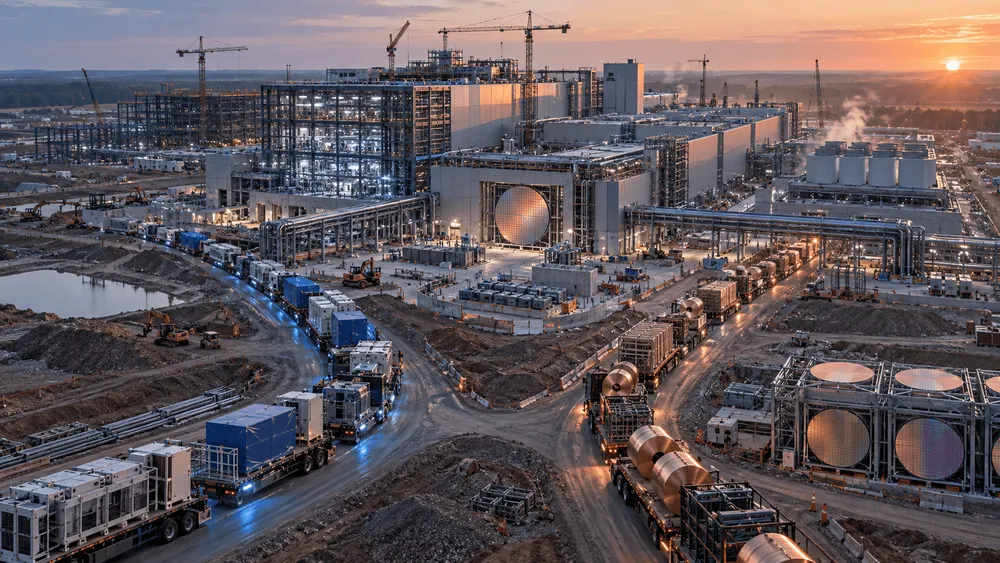
On September 16, 2026, Reuters reported that SK hynix is in talks with Intel about manufacturing memory in the United States. Citing three people familiar with the matter, the report said one option under discussion is for SK hynix to lease part of the semiconductor fab Intel is building in New Albany, Ohio. A joint venture involving Intel and a major cloud company is also said to be on the table. However, the talks are still in an exploratory stage, and neither a final agreement nor the type of memory to be produced has been decided.
If this reporting bears out, it would mark a new phase for SK hynix's US investments. The company's site under construction in Indiana is a back-end facility that receives wafers with circuits already patterned in Korea and handles stacking, packaging, and testing. If Ohio were to handle wafer fabrication as well, it would add front-end capability that has so far been missing from SK hynix's US footprint. But leasing Intel's building wouldn't mean DRAM or NAND production could start immediately. Between the headline and an operating fab lies a long list of unresolved items: tooling, process transfer, yield, and customer qualification.
What's confirmed so far is only that talks exist
According to Reuters, the SK hynix–Intel discussions involve at least two possible structures. One is for SK hynix to lease part of the Ohio fab; the other is a joint venture involving Intel and a major cloud company seeking to secure memory supply, a detail attributed to two sources familiar with the matter. Leasing and joint ownership are fundamentally different arrangements—they determine who owns the equipment and who bears the production risk and takes the output. At this point, it hasn't been disclosed which structure is more likely.
In response to Reuters, SK hynix said it is considering additional production sites but that nothing has been decided. Intel declined to comment on the talks, saying only that it continues to prepare the Ohio site. Neither company has confirmed a signed deal or mass production of memory in Ohio. What both have confirmed is limited to the existence of discussions and ongoing preparation or consideration on each side.
The product itself remains unspecified. Even if the talks are driven by demand for AI-related high-bandwidth memory (HBM), it hasn't been disclosed whether Ohio would produce DRAM dies for HBM or standard DRAM and NAND. HBM requires not only DRAM die fabrication but also back-end processes to stack multiple dies and connect them at high density. Without knowing the specific product, it's impossible to determine the equipment, process generation, or facility scale required.
Ohio's front-end could complement Indiana's back-end
Indiana is set to handle advanced packaging and testing of wafers made in Korea. The Ohio proposal could add domestic memory fabrication to that setup, but the product and process details remain undisclosed.
In late August, SK hynix broke ground on an advanced packaging plant for HBM in West Lafayette, Indiana. The investment exceeds $4 billion, with plans to open a cleanroom by October 2028 and begin mass production of next-generation HBM in the second half of 2029. The company's announcement made clear that advanced wafers manufactured in Korea would be shipped to Indiana for advanced packaging and testing in the US.
In other words, what Indiana localizes are the processes that come after wafer fabrication. The front-end steps—forming DRAM cells and peripheral circuitry on the wafer—remain in Korea. If SK hynix could fabricate its memory wafers in Ohio, some of the semi-finished wafers currently shipped from Korea to Indiana could instead be sourced domestically. That's the significance of pairing front-end and back-end operations within the US.
However, there is no announced plan to ship wafers made in Ohio directly to Indiana. It's also unclear whether the process generations at the two sites would align, or whether Ohio-made wafers would be added to Indiana's customer qualification process. It would be premature to characterize the Ohio proposal as "completing a US HBM supply chain." What can be said is only that, if realized, it could add a front-end option within the US.
Why negotiate now for a fab that won't be ready until 2030 or later
Intel is investing more than $28 billion in Ohio One, building two advanced semiconductor fabs there. Under the plan announced in February 2025, construction of Mod 1 is set to finish in 2030, with operations beginning in 2030–2031. Mod 2 is scheduled for completion in 2031, with operations starting in 2032. Intel has said it could accelerate the timeline based on customer demand, but for now construction is proceeding at a deliberate pace.
In its 2025 annual report, Intel also disclosed that it slowed construction in Ohio to align capacity with demand forecasts. The company further acknowledged that making its massive investment in advanced process technology economically viable would require production volume beyond what its own products alone could generate. Bringing in a major outside user would help turn an unfinished building into an operating asset. Talks with SK hynix or a cloud company would address exactly this challenge.
For SK hynix, using a fab already under construction, rather than acquiring land and building a new one from scratch, could shorten the ramp-up period. But a fab Intel designed for logic semiconductors is not the same as one suited to SK hynix's memory processes. Even if infrastructure like the building, power, and water systems can be shared, that doesn't mean the manufacturing equipment and process design can simply be carried over.
Leasing a building doesn't mean memory can be made
The value of a front-end fab lies not in its floor space but in the combination of equipment and manufacturing procedures that allows consistent, repeatable production at a given quality level. If SK hynix moves into Ohio, it would need to configure lithography and deposition tools, along with etching, cleaning, and inspection processes, to match its target products. How much of the equipment Intel has already ordered can be reused—versus how much SK hynix would need to bring in itself—would significantly affect the additional investment required.
Beyond that, manufacturing procedures established at Korean fabs would need to be reproduced with different equipment in a different building. Even with identical designs, yield can shift due to equipment variation, materials, temperature and humidity, and transport times. It would take repeated trial runs, narrowing down the causes of defects, and raising the yield to a level suitable for mass production. Customers would also need time to qualify quality and reliability for each application. Given Intel's published timeline, these talks are not something that would immediately resolve any near-term memory shortage.
Technology transfer also intersects with South Korean regulations. Under Korea's Industrial Technology Protection Act, transferring National Core Technologies (국가핵심기술)—technologies developed with state support—outside the country requires government approval, and even other technology holders may be required to file advance notifications in certain cases. Until it's determined which technologies would move to Ohio under which contract, the scope and outcome of any government review remain undetermined. Government review could pose an obstacle, but no denial has been decided.
Four disclosures that would signal a real deal
Four pieces of information would indicate whether these talks have moved from exploratory to concrete. First, the specific product and process generation to be manufactured. Second, whether Intel or SK hynix would operate the fab. Third, who would bear the costs of the building and manufacturing equipment. Fourth, the timeline from equipment installation through customer qualification to mass production. If a cloud company joins as part of a joint venture, it would also be worth confirming how much a long-term purchase agreement or upfront payment would reduce investment risk.
With construction already underway in Indiana, SK hynix has set its US HBM back-end plans in motion. What the Ohio talks would determine is whether front-end capability can be added to that existing trajectory. What matters more than the name of any contract is disclosure of which product, whose equipment and technology, and by when it would be shipped as a qualified, finished good.