

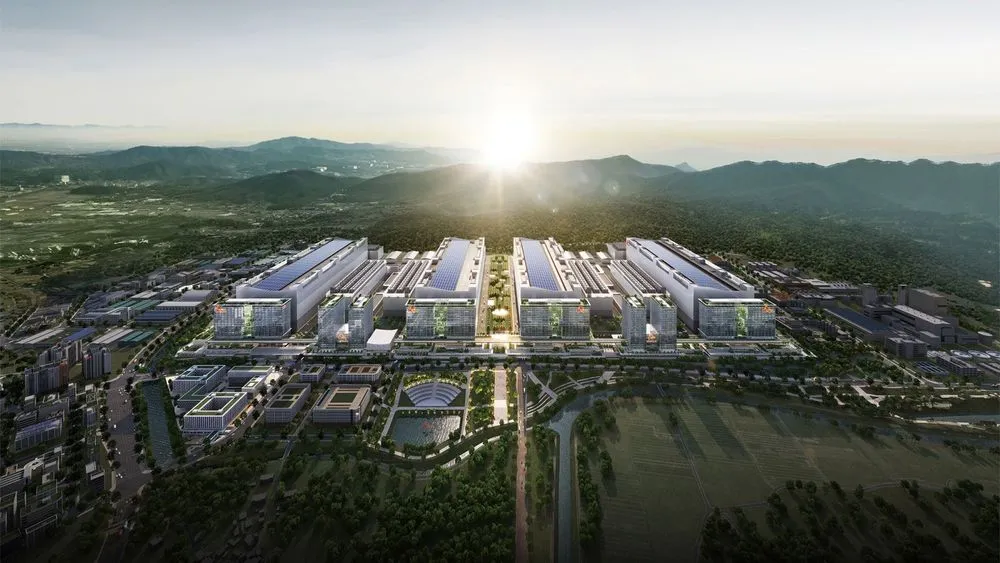
On August 7, 2026, SK hynix's board of directors approved investment in the second fab "Y2" to be built in Yongin, South Korea, and the NAND fab "M17" in Cheongju. The breakdown is ₩35.2 trillion for Y2 and ₩19.1 trillion for M17, totaling ₩54.3 trillion. The long-term vision of ₩1,100 trillion presented in June has now shifted into concrete construction projects with fixed dates for groundbreaking and clean room openings. That said, even once the buildings are complete, manufacturing equipment will still be installed in phases according to demand, so this approved amount does not itself mean a near-term increase in supply.
₩54.3 Trillion: Construction Schedules for the Two Fabs
Y2 is the second of four fabs planned in sequence at the Yongin Semiconductor Cluster, and it will produce next-generation DRAM including HBM. Its total floor area will be 341,000 pyeong, roughly 1.13 million square meters. Groundbreaking is set for July 2027, with the first clean room scheduled to open in June 2029; the investment period runs through October 2031.
The ₩35.2 trillion covers not only the main fab building but also employee management and welfare facilities, as well as an R&D center that will consolidate testing and analysis for product development. Supporting infrastructure includes water treatment facilities and shared utility tunnels, along with substations and warehouses. As of the announcement, the first-phase power and water infrastructure needed to bring Y2 online is already 99% complete.
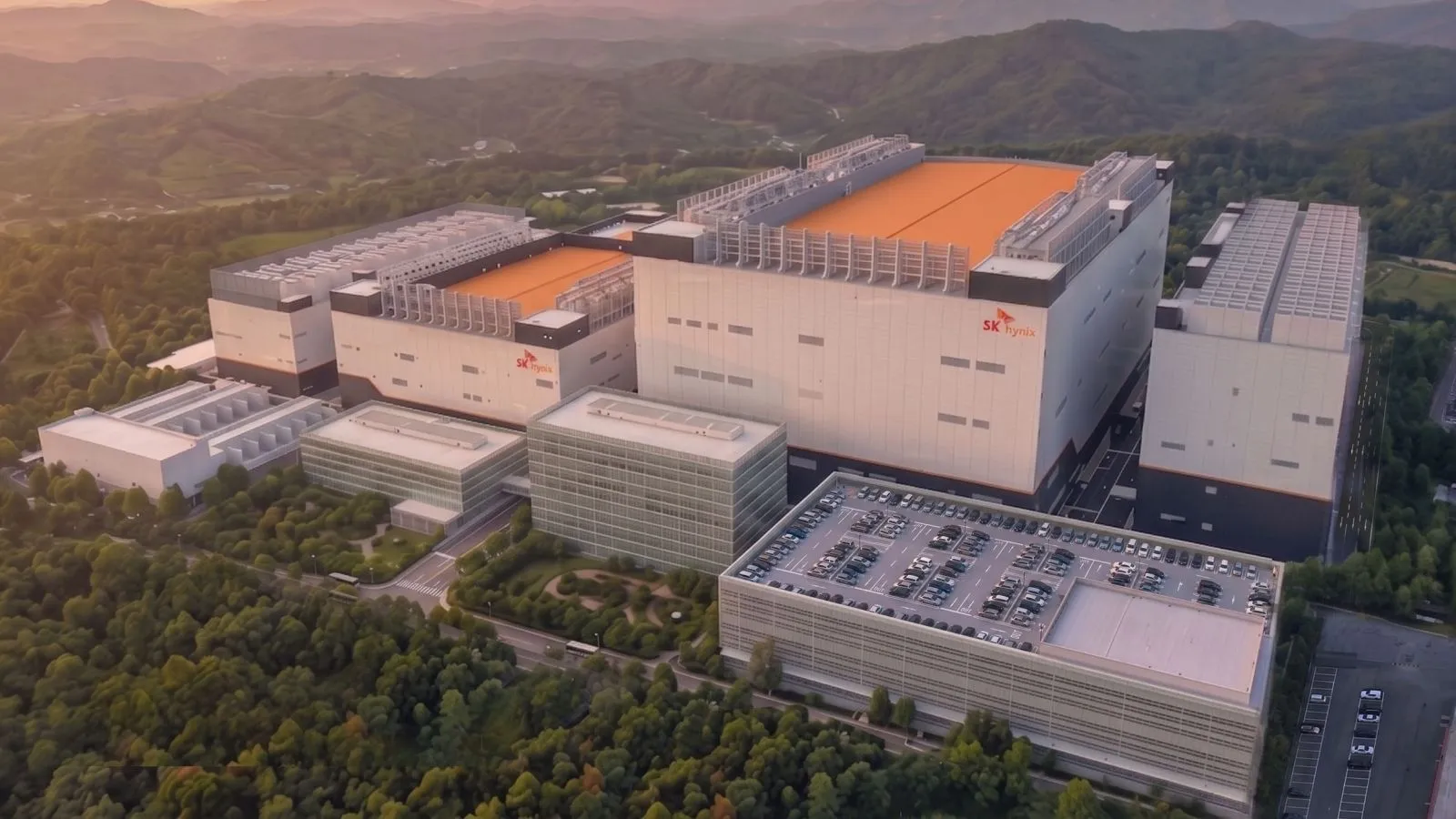
M17 is the NAND fab to be built in Cheongju, with a total area of 206,000 pyeong, or roughly 680,000 square meters. Groundbreaking is planned for February 2027, and the first clean room is expected to open in December 2028; the investment period continues through April 2031. Because M17 will be added to the existing site where M11, M12, and M15 already operate, it can more easily share facilities such as power and water, which is why SK hynix judged Cheongju to be the fastest location to build on.
Although the two projects were approved simultaneously, they serve different markets. Y2 will produce next-generation DRAM including HBM, while M17 will expand NAND output for enterprise SSDs, whose demand is growing alongside the expansion of AI services. With groundbreaking dates and first clean-room opening dates now fixed for each, it becomes possible to track progress against the long-term plan.
The ₩19.1 Trillion for M17 Is Not a Reduction of the Plan
This ₩54.3 trillion is not an amount added on top of the long-term investment announced in June. SK hynix has laid out plans to invest ₩600 trillion in Yongin, ₩100 trillion in Cheongju, and ₩400 trillion in a new site in southwestern Korea, and describes the approvals for Y2 and M17 as the execution of that plan.
Within the ₩100 trillion Cheongju plan, ₩80 trillion had been allocated to M17 and ₩20 trillion to the advanced packaging site P&T7 and others. Therefore, it would be incorrect to interpret the ₩19.1 trillion for M17 announced this time as a reduction from that ₩80 trillion figure. The ₩19.1 trillion is simply the portion approved by the board at this stage, and expansion of clean rooms and installation of manufacturing equipment for the fab as a whole will continue in line with demand.
The opening of clean rooms and the start of mass production also need to be considered separately. While M17's first clean room is set to open in December 2028, the company's plan as of July had targeted the start of operations for the first half of 2029. Since the building, the clean manufacturing space, and the installation and ramp-up of equipment proceed in sequence, these two dates are not contradictory. What determines the actual supply volume is which equipment is installed when, after the building itself is completed.
The Staircase of Expansion: From Y1 to M17 to Y2
The first to open will be Y1, the first fab in Yongin. Its first clean room is scheduled for February 2027, with a total of six clean rooms to be arranged across two buildings. Construction investment is about ₩31 trillion, and the February announcement explicitly stated that this figure does not include manufacturing equipment costs. Cheongju's M15X has also had its mass-production start date moved up, so its ramp-up will overlap with the construction of the new fabs in Yongin and Cheongju.
After that, M17's first clean room follows in December 2028, and Y2's in June 2029. For Yongin, the target for completing construction through the fourth fab has been moved up by 12 years, from 2045 to 2033. However, 2033 is the target for completing the first clean room of the fourth fab; investment in the remaining clean rooms and manufacturing equipment will continue beyond that date.
One reason the DRAM side requires so much fab area lies in how HBM is manufactured. HBM, which stacks multiple DRAM dies using TSV, requires more wafers than ordinary DRAM to produce the same memory capacity. As the share of AI-oriented products rises, the manufacturing resources required grow even faster than bit demand itself. Y2 is meant to absorb this load. Meanwhile, for M17, SK hynix expects storage demand to expand, including demand driven by KV cache usage during inference.
Why Secure the Buildings First
SK hynix cites Omdia's forecast that DRAM and NAND demand will grow at an average annual rate of 19% from 2025 through 2030. In the second quarter of 2026, the company signed long-term supply agreements with about ten major customers, and continued additional negotiations. Being able to work out required volumes with customers several years in advance is what supports the decision to build fabs ahead of time, even though completion takes years.
The financial capacity to carry out this investment is also substantial. At the end of June, cash and cash equivalents stood at ₩88 trillion, with net cash after deducting liabilities at ₩69.4 trillion. At the same time, the company says it will maintain discipline in capital expenditure, and does not plan to convert the entire ₩54.3 trillion into manufacturing capacity all at once. The plan is to build the core structure of each fab on schedule, while adding clean rooms and equipment step by step in line with customer demand.
Under this approach, if demand grows, equipment can be installed into the already-completed space to increase supply. Conversely, if the market slows, the pace of equipment investment can be reduced. That said, Y2 and M17 will not begin production within 2027. The milestones to watch—for determining whether this ₩54.3 trillion investment actually translates into real production capacity—will be M17's groundbreaking in February 2027, Y2's groundbreaking in July of the same year, and then the clean room openings in December 2028 and June 2029.