

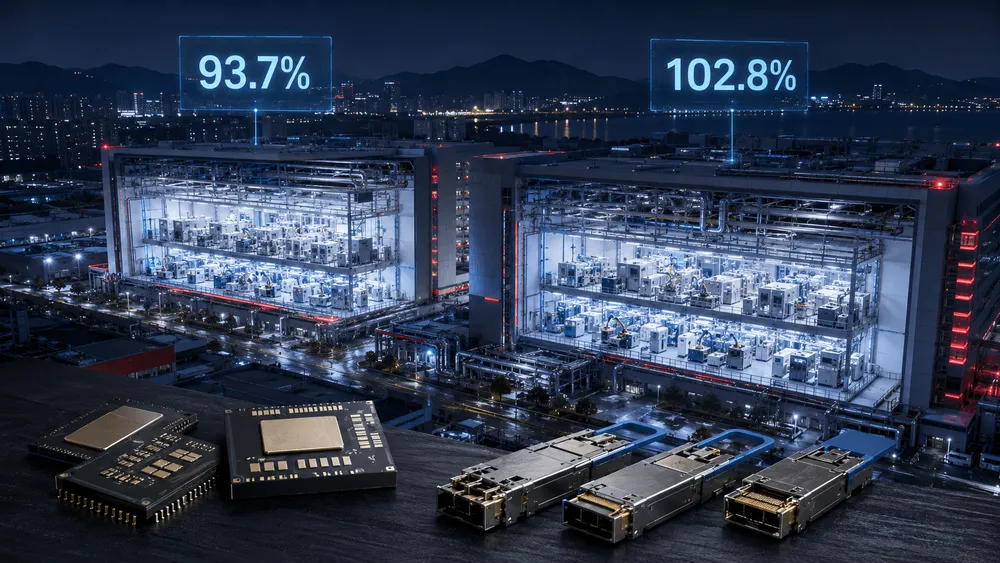
China's two largest foundries, SMIC (Semiconductor Manufacturing International Corporation) and Hua Hong Semiconductor, saw their production lines approach effective ceilings in Q2 2026. SMIC's utilization rate stood at 93.7%, while Hua Hong's reached 102.8%. But these two figures tell different stories. According to South China Morning Post (SCMP) reporting based on SMIC management's explanation, the company's policy of reserving roughly 5% of capacity for R&D purposes sets its ceiling. At Hua Hong, demand growth simply outpaced the rate of capacity expansion. With AI-related demand alongside consumer and industrial demand concentrating on mature and specialty process nodes, the two companies are pursuing different paths to prepare their next tranche of capacity.
93.7% vs. 102.8%: Same Squeeze, Different Meanings
SMIC's Q2 revenue reached $3,005.588 million, up 20.0% quarter-over-quarter. Gross margin also rose from 20.1% to 25.3%. Meanwhile, monthly capacity (in 8-inch equivalent terms) grew only 1.7%, from 1,078,250 wafers to 1,096,500 wafers. Shipment volume rose 14.4% to 2,869,495 wafers, and utilization ticked up 0.6 points to 93.7%. This was a quarter in which the company extracted substantially more revenue from existing lines rather than significantly expanding capacity.
Pricing also played a role. SMIC attributed its revenue growth to shipment volume, average selling price, and product mix, and stated that average selling price and product mix contributed to the gross margin improvement. However, the price increases did not apply across all products. According to SCMP's reporting based on the August 14 earnings call, prices rose for products in short supply, while smartphone-related products and display driver ICs—where demand remained weak—were excluded.
At Hua Hong, capacity expansion failed to keep pace with demand. Monthly capacity (8-inch equivalent) grew 3.9%, from 489,000 wafers to 508,000 wafers, and shipments also rose from 1,453,000 to 1,538,000 wafers. Even so, utilization climbed from 99.7% to 102.8%. This figure of 102.8% does not mean the company exceeded a physical limit; rather, it indicates that actual production surpassed the company's own capacity estimate. The company has not disclosed whether maintenance scheduling, product mix, or yield was the driving factor.
Hua Hong's revenue hit a record $717.537 million, up 8.6% quarter-over-quarter and 26.8% year-over-year. Gross margin improved from 13.0% to 16.5%. The company stated that increased shipments and higher average selling prices drove revenue growth, while price increases and cost reductions offset rising depreciation expenses. The earnings results from both companies show that the supply crunch has begun spreading from volume to pricing.
Demand Expanding Beyond GPUs: Power, Optics, and Memory
At SMIC, the segment that exceeded prior expectations was not the leading-edge process used for AI accelerators, but a different layer entirely. According to SCMP, SMIC Co-CEO Zhao Haijun explained that demand exceeded prior forecasts for logic ICs, power management ICs, and optical module components used in AI servers and data centers. He noted that for the BCD process used in power management, order visibility now extends through the end of 2027. Around every GPU, numerous chips are needed to regulate voltage, handle optical signals, and monitor various devices. Many of these are manufactured not on leading-edge nodes, but on mature and specialty processes refined for voltage tolerance and analog characteristics.
SMIC's product mix also reflects this broadening. In Q2, wafer revenue from consumer electronics accounted for 44.2%, industrial and automotive for 16.5%, and computers/tablets for 15.6%. The share of Chinese customers rose to 90.2%. According to SCMP, Co-CEO Zhao attributed this increase to AI-related demand, orders returning from overseas, and supply chain localization.
At Hua Hong, the product categories facing shortages are even more clearly defined. Revenue from standalone non-volatile memory rose 149.3% year-over-year to $68.8 million, while embedded non-volatile memory grew 41.8% to $200.1 million. Processes at 65nm and below grew 63.4% to $205.1 million, and 12-inch wafers grew 33.5% to $445.7 million. NOR flash, MCUs, and power management products—used across both AI equipment and consumer devices—filled the 12-inch lines.
But demand is not monolithic. At Hua Hong, revenue from consumer electronics grew 34.7% and industrial/automotive grew 25.5%, while communications-related revenue fell 12.8%. SMIC too has products where price increases have not been possible. Interpreting high utilization rates as a blanket supply shortage across the entire Chinese semiconductor market risks misreading how prices will move once new capacity comes online.
SMIC's Spare Space vs. Hua Hong's Fab 9B and Huali Micro
SMIC invested $8.1 billion in 2025, and made capital expenditures of $1,835.7 million in Q2 alone. Yet the increase in monthly capacity by quarter-end was just 1.7%. While investment amount and capacity growth within the same period cannot be linked one-to-one, the numbers make clear how much time is required to build facilities, install equipment, and qualify processes and customer products. According to SCMP, the company is considering a plan to add equipment into spare space at existing facilities. The scale, target processes, and timing of operation have not yet been disclosed.
Hua Hong, meanwhile, is pursuing construction and acquisition in parallel. The publicly announced plans are as follows:
| Plan | New Capacity or Acquisition Target | Current Status and Timeline |
|---|---|---|
| Additional equipment at SMIC's existing fabs | Undisclosed | Under consideration. Details to be announced in the future |
| Wuxi Fab 9B | 55,000 wafers/month (12-inch) | Construction completion target: January 31, 2027. Equipment installation, process qualification, and customer certification to follow |
| Acquisition of Huali Micro Fab 5 | Existing 38,000 wafers/month (12-inch) | Registration approved by China Securities Regulatory Commission. Not new capacity for the overall market; will be consolidated only after the acquisition is completed |
Fab 9B will make use of existing production and utility buildings, adding new cleanrooms and utility infrastructure. The Wuxi Public Resources Trading Center states the total investment at RMB 4.975 billion. A separate tender notice citing RMB 3.8 billion refers to the estimated value of the EPC (design-procurement-construction) contract, not the total investment. Upon completion, the facility is planned to have 55,000 wafers/month of specialty 12-inch process capacity, but January 31, 2027 marks only the construction completion target—not the start of mass production or full operational capacity.
The Huali Micro acquisition offers a way to bring existing capacity into the group without waiting for new construction. Hua Hong plans to acquire 97.4988% of Huali Micro's shares for RMB 8.2679 billion. On July 6, the China Securities Regulatory Commission approved the issuance of a total of 190,768,392 shares as acquisition consideration, along with fundraising of up to RMB 7.55629 billion. The target, Fab 5, handles 65/55nm and 40nm processes with 12-inch monthly capacity of 38,000 wafers. However, regulatory approval does not mean the deal is complete. Until asset transfer and consolidation are finalized, this capacity cannot be counted as part of Hua Hong's supply.
Looking at these two expansion strategies together, it seems unlikely that a large tranche of new capacity will suddenly appear within 2026. SMIC's additional equipment plan awaits further details, and Fab 9B remains under construction. The Huali Micro acquisition changes ownership and consolidation scope for existing Fab 5 capacity—it is not a transaction that increases overall market supply. In the near term, allocation across existing lines and product-specific pricing will move first in response to the current squeeze.
Will Expanded Capacity Resolve the Supply-Demand Gap, or Trigger Renewed Price Competition?
High utilization does not guarantee a permanent shortage. Hua Hong's full-year 2025 utilization rate of 106.1% exceeded 2024's 99.5%, but the company's annual report also notes the risk that growing domestic supply capacity in China could intensify price competition. Because customer qualification for specialty processes takes time, product categories in short supply and those in oversupply can coexist within the same cluster of fabs. The current pattern of product-specific price increases reflects exactly this dynamic.
Near-term momentum remains strong. SMIC expects Q3 revenue to grow 2-4% quarter-over-quarter, with gross margin projected at 26-28%. Hua Hong forecasts Q3 revenue of $770-780 million, with gross margin of 16-18%. Both companies expect revenue growth in Q3. Notably, SMIC's gross margin guidance exceeds its Q2 actual result, while Hua Hong's guidance range straddles its actual Q2 figure.
The number of completed facilities alone is insufficient to judge the trajectory toward 2027. What needs verification includes: whether SMIC's reported 95% utilization policy—as reported by SCMP—will continue; when the Huali Micro acquisition will be consolidated; and when equipment installation and customer qualification will be completed at Fab 9B. The timing at which new capacity transitions into qualified processes for currently constrained products, combined with shifts in demand composition and competitors' own capacity expansions, will serve as key indicators for whether the current round of price increases proves sustainable.