

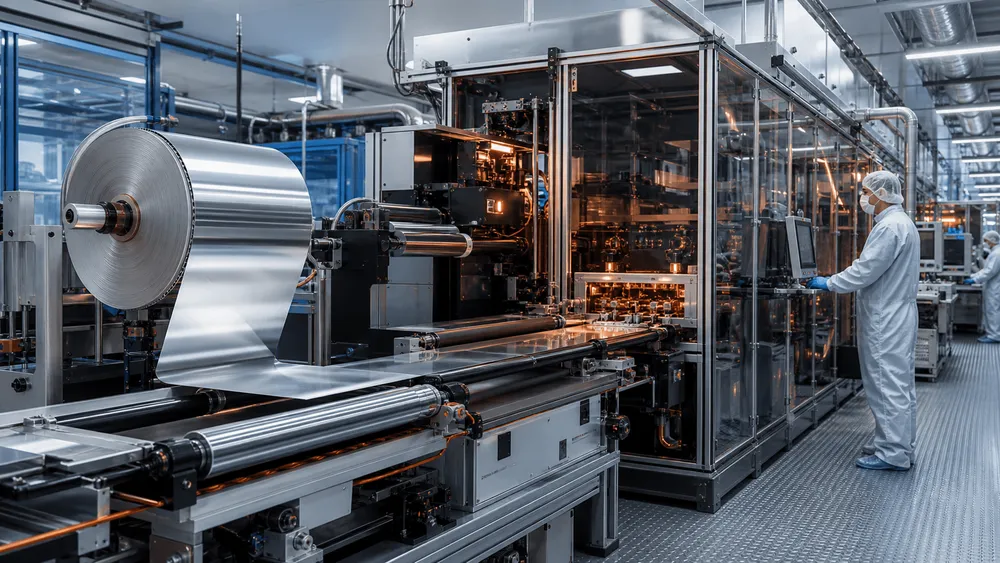
Europe's research and development project "SOLiD" is advancing from the stage of making all-solid-state lithium metal batteries in the lab to continuously manufacturing each layer on pilot equipment. The approach combines a cathode made by dry extrusion with a solid polymer electrolyte coated by roll-to-roll (R2R) processing. Thin-film lithium anodes and in-process defect inspection are also being brought onto the same production line. According to the European Commission's CORDIS, the project—funded with roughly €6.98 million—runs through April 30, 2027. The remaining task is to bring together the results from individual processes into an all-solid-state pouch cell and confirm whether it can hold up as a mass-production process.
SOLiD's Design for Linking Processes Together
What SOLiD is trying to manufacture is a "Gen.4b" cell that combines an NMC811 cathode, a solid polymer electrolyte, and a lithium metal anode. For the cathode, the active material, polymer electrolyte, and conductive additive are mixed in an extruder and processed into a thin film without using any solvent. The electrolyte layer is formed by R2R slot-die coating and UV curing, while on the anode side, lithium is deposited onto copper foil via R2R pulsed laser deposition (PLD).
Conventional wet electrodes require solvent recovery after coating and removal of moisture and solvent residues through long drying ovens. SOLiD's dry extrusion process eliminates this drying step. In a 2024 announcement, VTT stated that dry coating could reduce energy consumption during battery manufacturing by 40%. This is not a result showing a 40% reduction in the environmental footprint of the entire finished cell, but it is a figure that could reshape factory equipment configurations.
According to the official progress update from April 2026, dry cathode extrusion, R2R coating and UV curing of the solid polymer electrolyte, and R2R deposition of lithium metal have all moved to pilot-scale processes. Making one good cell in a lab and continuously coating a wide substrate uniformly present different challenges. Whether variations in film thickness, foreign particles, and interfacial delamination can be suppressed during manufacturing determines the yield needed to reproduce performance.
The 3-10µm Lithium Film and Interface Challenges
For the anode, lithium layers with thicknesses of 3µm and 10µm were fabricated on copper substrates using PLD. The area of sheet samples expanded roughly fourfold, from about 40×60mm² to 100×100mm², while processing time remained largely unchanged, and quality and reproducibility reportedly improved as well. The 5µm target set at the start of the project was a design goal, and it needs to be distinguished from the actual performance figures confirmed here.
While thinner lithium reduces material usage and volume, if contact with the solid electrolyte degrades, resistance increases, and dendrites can grow during charge and discharge. SOLiD uses atomic layer deposition (ALD) and PLD to form inorganic protective layers on the lithium surface, stabilizing deposition and dissolution. The design also forms ALD protective layers on NMC811 particles to suppress side reactions between the high-nickel cathode and the electrolyte.
On the electrolyte side, the April 2026 announcement reported stable operation exceeding 500 cycles in coin cells and single-layer pouch cells using solid polycarbonate-based materials. However, capacity retention rate, charge/discharge rate, and test temperature were not disclosed. In the previous year, with a semi-solid PESDA-based polymer electrolyte tested, a coin cell using an NMC622 cathode and thin-film lithium maintained 95% of its initial capacity after 120 cycles at room temperature. Since the cell format and materials differ, these two figures cannot be compared as a continuous performance improvement.
Inspection Down to 5µm Particles, Control Still to Come
To prevent defects from carrying over into later processes during continuous production, SOLiD detected 5µm particles using laser speckle photometry. It has also developed a system that creates 3D maps of the electrode surface from line-camera images to identify holes and foreign particles. Furthermore, optical monitoring of the liquid meniscus at the slot-die tip has been implemented, and an electrochemical impedance spectroscopy (EIS) inspection system has been integrated into the roll equipment.
These measurements are planned to be gathered into a digital twin, which would adjust process conditions based on the results. As of April 2026, the inspection equipment had been integrated into the pilot line, but closed-loop control using feedback was still in final adjustment. There remains a gap between the capability to detect defects and the capability to automatically correct coating or curing conditions based on measurement results.
Evaluation of the manufacturing process also includes environmental impact. In a life-cycle assessment of a reference cell using liquid electrolyte, dry room operating energy accounted for over 70% of the climate change impact, while cell manufacturing accounted for over 20-25%. How much SOLiD's dry process can shrink the dry room requirements will be a manufacturing consideration alongside electrode performance. However, comparative evaluation against all-solid-state cells has not yet been completed.
Will the All-Solid-State Pouch Cell Determine the Move to Mass Production?
As a benchmark for comparison, the project fabricated Gen.2b pouch cells using an NMC622 cathode, graphite anode, and liquid electrolyte in 1Ah and 10Ah formats. By April 2026, reference cells of up to 10Ah had been assembled, but this is not an achievement of the all-solid-state cell itself. It serves as a yardstick to measure how much the all-solid-state prototypes to be built going forward can exceed this in performance and safety under the same test conditions.
Breaking down the current status and remaining verification by process clarifies the differences in progress achieved.
| Process | Confirmed by 2026 | Remaining Before Mass-Production Decision |
|---|---|---|
| Cathode | NMC811 composite dry-extruded, moved to pilot process | Film thickness uniformity and yield in long-run coating |
| Electrolyte | R2R slot-die coating, UV curing, charge/discharge in single-layer pouch cells | Lifespan and interfacial stability in multi-layered all-solid-state cells |
| Lithium Anode | Fabrication of 3µm and 10µm films, demonstration of R2R PLD | Dendrite suppression and safety after stacking |
| Quality Control | 5µm particle detection, 3D surface measurement, in-line EIS | Closed-loop control feeding measurements back into the process |
The four processes are not at the same level of maturity. The cathode, electrolyte, and anode have moved to continuous processing, and inspection equipment has begun operating, but long-term testing of the all-solid-state cell formed by stacking these layers remains a later-stage task. Lining up the best individual results from each process does not determine the overall yield of the production line or the lifespan of the cell.
The volumetric energy density exceeding 900Wh/L that CORDIS sets as a target also remains just that—a target—at this point. Regarding the ionic conductivity of the solid polymer electrolyte, official materials describe it as "approaching" 0.5mS/cm for binder use and 0.1mS/cm for separator use at 30°C, without declaring these as achieved. Being able to produce thin individual layers and having a stacked cell from those layers operate stably over the long term are separate matters requiring separate verification.
SOLiD's achievement lies not in the start of all-solid-state battery mass production, but in the fact that the equipment and comparison benchmarks needed to gauge the feasibility of mass production have begun to come together. If, by April 30, 2027, the assembly and safety testing of all-solid-state pouch cells, closed-loop control, and environmental comparison with reference cells are all in place, the figures necessary for a decision to industrialize this manufacturing method in Europe will, for the first time, all be lined up.