

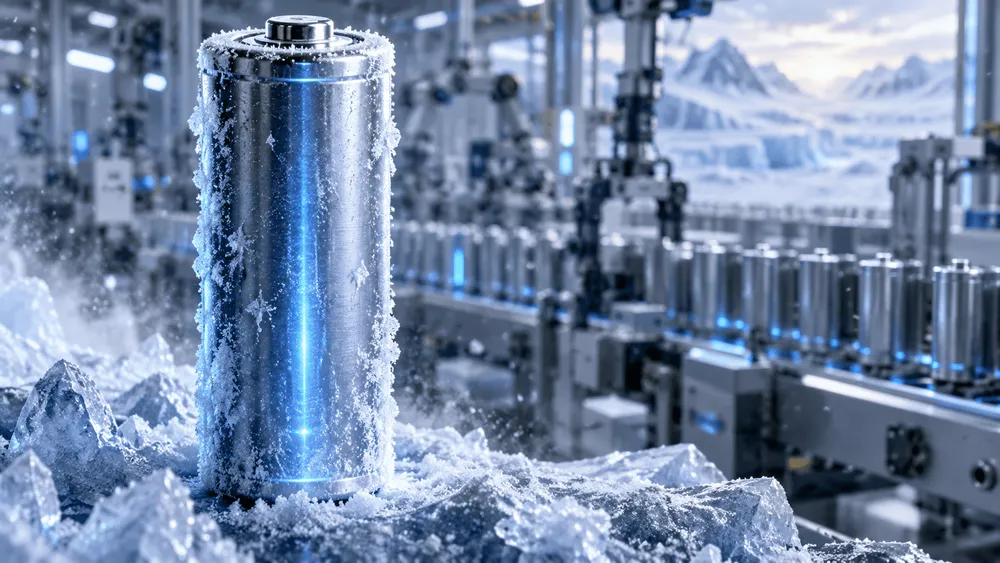
US battery maker South 8 Technologies announced on September 24, 2026, that it has started operating a semi-automated manufacturing line for cold-weather lithium-ion cells in San Diego, California.
The line makes the ARCTIC AE35, a cylindrical cell that uses South 8's proprietary liquefied-gas electrolyte, LiGas. The company plans to expand it to a line with an annual cell production capacity of 5 MWh in 2027.
The move is a step toward supplying more cells to customers prototyping in the defense sector. However, the company has not yet disclosed current production volumes or any figures showing formal adoption as standard equipment.
5 MWh per year is a 2027 target, not current output
What South 8's announcement confirms is that the new semi-automated line in San Diego has begun operating.
The "5 MWh per year" figure is the annual cylindrical cell production capacity the company expects the line to reach in 2027. It does not mean that 5 MWh worth of cells had already been produced and shipped as of September 2026. The announcement also does not disclose current production volumes, yields, or the number of cells delivered.
MWh is a unit of the amount of energy a battery can store. Here, 5 MWh per year refers to the combined energy content of the cells produced in a year.
It does not mean building one 5 MWh energy storage system, nor does it mean supplying 5 MW of power continuously.
On numbers alone, this is small compared with large EV battery plants, but South 8 is targeting batteries for defense and specialty uses in extreme low-temperature environments. The market differs in nature from that for mass-produced automotive cells.
The PowerForward grant agreement with the State of California that the company announced in April also shows how the company arrived at this expansion.
The grant is worth $9.2 million. At the time, South 8 planned to expand to a setup capable of producing 100 MWh per year of LiGas electrolyte and 2 MWh per year of battery cells.
| Announced | Item | Scale | Status at announcement |
|---|---|---|---|
| April 2026 | Battery cells | 2 MWh/year | Production expansion plan using the grant |
| April 2026 | LiGas electrolyte | 100 MWh/year equivalent | Electrolyte production expansion plan |
| September 2026 | Cylindrical cells including AE35 | 5 MWh/year in 2027 | Capacity targeted after the new line begins operating |
The 2 MWh per year cited in April was the cell production expansion plan at the time, while the 5 MWh per year now is the capacity targeted for 2027. Neither indicates current shipment results.
It is also unclear whether the plan for the same equipment changed from 2 MWh to 5 MWh between April and September, or whether the new figure includes additional equipment. It is therefore not possible to conclude simply that production capacity has grown 2.5-fold.
The 100 MWh per year figure for LiGas measures electrolyte production capacity, a separate metric from annual cell output.
What a liquefied-gas electrolyte changes at low temperatures
The AE35 is an 18650-format cylindrical cell.
Instead of a conventional liquid electrolyte, South 8 uses LiGas, a proprietary electrolyte made by liquefying a gas under pressure. According to the company's product page, LiGas is injected into the cell with dedicated equipment and stays liquid after sealing thanks to the pressure inside the cell.
South 8 says it offers not only finished cells but also an electrolyte injection system for introducing LiGas into existing cylindrical cell production lines.
In ordinary lithium-ion batteries, lower temperatures make it harder for lithium ions to move through the electrolyte, reducing available power and degrading charging performance.
South 8 aims to ease this problem by exploiting LiGas's resistance to freezing down to very low temperatures.
The announcement says the AE35 can charge and discharge from −60°C to +60°C. For drones and communications equipment used in extreme cold, this could reduce the need for heaters to warm the battery and the power they consume.
However, being able to operate at −60°C is different from delivering the same performance at −60°C as at room temperature.
The materials South 8 has published this time contain no detailed data on how much capacity is retained at −60°C, what current levels the cell can charge and discharge at, how long it can run continuously, or how degradation changes with repeated cycling.
The materials available also include no third-party test results comparing the AE35 with other manufacturers' cells under identical conditions.
The low-temperature properties of the LiGas electrolyte itself should therefore be considered separately from the performance of finished cells and battery packs that use it.
Defense work is still at the prototyping and evaluation stage
Batteries for polar use require not only low-temperature performance in the cell itself but also suitable protection circuitry, enclosures, and compatibility with the equipment they connect to.
The customers South 8 named this time are Australia's 3ME Technology and defense equipment company Galvion. Both are working to bring LiGas-based battery systems into practical use, but neither has confirmed volume adoption at this point.
In February 2026, 3ME signed a letter of intent with South 8 to jointly develop cold-weather battery systems.
Afterward, its portable power system EdgeVOLT was selected for a prototype program of the US Defense Innovation Unit (DIU), and a cold-weather version using South 8 cells is to be prepared for evaluation.
This, however, is a stage of delivering prototypes for evaluation. It does not mean that a cold-weather version using South 8 cells has been adopted in volume as formal equipment by the US military or others.
South 8 signed a letter of intent with Galvion in November 2025 to pursue joint research, product development, and field testing of technology for extreme-cold environments.
The latest announcement also names Galvion as a defense customer, but it does not say which specific product will carry the AE35 or how many will be purchased.
The mention of 3ME and Galvion therefore cannot be taken as confirmed order volumes or volume contracts.
Making cells in the US alone does not meet sourcing requirements
South 8 has started the cell production line in San Diego and plans to expand LiGas electrolyte production at the same site. It also says it has signed supply agreements for key cell materials and components.
The background is US regulation of Department of Defense battery procurement.
10 U.S.C. § 4865 phases in restrictions on procuring military batteries, their components, and related technology from certain foreign entities or companies under their influence.
The restrictions apply from January 1, 2028, for new procurement programs, January 1, 2029, for standard commercial batteries, and January 30, 2031, for existing programs.
The key point is that assembling the final cell in the US is not enough to meet the requirements.
The law also covers cathode and anode materials and separators, as well as electrolyte solvents, additives, salts, and internal safety components of the cell.
In other words, to supply defense uses, it is necessary to verify not only where the finished battery is made but also where the key materials, components, and technology come from.
South 8's announcement likewise says only that it offers a path toward compliance with these US procurement requirements.
As of now, it has not been disclosed that the AE35 has been certified as meeting specific procurement requirements, nor has the country of origin of all the materials and components the company has contracted for been made public.
The significance of the new line is that it starts building a capability to produce, in the US on a continuing basis, lithium-ion cells intended for extreme low-temperature environments.
The points to watch are how far actual production rises toward the 5 MWh per year target, what results come out of evaluations of cold-weather battery packs, and how much more is revealed about where key materials are sourced.
Once that information is available, defense customers will find it easier to judge whether to adopt the cells, taking into account not only low-temperature performance but also US procurement requirements.