

In the first half of 2026, Alphabet, Meta, Microsoft, and Amazon together poured over $200 billion in capital expenditure into AI infrastructure. Line up GPUs, run power, pump cooling water—this repeated cycle has driven the expansion of AI compute capacity. But now a different constraint stands in the way: power grid capacity, land availability, cooling water supply, and construction permits. The cost and time required to build data centers on the ground can no longer keep pace with the growth in AI demand.
The idea of bypassing these constraints by moving into space is not new. But when SpaceX acquired xAI in February 2026 and, later that same month, filed an application with the FCC for up to one million "orbital data center satellites," the concept landed on a regulator's desk for the first time. The filing document contained the phrase "a first step toward a Kardashev Type II civilization"—a declaration that a satellite constellation would mark humanity's first step toward a civilizational stage capable of harnessing the full energy output of a star.
Then, on August 4, during its first earnings call since going public, SpaceX carved a specific silicon name into that vision.
"NVIDIA and Only NVIDIA" Sends a Crack Through the AI Chip Market
On the earnings call, Elon Musk stated unequivocally that SpaceX would consolidate its AI compute infrastructure entirely around NVIDIA. "We believe the Vera Rubin architecture is the best architecture. It's the best AI computer, and we greatly value our multi-layered partnership with NVIDIA. That's why we're going exclusively with NVIDIA."
That same evening, Musk posted on X: "SpaceX has decided to exclusively use NVIDIA GPUs, because they are the best."
The declaration moved the market instantly. NVIDIA shares rose 4%. AMD, meanwhile, despite reporting record quarterly revenue of $11.5 billion that same day (up 50% year-over-year), saw its stock drop 8%. Intel fell 1% as well. For AMD, which had been pitching its next-generation AI chip, the Instinct MI450, as an alternative for hyperscalers, losing one of its biggest potential customers carries significant weight.
It's unusual for a major tech company to narrow itself to a single supplier. Supply disruption risk, loss of pricing leverage, technology lock-in—the conventional wisdom is to diversify across multiple vendors. What upended that convention, according to Musk, is that SpaceX will receive a "substantial percentage" of NVIDIA's GPU output next year. In other words, SpaceX is not just a customer—it's becoming a force that will shape NVIDIA's revenue composition.
One NVIDIA Rack in Orbit: The Design Philosophy of Starmind AI1
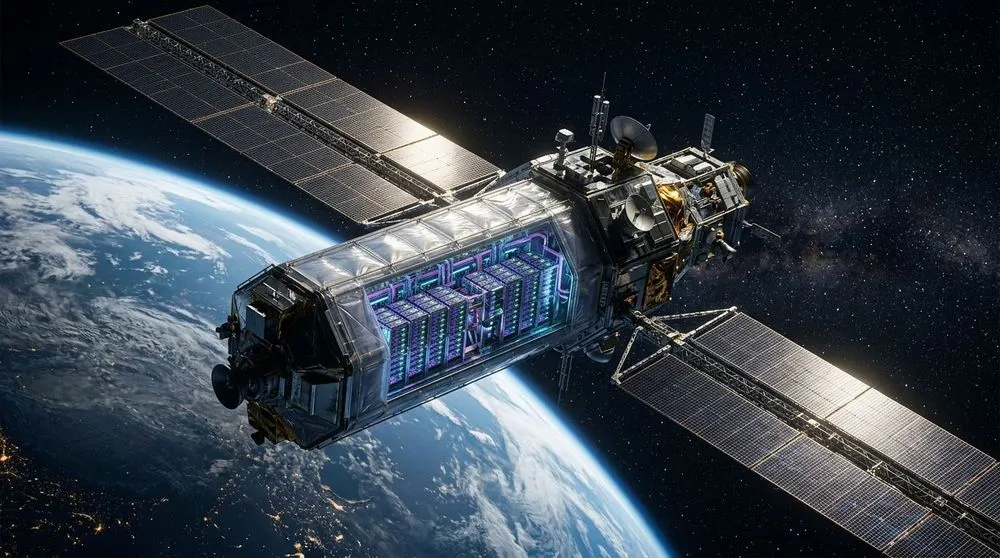
On the same day as the exclusivity announcement, SpaceX revealed via its official X account that it would co-design the compute payload for Starmind AI1 with NVIDIA. Each satellite will carry NVIDIA Rubin GPUs and Vera CPUs, delivering what the company calls "datacenter class space compute."
The specifications SpaceX released for Starmind AI1 represent a scale that dwarfs conventional communications satellites by orders of magnitude.
| Item | Starmind AI1 | Conventional Starlink V2 Mini Satellite (for reference) |
|---|---|---|
| Full deployed height | 30 m | approx. 4 m |
| Wingspan (solar array) | 75 m | approx. 23 m |
| Compute payload power | Peak 250 kW / Average 175 kW | Several kW |
| Power density | 75 kW/ton | N/A |
| Onboard chips | NVIDIA Rubin GPU + Vera CPU | ASIC for communications relay |
Each satellite is designed to power a single NVIDIA Vera Rubin NVL72 rack (power consumption of 190–230 kW). The NVL72 links 72 Rubin GPUs and 36 Vera CPUs via sixth-generation NVLink (260 TB/s bandwidth), delivering 3,600 PFLOPS of NVFP4 inference performance per rack. It weighs roughly 1,800 kg (4,000 pounds)—about the size of a pickup truck. This is what will be carried into orbit, powered by sunlight, and made to dissipate heat into a vacuum.
Cooling is the biggest technical hurdle. Ground-based data centers shed heat through convection—air or water flow—but there's no convection in space. A large radiator is required to release heat as infrared radiation. NVIDIA CEO Jensen Huang acknowledged at GTC in March that the cooling mechanism remains unfinished, saying, "In space there's no conduction, there's no convection. There's just radiation. And so we have to figure out how to cool these systems out in space." SpaceX has adopted a design for Starmind AI1 that includes a deployable liquid cooling system covering approximately 160 square meters.
Radiation protection is also necessary. Space radiation can cause computation errors in chips. NVIDIA's Space-1 Vera Rubin Module may support lockstep processing, in which two chips run the same calculation redundantly and cross-check the results. Presentation materials at GTC showed a rendering of a module equipped with two Vera Rubin chips.
According to NVIDIA, the Space-1 Vera Rubin Module delivers up to 25 times the space inference performance of an H100 GPU. NVIDIA claims the ground-based Vera Rubin NVL72 delivers 10 times the inference performance per watt, one-tenth the cost per token, and requires only one-quarter the number of GPUs for training compared to the previous Blackwell generation.
| Metric | Blackwell Generation | Vera Rubin Generation | Improvement Factor |
|---|---|---|---|
| Inference performance/watt | Baseline | 10x | 10× |
| Cost per token | Baseline | 1/10 | 10× |
| GPUs required for training | Baseline | 1/4 | 4× |
| Space inference performance (vs. H100) | Baseline | 25x | 25× |
What the Numbers Say About SpaceX's Transformation Into an AI Company
Behind the Starmind vision lies a dramatic shift in SpaceX's financial structure. The second-quarter 2026 earnings report, released on August 4, marked the company's first earnings disclosure since going public.
Revenue came in at $7.81 billion, up 92% from $4.1 billion in the same period a year earlier, beating analyst expectations of $6.93 billion. Net loss was $541 million ($0.09 per share), narrowing from $1 billion ($0.34 per share) a year earlier—though the company has yet to turn a profit.
The AI division drove the growth. Quarterly AI revenue of $2.56 billion was up 213% from the previous quarter and 247% year-over-year, fueled by cloud hosting agreements with Google and Anthropic, as well as subscription revenue from Grok and X. CFO Bret Johnsen said that an additional $6.7 billion in cloud service revenue would begin being recognized starting in October, and projected the company would reach an annualized run rate of $100 billion in revenue by year-end.
On the other hand, the surge in capital expenditure spooked investors. Quarterly CapEx reached $18.37 billion, 6.5 times the $2.83 billion spent in the same period a year earlier. Of that, direct investment in AI infrastructure totaled $15.83 billion, a 21-fold increase from $749 million a year earlier. Following the earnings release, SpaceX shares fell about 8% in after-hours trading. Having listed at $150 on June 12 and peaked at $225.64 in mid-June, the stock closed at $125.33 on August 4—wiping out more than $1 trillion in market capitalization since the IPO.
Adding to the pressure, the insider lockup from the IPO is set to expire on August 7, releasing roughly 912 million shares onto the market. That would roughly double the number of publicly tradable shares, and selling pressure is expected to persist for the time being.
Three Uncertainties Remaining on the Road to One Million Satellites
SpaceX has set a target of securing 2 GW of compute capacity by the end of 2026 and 10 GW by the end of 2027. In an internal email, Musk wrote that "within two to three years, the cheapest way to compute AI will be in space." The math behind this: if Starship can launch 200 tons per flight and deliver 1 million tons to orbit annually, and each ton supports 100 kW of compute, that would add 100 GW of AI compute capacity per year.
However, at least three unresolved problems remain on this path.
First, regulation. The FCC accepted SpaceX's application on February 4, 2026, but has not yet issued a final ruling. A constellation of one million satellites would far exceed the scale of any existing satellite network, and there is no precedent for reviewing an application of this magnitude.
Second, technology. The cooling mechanism remains unfinished, and radiation countermeasures have yet to be verified. Prototype testing for Starmind AI1 is scheduled for early 2027, with mass production planned for later that year. A timeline of under two years from design to mass production is unusually fast for a spacecraft—and correspondingly carries a high risk of delay.
Third, economics. Johnsen claimed that the payback period for AI hardware investment would be "well under a year," but no independent verification exists comparing the manufacturing, launch, and operating costs of spacecraft against ground-based data centers. SpaceX plans to build a "Gigasat Factory" in Bastrop, Texas, to mass-produce AI satellites by the thousands starting in the second half of 2027—but yield rates and unit cost projections have not been disclosed.
Marlon Sorge, a technical expert at the Aerospace Corporation, has warned that the 800–1,000 km orbital band still contains more than 3,000 pieces of debris left over from China's 2007 anti-satellite test. "If you add debris at that altitude, it doesn't go away. If something goes wrong, it stays there," he cautioned.
At the opening of the earnings call, Musk said SpaceX is doing "very big things." Whether that scale of ambition will generate returns commensurate with a $1.75 trillion market capitalization remains to be seen. The answer won't come until the 2027 prototype reaches orbit.