


Since the invention of the laser, much of optical technology has been built on the assumption of "coherent light," in which the phase is aligned. In optical communications, optical computing, and interferometric measurement, light with an ordered wavefront is easy to handle, and its behavior is easy to predict theoretically. By contrast, starlight that has passed through atmospheric turbulence, light that has traveled through a scattering medium, and light mixed from several independent sources all become "partially coherent light," in which the phase correlations among the light's components are partly lost. This imperfect coherence lowers interference-fringe contrast and degrades information transfer, so conventional optical systems have mostly treated it as an undesirable property.
From the standpoint of statistical optics, however, partially coherent light is not mere disordered noise. If you mathematically diagonalize the "coherency matrix," which expresses the statistical correlations among the components of the electric field, you can decompose the light field into independent spatial modes with no statistical correlation to one another, known as "coherence modes." In theory, extracting these eigenmodes individually makes it possible to use the information carried by a complex, mixed light field. Yet no one had demonstrated a technique that performs this matrix diagonalization directly in optical hardware and physically separates the light into different output ports. Conventional optical tomography must numerically reconstruct the coherency matrix from light intensities obtained in different measurement bases, and it cannot extract the light itself mode by mode.
In a paper published online in Nature Photonics on October 30, 2026, a research team including Paul-Alexis Mor and Anne R. Kroo of Stanford University and elsewhere demonstrated this theoretical concept on a silicon photonic integrated circuit. Using a mesh of Mach-Zehnder interferometers (MZIs), the team developed a processor that automatically finds the eigenmodes of unknown partially coherent light and routes each into an independent waveguide. The result shows that the statistical correlations of light can be analyzed directly on a chip, and that the separated light can be fed straight into subsequent optical processing.
Decomposing Light Into Orthogonal Eigenmodes, Not Recovering the Sources
The key point in understanding this research is that the chip does not recover the original light sources individually. For example, when light from multiple lasers or celestial objects is mixed together, the chip does not simply extract the light emitted by each source. What it performs is "diagonalization," a mathematical eigenvalue decomposition of the light field's coherency matrix, which is a different process from so-called blind source separation.
The coherency matrix , which expresses the statistical correlations of the electric field, is a Hermitian matrix, and its eigenvectors define the coherence modes. These eigenmodes are spatially orthogonal to one another and statistically uncorrelated, that is, mutually incoherent. The optical power carried by each mode is given by the corresponding eigenvalue. Diagonalizing the coherency matrix therefore amounts to decomposing the light field into independent modes that do not interfere with one another and determining the optical power each carries.
For example, if two independent laser beams whose spatial distributions are not mutually orthogonal are input, the coherence modes the chip extracts will generally contain components of both beams. The separated eigenmodes match the original laser beams only when the two input beams are spatially orthogonal from the start. In other words, this circuit is not a device for identifying the sources of light, but one that decomposes a given light field into statistically independent orthogonal modes.
The idea itself is not new. A prior study published in Light: Science & Applications in 2024 presented a theoretical framework, mainly through numerical simulation, for separating and synthesizing coherence modes using a self-configuring optical network. The significance of the present work is that it implemented the concept on a silicon photonics chip made at a semiconductor foundry and verified its operation with real light.
With conventional optical tomography, the measurement result is a coherency matrix on a computer. The new photonic integrated circuit, by contrast, routes the eigenmodes into physically distinct waveguides. Because the separated light continues to propagate on the chip, it can be phase- or amplitude-modulated downstream, or fed into an optical neural network or a communications receiver. The major difference from conventional methods is that it can not only analyze the state of light as numerical data, but also physically extract the light corresponding to the result of that analysis.
The 8×2 Interferometer Network and Frequency-Multiplexed Dithering
The team used two independent tunable semiconductor lasers at a wavelength of about 1,534.65 nm to generate partially coherent light with no temporal correlation between the beams. It sent this light into the chip to test whether the coherence modes could be extracted. The experiments used precisely controlled laser light; they did not directly test imaging in natural environments or astronomical observation.
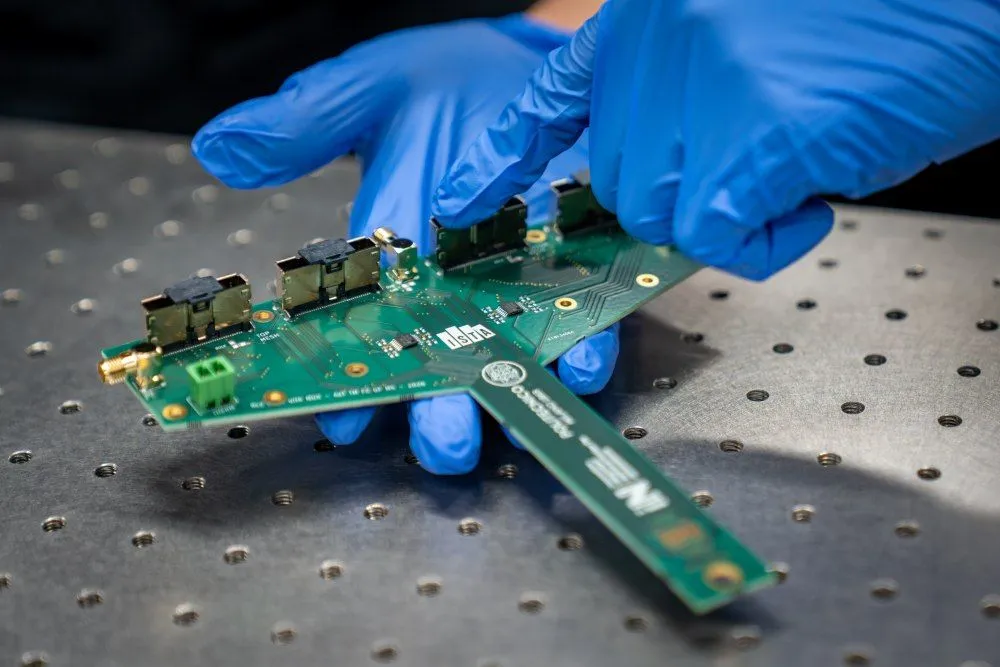
The chip was fabricated on a silicon-on-insulator (SOI) substrate with a 220-nm-thick crystalline silicon layer. It was manufactured by Advanced Micro Foundry in Singapore using a 193-nm deep-ultraviolet (DUV) lithography process. Light is carried by single-mode silicon wire waveguides about 500 nm wide, surrounded by a silicon dioxide (SiO₂) cladding.
To couple light in from free space, nine grating couplers were placed on the chip. Adjacent couplers are spaced about 50 μm apart, and light is incident at about 11 degrees, the designed optimal angle. Inside is a reconfigurable interferometer network in which 2-input, 2-output MZIs are connected hierarchically. The network has a two-layer cascade structure: the first layer extracts one mode, and the remaining light components orthogonal to that mode are passed to the second layer.
The circuit itself has a 9-input, 2-output configuration, but in the paper's main experiment one of the nine inputs was deliberately left unused, and some MZIs in the final stage were repurposed to measure interference between the outputs. In practice, it therefore operated as an 8-input, 2-output (8×2) processor.
The eight input spatial modes first pass through the self-configuring MZI network of the first layer. Here the circuit is tuned to maximize the optical power gathered at output port 1, extracting the first coherence mode, which corresponds to the largest eigenvalue. The remaining light components orthogonal to the extracted mode are sent to the second layer, where the same optimization guides the second eigenmode to output port 2.
Each MZI incorporates a thermo-optic phase shifter made from a titanium nitride (TiN) thin-film resistive heater. The heaters measure about 2 μm × 120 μm with a resistance of about 780 Ω, and applying about 20 mW produces a phase change of π radians. Isolation trenches are also placed around the heaters to limit thermal influence on neighboring elements.
The mechanism by which the circuit automatically finds coherence modes is based on variational optimization that maximizes output optical power. Finding the largest eigenvalue of the coherency matrix can be expressed mathematically as maximizing the Rayleigh quotient. The team searched for the mode corresponding to the largest eigenvalue by adjusting the MZI phase settings in the direction that increases optical power. However, the optimization problem over the phase-shifter settings is generally not convex, so this does not mean convergence to the global optimum is guaranteed under arbitrary conditions.
To efficiently tune up to 14 phase shifters in each layer, the team adopted a technique called "frequency-multiplexed dithering." In this method, a small sinusoidal voltage at a different frequency is applied to each phase shifter, and their effects are measured simultaneously. In the experiment, signals centered around 30 Hz and spaced about 0.5 Hz apart in frequency were applied to the individual phase shifters.
Demodulating the output signal captured by the photodetector at each drive frequency yields the influence of each phase parameter on the output optical power individually. This makes it possible to estimate the gradients of the output power with respect to all phase parameters ( and ) simultaneously in a single measurement step, without preparing a detailed mathematical model of the circuit in advance. The resulting gradient information is sent to an external control system, and the phase settings are updated iteratively by the optimization algorithm Adam.
When the first layer's optimization is complete, the coherence mode corresponding to the largest eigenvalue is gathered at output port 1. With those settings fixed, the second layer performs the same process on the remaining orthogonal subspace and guides the second eigenmode to output port 2. With this staged structure, each layer searches only the components orthogonal to the modes already extracted.
To check whether the two extracted modes were actually mutually incoherent, the team also incorporated a test 2×2 MZI that couples the output waveguides. If the phase of one arm of this interferometer is varied while the light intensity is measured, interference fringes appear whenever mutual coherence remains between the output beams. In the experiment, the fringe contrast (visibility) was observed to vanish as the optimization progressed. This is direct experimental evidence that the output optical power was not merely maximized, but that the two output beams were separated into statistically uncorrelated modes.
Accuracy Evaluation Limited to Four Input Ports, and the Measurement Conditions
To evaluate the accuracy of the partially coherent light analyzer (PCLA) they developed, the team also implemented a comparison method called "mixture tomography" on the same chip.
In mixture tomography, the two lasers are not switched on simultaneously but one at a time. With single-laser coherent light input, the complex amplitude vector of each beam is measured using existing self-configuring interferometer techniques. The coherency matrix is then numerically reconstructed from the two separately measured state vectors and used as the reference for evaluating the PCLA's results.
This method is available only in a laboratory setting where the lasers can be controlled individually. The PCLA, in contrast, finds the eigenmodes with both lasers input at the same time, so there is no need to manipulate the original sources individually.
One caveat in assessing accuracy is that the detailed comparison shown in Figure 2 of the paper was performed with only four input ports, not all nine on the chip. Under this four-input condition, the fidelity of the eigenvectors found by the PCLA reached 97.8% for the first layer and 99.9% for the second. The estimation errors for the optical power corresponding to the eigenvalues were 0.29% for the first layer and 3.11% for the second.
| Method | Measurement approach | Result obtained | Role and limitations in this study |
|---|---|---|---|
| Projective tomography (conventional) | Switch among multiple measurement bases in sequence, measure light intensity, and reconstruct the matrix numerically | Coherency matrix as numerical data | Cannot physically separate the light; generally requires measurements for $N$ modes |
| Mixture tomography (comparison reference) | Switch on the lasers one at a time, measure each coherent state, and combine them | Coherency matrix as numerical data | Reference for comparison, premised on a laboratory setting where each source can be controlled individually |
| PCLA (technique demonstrated here) | Input both beams simultaneously and extract eigenmodes through frequency-multiplexed dithering and variational optimization | Light separated into independent waveguides, plus eigenmodes obtained from the phase settings | Physically separates light while preserving it, and searches for modes by exploiting low-rank structure |
These figures, however, do not represent statistical yield or performance variation obtained by evaluating many fabricated chips. In the representative optimization reported in the paper, all MZIs were initialized to a 50:50 coupling ratio, and 200 epochs of optimization were run for each layer. The reported numbers cannot be interpreted as performance guaranteed across mass-produced chips.
In the measurement setup, the laser light was intensity-modulated at 1.226 kHz, and the output of the InGaAs photodetector was demodulated with a lock-in amplifier. Each epoch averaged more than 10,000 samples, and the relative uncertainty of the lock-in readout was typically kept below 1%. In the representative optimization, about 50 iterations were needed for the gradient to settle near zero. However, the number of iterations to convergence varies with the gap between eigenvalues of the coherency matrix (the spectral gap) and the signal-to-noise ratio (SNR). These results therefore cannot be generalized to the processing time or operating speed for arbitrary partially coherent light.
Telling Phase Differences Apart Even When Intensity Distributions Are the Same
To show that the new photonic circuit can extract information that conventional intensity measurements cannot, the team ran two kinds of demonstration experiments.
In the first, one laser beam was held fixed while the other was translated across the array of grating couplers. This changed the degree of spatial overlap between the two beams, and the state was measured with the PCLA. Of particular importance is "position B," where the centers of the two beams coincide.
Ordinary cameras and photodetector arrays obtain information from the intensity distribution of light. When two beams overlap perfectly in space, the intensity distribution alone cannot distinguish a single beam from a superposition of several. In this experiment too, the "intensity entropy" obtained from the intensity distribution was nearly zero () at position B.
The PCLA, in contrast, can extract information that reflects not only intensity but also the phase correlations between spatial modes. The team normalized the eigenvalues , which correspond to the optical power of each coherence mode, and defined
Using these normalized eigenvalues, the "coherency entropy," which expresses the degree of statistical mixing of the light field, can be written in the same form as the von Neumann entropy.
In the PCLA measurements, even at position B, where the intensity entropy was nearly zero, the coherency entropy showed a finite value of about 0.6 (). This means that even though the intensity distributions overlapped, differences remained in the spatial phase distribution because the two beams were incident from different angles. The PCLA captured this phase structure and detected the presence of multiple coherence modes that cannot be distinguished from the intensity distribution alone.
To verify this result, the team built a theoretical model that adds a relative wavefront tilt between the beams to the light intensity distribution. Fitting a relative incidence angle of 4.40 degrees reproduced the main variation in coherency entropy observed in the experiment. The result supports the idea that phase information, which is lost in intensity measurements alone, helps identify coherence modes. However, the team did not actually improve image resolution by building this into a microscope or telescope.
In the second experiment, both beams were kept spatially overlapped on the grating coupler array while the incidence angle of just one beam was varied continuously. Adjusting the angle makes it possible to create conditions in which the spatial modes of the two beams received by the chip are mutually orthogonal.
Under this condition, the two input laser beams coincide with the eigenmodes of the coherency matrix. When the team ran the PCLA, the optimization that maximizes optical power automatically routed one beam to the first layer's output and the other to the second layer's output, even though the spatial shapes of the input beams had not been given in advance. This shows that orthogonal beams can be separated by exploiting the properties of coherence, without knowing the spatial profile of the light beforehand.
The crosstalk (separation leakage) measured between the two outputs was as low as . Crosstalk and the eigenvector fidelity described earlier, however, are different performance metrics. Fidelity expresses how closely the estimated eigenvectors match the reference values. Crosstalk, on the other hand, evaluates how much optical power from the other beam leaks into the physically separated output light. An eigenvector fidelity of 98% or higher therefore does not mean that physical separation leakage is suppressed to the same degree.
In the experiment varying the incidence angle, the coherency entropy reached its maximum value of 1 ($S=1$) under the condition where the two beams were orthogonal. Meanwhile, even in the region where phase and amplitude were aligned and the light approached a single dominant mode, the entropy dropped only to about 0.64. The team attributes this residual entropy to phase differences that could not be completely eliminated, a faint incoherent background light, and imperfect confinement of optical power within the waveguide network.
Scalability and the Challenges Ahead for Practical Use
The technique matters for future photonic integrated circuits not only because it can process partially coherent light directly, but also because it may keep the number of required optical elements low.
Conventional projective tomography requires measurements to obtain the coherency matrix of a general light field with $N$ spatial modes. In real light fields, however, the number of effective statistically independent modes, that is, the rank $r$ of the matrix, can be far smaller than the total number of spatial modes $N$ ().
In the present PCLA, each layer that extracts one eigenmode can be built from at most optical elements. To decompose a light field of rank $r$, it suffices to prepare $r$ such layers and optimize them in sequence, so the total number of optical elements is held to . For low-rank light fields with few effective modes, the required information may be obtainable with a smaller circuit than would be needed to measure the correlations among all modes individually. However, this scaling mainly concerns the number of optical elements and does not guarantee that actual processing time or power consumption would fall at the same rate.
In addition to the two-layer, rank-2 circuit used in the main experiment, the team also ran a rank-3 experiment using a fully reconfigurable 9×9 MZI network. In this additional experiment, partially coherent light generated from three independent lasers was input, and the three outputs were confirmed to converge to a state with no statistical correlation among them. This shows that the same principle can separate light even as the number of eigenmodes increases.
The team further demonstrated that the optimized circuit can be run in reverse to resynthesize partially coherent light. When mutually incoherent light with the same wavelength and power as each separated mode is input backward from the output side, the circuit can reproduce the learned partially coherent light field or its phase-conjugate field. This means that the optimized phase settings retain information equivalent to a hologram of each coherence mode. The PCLA may therefore serve not only to analyze and separate light but also as a device for synthesizing desired partially coherent light.
The result is, however, a laboratory proof of principle, and several challenges must be solved before it can develop into a practical optical signal processing system.
The first challenge is operating speed. The chip uses thermo-optic phase shifters and measures output-power gradients with dithering signals of a few tens of hertz. With this configuration, it is difficult to track in real time wavefronts that change rapidly due to atmospheric turbulence, or the state of high-speed optical communication signals. Drawing on prior work that achieved sub-millisecond control, the paper says that introducing dedicated control integrated circuits or electro-optic (EO) phase shifters could bring tracking speeds of kilohertz or higher into view. However, such high-speed operation has not been demonstrated with the present experimental setup.
The second challenge is optical loss and inter-element interference as circuits scale up. In the paper's supplementary material, robustness under conditions with uniform and non-uniform optical loss, thermal crosstalk, and finite detection SNR is examined through numerical simulation. Although a certain tolerance was shown, there are as yet no measured results for scaling the number of modes $N$ or the rank $r$ to tens or hundreds. How far optimization convergence and eigenvalue estimation accuracy degrade as waveguide propagation loss and MZI insertion loss accumulate must be verified on larger chips. Thermal crosstalk and the growing complexity of control circuitry as element counts rise will also be important considerations for practical use.
The third challenge is effectiveness in real application environments. The team cites wavefront compensation in optical communications, mode analysis of quantum light sources, astronomical coronagraphs, and super-resolution imaging as future application areas. In these fields, using not only the intensity of light but also its phase and spatial correlations is highly significant. What was demonstrated here, however, is the operation of a photonic integrated circuit with precisely controlled near-infrared laser light; performance improvements in an actual communication system, astronomical telescope, or microscope have not been confirmed. Whether the circuit can operate with the same accuracy and stability on the complex partially coherent light found in natural environments is left to future verification.
The study shows that the statistical correlations of partially coherent light, which were conventionally analyzed through numerical computation, can be handled directly on a silicon photonic integrated circuit. The ability to separate eigenmodes physically and pass the light on to the next stage of processing while preserving it is a result that broadens the possibilities of optical signal processing. If larger circuits and faster control are realized, it could lead to new photonics technologies that actively exploit the coherence of light.