

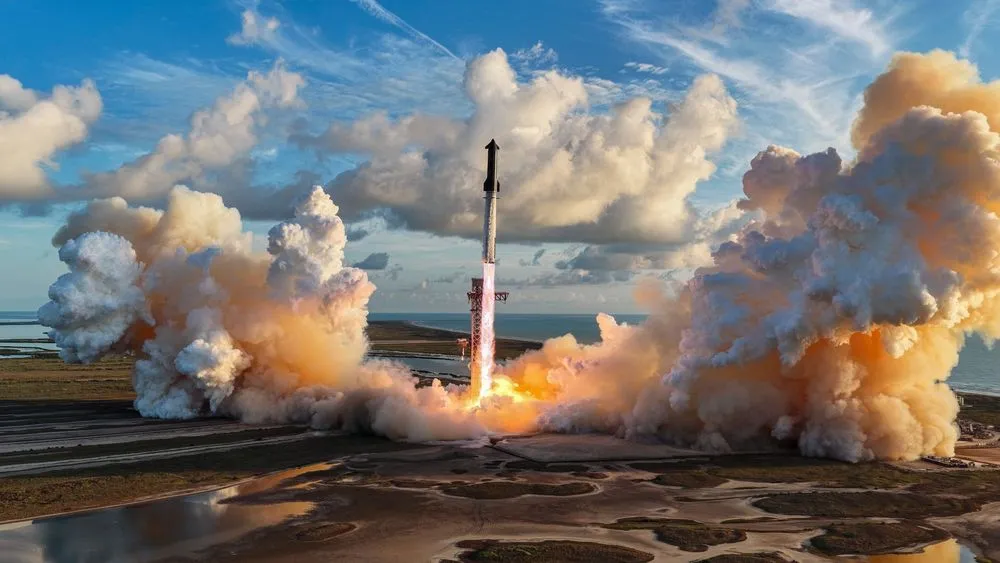
On September 28, 2026, on its 14th flight test, SpaceX's giant Starship rocket reached Earth orbit for the first time and released 26 next-generation Starlink V3 communications satellites.
On the previous 13th flight, Starship also released 20 V3 satellites into space. However, that flight followed a suborbital trajectory that did not circle the Earth, and the satellites were planned to re-enter the atmosphere about 20 minutes later.
The major difference this time is that the 26 satellites were carried into Earth orbit, ready to begin operations to join the actual Starlink network.
Not everything went according to plan, however. On the Super Heavy booster, one Raptor engine shut down during ascent, and some engines then failed to relight during the return. On the Starship upper stage, one of its six engines also shut down earlier than planned.
The upper stage kept flying on its remaining engines and ultimately reached orbit, but the flight, planned for about 10 hours, was ended after about 3 hours to prioritize safety.
The flight showed for the first time that Starship can deliver operational satellites to orbit, while also leaving open the question of engine reliability for long-duration orbital flight. The satellite delivery achievement and the problems still to be solved need to be considered separately.
From suborbital deployment to putting operational satellites in orbit for the first time
On the 13th flight test, held on July 24, Starship deployed 20 Starlink V3 satellites, and SpaceX succeeded in communicating with all of them.
However, according to SpaceX's official record, the satellites were released into the same suborbital trajectory as Starship and were planned to re-enter the atmosphere and burn up about 20 minutes later.
In other words, that was a test to verify the deployment mechanism and communication functions in the actual space environment, not a launch to add satellites to the Starlink network.
On the 14th flight, this changed significantly.
After its first ascent burn, the Starship upper stage was, as before, on a trajectory that would have returned it to the atmosphere if left alone.
SpaceX then checked the vehicle's condition and relit one sea-level Raptor engine in space.
The burn of about 19 seconds added the final speed needed, placing the vehicle in Earth orbit at an altitude of about 276 km.
Although the previous flight also released satellites into space, keeping them around the Earth as working communications satellites requires accelerating to a speed high enough that they keep circling rather than falling back.
On Flight 14, Starship completed this step for the first time.
After reaching orbit, it released the 26 Starlink V3 satellites one after another. SpaceX says it established communication with all 26 through laser links, radio links and other means.
Being able to communicate, however, is not the same as already providing service to users.
The satellites will now check their equipment and raise their orbits before being integrated into the existing Starlink network. The 26 satellites did not immediately begin providing communications to users after this launch.
Engine problems on both Super Heavy and Starship
Engine reliability also remained an issue on this flight.
The first-stage Super Heavy ignited 33 Raptor 3 engines at liftoff, but one shut down during ascent.
After separating Starship, Super Heavy continued its flight back toward the Gulf of Mexico, but some additional engines did not relight properly during the return.
According to SpaceX, 31 of the 33 planned engines fired during the boostback burn that changes the booster's velocity toward its return direction.
In the burn just before splashdown, 11 of the 13 planned engines were lit initially, and the number was then stepped down to 5 and then 3 to slow the vehicle.
This flight also tested using Super Heavy's liquid oxygen close to its limit, and the flight termination system was deliberately activated at splashdown.
No attempt was made to catch the booster with the launch tower's giant arms.
Problems also occurred on the Starship upper stage.
The upper stage carries six Raptor engines, three sea-level and three vacuum, and one of the vacuum Raptors shut down earlier than planned during ascent.
The remaining five engines burned longer to make up the shortfall, and the upper stage reached its planned flight path.
At that point, SpaceX carefully considered whether to continue toward orbit.
For a time, the possibility of forgoing orbital insertion and returning to the atmosphere from a suborbital trajectory was raised, but after confirming that the three sea-level Raptors needed for orbital insertion and return were healthy, SpaceX decided to continue.
One of them was relit, and Starship entered Earth orbit for the first time.
The engine problems on the booster and the early shutdown of the Starship upper-stage engine are separate issues.
Starlink V3 aims for 1 Tbps downlink per satellite
The Starlink V3 satellites placed in orbit this time are the next-generation satellites at the center of SpaceX's plans to expand its network.
According to the official Starlink specifications, a single V3 satellite is designed for up to 1 Tbps downlink and 160 Gbps uplink capacity.
That is roughly 10 times the downlink capacity of V2 and about 22 times the uplink capacity.
However, this is the total design capacity of a single satellite.
It does not mean a single user terminal can achieve 1 Tbps, nor that the 26 satellites are already providing 26 Tbps in total to users.
The satellites also have far greater ability to divide their radio beams finely so they can communicate with many areas and terminals at once.
Where V2 had 192 downlink and 144 uplink beams, V3 will have 2,048 beams for both downlink and uplink.
In simple terms, that is about 10.7 times more for downlink and about 14.2 times more for uplink.
Beams are a mechanism by which a satellite's antenna divides the area in which it sends and receives radio signals to and from ground terminals.
Increasing the number of beams widens the scope for allocating capacity to more areas and users.
However, the beam-count multiple cannot be taken directly as the multiple of an individual user's speed.
Stronger inter-satellite lasers and ground-station links
Increasing communications capacity is not enough if only the link between user terminals and satellites gets faster.
Lines are also needed to carry the large volumes of received data to other satellites and to the ground-based internet.
Starlink V3 carries six 400 Gbps space laser links.
This allows large volumes of data to be transferred between satellites without going through ground stations.
For communication with ground stations, it uses the Ka, E, V and W bands, and is designed with up to 1.2 Tbps of total backhaul capacity.
Solar power generation is also said to be about double that of V2.
In other words, V3 strengthens not only communication with users but also inter-satellite links, links to ground stations and power supply.
Even so, launching 26 satellites does not necessarily mean overall speeds for Starlink users will immediately rise significantly.
Caleb Henry of satellite industry research firm Quilty Space, interviewed by Ars Technica, noted that while adding V3 capacity in orbit is meaningful, it will not be the main driver of the user experience until enough satellites are deployed.
Only when these 26 satellites move to their planned orbits, are integrated into the existing Starlink network, and are joined by more V3 satellites on future launches will the large design capacity begin to show up as changes for users.
Why a roughly 10-hour plan was cut to about 3 hours
Starship succeeded in reaching orbit and releasing 26 satellites, but it did not carry out the full flight originally planned.
The plan called for six orbits of the Earth and about 10 hours in orbit.
However, taking into account the upper-stage engine problem during ascent, SpaceX shortened the time in orbit, prioritizing safety.
After the satellite deployment, one sea-level Raptor was fired again, and Starship carried out a deorbit burn for the first time.
This burn slows the vehicle so that it re-enters the atmosphere from Earth orbit at the intended location.
Starship then re-entered the atmosphere and headed for a preset area of the North Pacific.
About three hours after launch, just before splashdown, three sea-level Raptors relit to flip the vehicle, which had been descending sideways, upright and slow it, and it splashed down in the planned area.
The vehicle then toppled over and was engulfed in a large fireball.
This is a separate phenomenon from the flight termination system deliberately activated at the Super Heavy splashdown.
This Starship upper stage was also not planned to be recovered from the sea and reused.
What matters is that, while it carried out satellite deployment, deorbit, atmospheric re-entry and return to the designated sea area, it did not complete the originally planned long flight of about 10 hours.
The test of operating the vehicle and its systems for a long period over six orbits has been pushed to a future flight.
Reaching orbit is a first, but reuse is still to come
Starship's ultimate goal is not only to carry large payloads to orbit.
It aims for full reusability, recovering both Super Heavy and the Starship upper stage and flying them repeatedly.
For Super Heavy, SpaceX has already succeeded in catching it in midair with the launch tower's large arms.
The Starship upper stage, on the other hand, has not yet been returned to the launch site, caught, refurbished and flown again.
This time too, the upper stage splashed down at sea, so the ability to recover and reuse a vehicle that has been placed in orbit remains unproven.
What this flight showed is that Starship can carry real large satellites into Earth orbit and, after releasing them, leave orbit and return on its own.
The next major stages will be the reliability to do this repeatedly and the ability to recover and reuse the upper stage itself.
Deployment pace will matter for Starlink V3
From Starlink's perspective, the focus going forward is how quickly V3 satellites can be added in orbit.
The 26 satellites alone carry substantial communications capacity, but the Starlink network as a whole consists of thousands of satellites.
SpaceX has outlined a vision of launching up to 60 V3 satellites on a single Starship in the future.
Simply adding up the design downlink capacity per satellite would give the equivalent of up to 60 Tbps per launch.
However, this is a theoretical figure obtained by summing satellite specifications.
The capacity that can actually be used depends on satellite placement, ground stations, inter-satellite lasers, user terminals, regional demand and other factors.
Likewise, for these 26 satellites, multiplying the 1 Tbps-per-satellite specification by 26 does not give the Starlink communications capacity currently available.
In the satellite network race, launch capacity also makes a difference
Expanding a satellite network requires not only building high-performance satellites but also rockets that can carry large numbers of them to orbit.
Competing Amazon Leo added 29 satellites in a July 2 launch, bringing its cumulative total of satellites deployed to 396.
However, that 396 is the cumulative number of satellites deployed as of July 2, and not necessarily the number actually in service at the end of September.
Starlink V3 and Amazon Leo also differ in per-satellite capability, orbit and communication methods.
Comparing only this launch of 26 Starlink V3 satellites with Amazon Leo's satellite count does not allow a judgment about the performance gap between the networks as a whole.
Still, both share the fact that securing rockets able to keep putting large numbers of satellites into orbit shapes the speed of network expansion.
Starship's delivery of operational satellites to orbit is an important milestone for Starlink not only in the evolution of the satellites themselves but also in deployment capability.
A lunar lander will need longer flights and propellant transfer
Starship's uses are not limited to transporting Starlink satellites.
Under the Artemis program, NASA is planning to use Starship as the Human Landing System (HLS) lunar lander.
A Starship heading for the Moon will need far more complex operations than this delivery of satellites to low Earth orbit.
Among the most important is in-orbit propellant transfer, in which a Starship receives cryogenic propellant from another Starship in space.
It will also have to store propellant for long periods and bring multiple spacecraft together and dock them in orbit.
On this flight, Starship succeeded in about three hours of orbital flight and in relighting engines for orbital insertion and deorbit.
However, the originally planned flight of about 10 hours was not carried out, and full-scale propellant transfer between Starships remains a challenge.
It will also be necessary to investigate the cause of the upper-stage engine that shut down early and ensure that long orbital flights can be completed as planned.
On Flight 14, Starship did real work for the first time as a rocket that carries large operational satellites to Earth orbit.
But what SpaceX is aiming for is a system that does this at high frequency, recovers and reuses the vehicles, and goes on to perform the propellant transfer needed to head for the Moon.
This success is a major step forward, but demonstrating the ability to deliver satellites to orbit and completing a fully reusable space transportation system are still separate stages.