

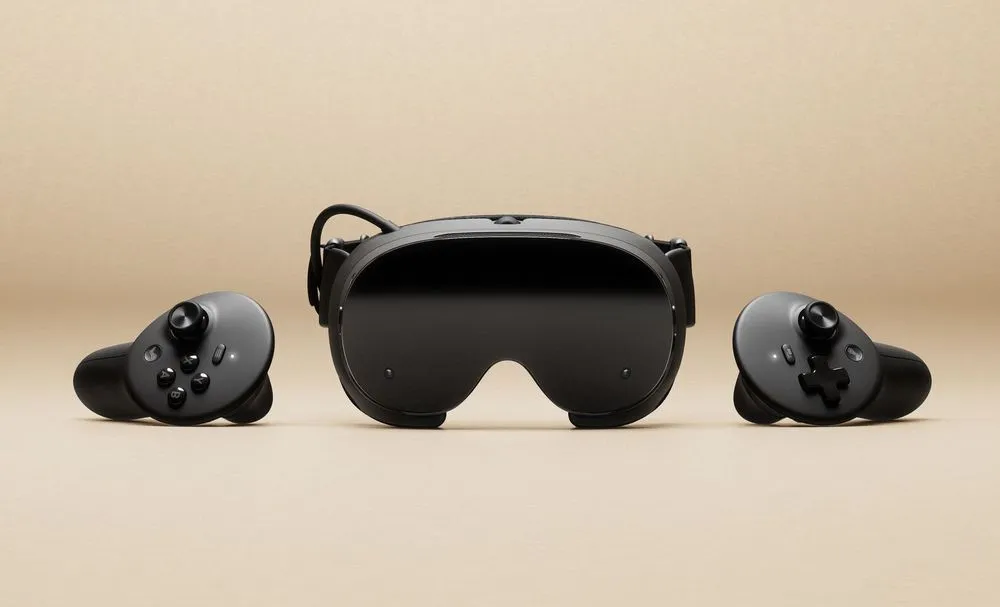
On September 14, Valve announced pricing and the start of lottery reservations for Steam Frame, its wireless VR headset. In the US, the 256GB model costs $1,059 and the 1TB model costs $1,299. Purchase-invitation emails will go out in waves starting September 18. After Valve revisited the price and shipping plans because of component shortages, the product is finally moving toward checkout. But to judge a starting price of $1,059, you need to separate two things: the headset's ability to run games on its own, and the mechanism that receives video from a PC you already own. Steam Frame's design leaves heavy rendering to the PC while centering the experience on playing free of cables.
Lottery reservations from $1,059, and sales in Japan
The US prices given in Valve's launch announcement are as follows. Both models combine a headset and controllers, and both come with a wireless adapter for connecting to a PC.
| Model | US price | Built-in storage |
|---|---|---|
| Steam Frame 256GB | $1,059 | 256GB UFS |
| Steam Frame 1TB | $1,299 | 1TB UFS |
The difference between the two models is $240 (1,299 − 1,059). Both have a microSD card slot, so the choice of capacity depends on how many games you plan to install on the headset itself. If you play by receiving video from a PC, the games are stored on the PC side. Note that these are US prices and do not indicate pricing in Japan.
In regions where Valve sells directly through Steam, applications are accepted until 10:00 a.m. Pacific Daylight Time on September 17 (2:00 a.m. on September 18 in Japan). After that, the queue order is randomized once. It is not a first-come, first-served system. Valve says the aim is to reduce the advantage that bots and fast connections would have in a short first-come sale, and to discourage applications made for resale.
After the lottery, applicants are notified whether they secured a reservation slot or were placed on a waitlist. Purchase invitations for those who secured a slot begin going out on September 18, and payment must be completed within 72 hours of receiving the email. September 18 is the date invitations begin, not a shipping or delivery date for everyone. Those on the waitlist move up as cancellations occur or additional units are produced.
The official FAQ says you need an account in good standing and a purchase history from before April 27, 2026. Only one application is allowed per household, and lists are separated by region and model. The model cannot be changed after the lottery, and applications submitted after the deadline go to the back of the waitlist.
In Japan, KOMODO handles sales. Taiwan and Hong Kong are also served through the company, and South Korea is scheduled to ship later. As of September 15, KOMODO's product page was down for maintenance, so we could not confirm the domestic price or the application dates. The lottery conditions for Steam's direct-sales regions cannot simply be assumed to apply in Japan.
Accessories also deserve attention. Half-Life: Alyx can be redeemed from the headset's settings, but an account that already owns it cannot claim an additional copy. The power adapter is sold separately; Valve's official 45W adapter costs $29 in the US. Official accessories are added at checkout for the headset by those who receive a purchase invitation.
How component costs changed the price and the hardware
In its February 4 explanation, Valve said that severe shortages of memory and storage, and the resulting price increases, meant it needed to reconsider the pricing and shipping schedule for Steam Frame and other products. The current price was announced after that review.
In PC Gamer's coverage at launch, Valve hardware engineer Joy Lyons also explained that the global RAM shortage changed the original price target. Software engineer Jeremy Selan said the company had wanted to ship at the price it had in mind the previous year. However, these explanations do not reveal the old target price or how much was added for each component. Nor can the $240 gap between models be read as the parts cost of the storage.
The headset has a Snapdragon 8 Gen 3 and 16GB of LPDDR5X memory, and runs SteamOS. The display is an LCD with 2,160 × 2,160 pixels per eye and a refresh rate of 72 to 144Hz; 144Hz is listed as experimental in the specs. It uses pancake lenses, and the core module plus headstrap weighs 440g.
Outward-facing cameras track the headset and controllers, which removes the need for external base stations. On the other hand, the standard passthrough view of the surroundings is monochrome. It would be premature to assume from the price alone that this is a product with every display and camera feature. Valve has also put effort into how video is carried between the PC and the headset.
The three processes behind wireless play do different jobs
Steam Frame includes a dedicated 6GHz wireless adapter. The headset supports Wi-Fi 7, while the adapter itself is Wi-Fi 6E. The headset's two wireless systems split the work, with one handling video and audio from the PC and the other handling regular Wi-Fi. The product page also describes "Multi-Link Streaming," a feature that distributes data across multiple available connections at once and adapts to network conditions.
The feature that changes streamed image quality based on gaze, the feature that reduces rendering load, and the feature that adds wireless paths each act on a different process. Sorting Valve's product description and its February technical FAQ by what each process targets and what implementation requires makes the differences clear.
| Mechanism | What it changes | Implementation and usage conditions |
|---|---|---|
| Foveated Streaming | Concentrates high-quality video where the user is looking | A system-level feature; no extra work required from game developers |
| Variable-resolution rendering using eye tracking | Changes the area the game renders at high resolution to match gaze | Must be implemented in the game. Can be used together with the transmission-side feature |
| Multi-Link Streaming | Uses multiple connection paths at once to make transmission more stable | Draws on the included adapter and the headset's wireless systems, adapting to available connections |
The table compares Valve's explanations as checked on September 15; it is not a comparison of measured performance. In particular, Foveated Streaming changes the stage where video is sent, not the stage where the PC renders it. Having eye tracking does not mean this feature alone reduces the PC's rendering load.
Multi-Link Streaming also has a different role from the process that changes image quality to follow the gaze. It is designed to stabilize the connection by adding usable transmission paths and providing redundancy. Valve touts improved quality and reliability, but it has not given a uniform figure for how much latency or image quality improves in any particular home network.
In other words, even with a wireless headset, the condition of needing a PC with enough power to render the game remains. On top of that, the rendered video is sent according to where the user looks, and multiple connection paths are used. It is a configuration that lets PC computing power and wireless quality be improved separately.
Standalone certification criteria and battery life when connected to a PC
In its launch announcement, Valve said more than 100 games have received standalone certification. But this certification evaluates the experience of running games inside the headset. It is a different target from streaming from a PC.
The developer certification criteria require the following minimum performance during normal play.
| Game type when running standalone | Minimum resolution for certification | Minimum frame rate |
|---|---|---|
| 2D games | 1,280×720 | 30fps |
| VR games | 1,728×1,728 | 72fps |
This is the floor for certification, not the resolution of the built-in LCD, and not a guarantee of performance that every game can reach. It would also be a mistake to see 144Hz in the spec sheet and expect every standalone VR game to render at 144 frames per second. Proton, which runs Windows games, also has compatibility limits, so each title you own needs to be checked.
The effect of leaving rendering to an external PC also shows up in the headset's battery life. PC Gamer's Jacob Ridley reported runtimes in Half-Life: Alyx of 63 minutes for standalone Arm play and 114 minutes when streaming from a PC. Both tests were run in Playtime mode, which caps the frame rate at 72fps, so the figures do not guarantee the same duration for other games or settings. Even so, they offer a concrete example of how where the game runs affects runtime while the headset is worn.
Before choosing Steam Frame, it is worth settling how you will use it: run the games you want to play on the headset itself, or send them from a PC you already have. In the former case, certification status and the headset's storage capacity matter; in the latter, the PC's performance and your wireless environment shape the experience after purchase. Once Japan's sales terms are confirmed, weighing the total cost, including the necessary power adapter and PC, will show what a product starting at $1,059 actually solves in your own setup.