

Video streaming plays without a hitch, cloud AI responses arrive instantly—every day, as if it were nothing. Behind this lies undersea cables, long assumed to be infrastructure laid and leased out by telecom carriers like NTT or KDDI. Yet over the past 15 years, three-quarters of the data flowing through international lines has come to pass through companies that aren't even telecom carriers at all—Google, Meta, Amazon, Microsoft. Their share was essentially zero in 2010. Why did this reversal happen so fast?
The answer isn't simply a matter of financial muscle. The very nature of the bandwidth AI workloads demand pushed these four companies to choose "owning" over "renting." And yet what they actually gained was the right to use capacity—the power to actually build the cables still rests with three entirely different companies.
Non-Carrier Content Giants Now Use 75% of International Bandwidth
As of 2025, content and cloud companies account for roughly 75% of bandwidth usage on international submarine cables, with Google, Meta, Microsoft, and Amazon as the largest sources of demand. On trans-Pacific routes, these companies consume over 80%; on trans-Atlantic routes, close to 90%. As of 2010, this category's share was essentially zero. In just 15 years, the leading players in international telecommunications have completely changed.
Looking at individual companies makes the shift even starker. According to TeleGeography's tally, Google holds ownership stakes in more than 30 cable systems, Meta is involved in around 20, and Microsoft and Amazon together appear on roughly 10. Because joint-investment projects overlap, a simple sum doesn't yield a single figure, but these four non-carrier companies are involved in more than 60 cable projects combined. Worldwide, there are roughly 600 submarine cables in operation or planned, with total length reaching about 1.7 million kilometers according to 2025 data from the International Cable Protection Committee (ICPC). While this represents only a portion of the total number of projects, investment is concentrated on the major high-capacity routes connecting AI infrastructure and intercontinental data centers.
Most submarine cables are built through a consortium model funded by multiple companies. There are two ways to secure capacity: holding an equity stake through construction investment, or purchasing a long-term usage right known as an IRU (Indefeasible Right of Use). Either way, one thing remains constant: "controlling capacity" and "owning or building the cable itself" are two separate things. Tech giants have used this mechanism—investing in consortiums and signing long-term capacity contracts—to effectively secure thick pipelines as their own. It is this de facto control achieved through contractual structure that has made this shift technically possible.
According to KDDI, more than 99% of Japan's international communications still travel via fiber-optic submarine cables, meaning nearly all of the country's daily life and work depends on this physical infrastructure. And the bulk of usage on those thick pipelines is now held by foreign content and cloud companies that are not telecom carriers. This shift that unfolded over the 15 years since 2010 is not a distant problem for Japan either.
The Same Changing of the Guard, 170 Years Ago
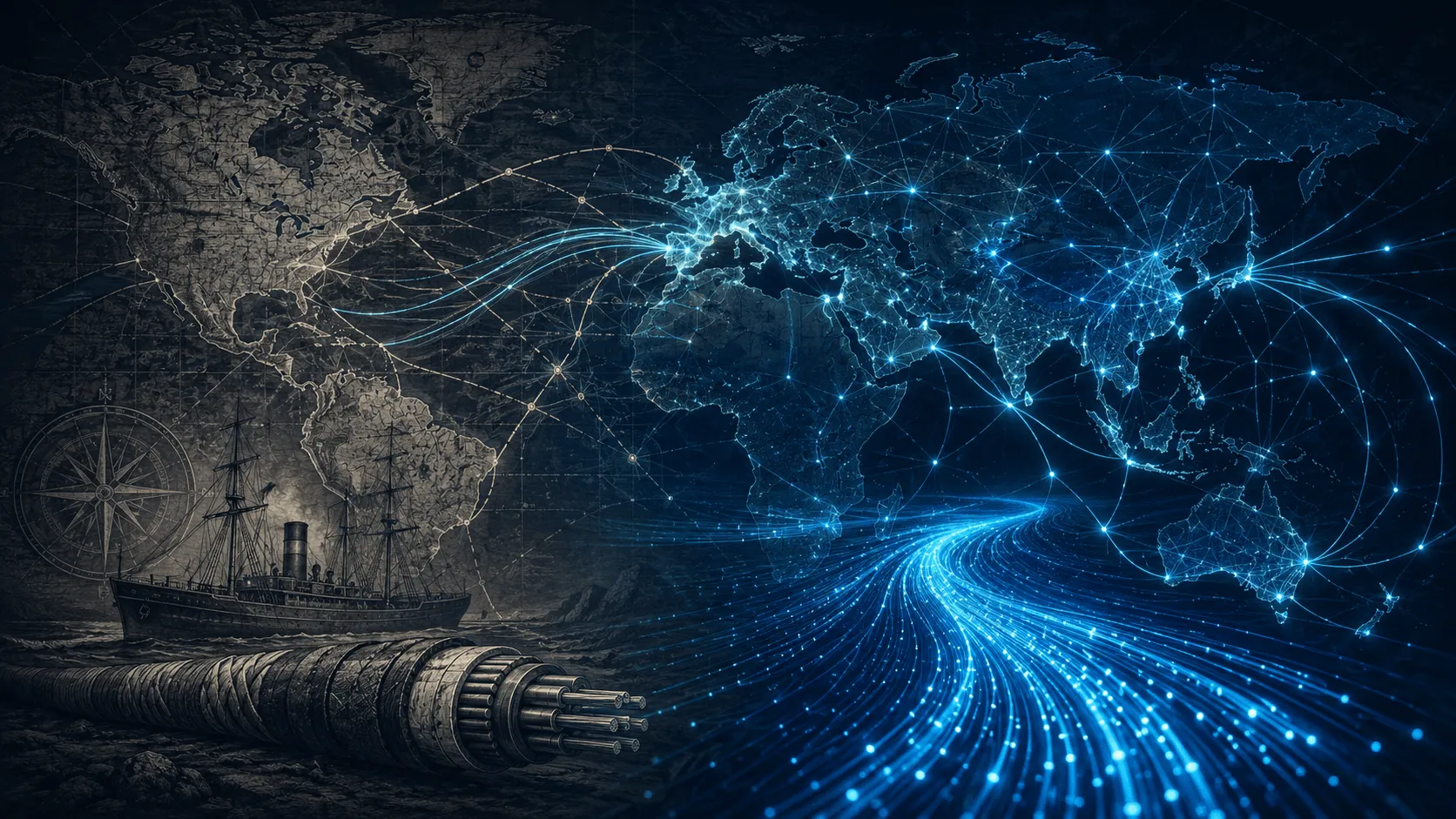
The world's first submarine cable was laid across the Dover Strait between Britain and France on August 28, 1850. It broke on its very first day and ended in failure; stable operation wasn't achieved until 1851. In Japan, the first submarine telegraph line opened between Nagasaki and Shanghai in June 1871, and a trans-Pacific line opened in August 1906. In its earliest days, the submarine cable business was a domain accessible only to a select few players who could shoulder enormous upfront investment and the risk of failure.
Britain's Eastern Telegraph Company, founded in 1872, is a textbook example. Its cable network, which started at 8,860 miles at founding, reached 22,400 miles just 15 years later, around 1887—growing to a scale that nearly monopolized the world's submarine communications. The British Empire's telegraph network was called the "All Red Line," treated as a strategic asset that let communications between colonies be completed entirely with domestic capital.
As the international landscape shifted through two world wars, this monopoly structure came to an end—first through the 1929 merger of Eastern Telegraph and Marconi (forming the holding company Cable and Wireless Ltd, unified under the name Cable and Wireless in 1934), and then through nationalization by the British government in 1947. From then on, throughout the 20th century, the model of national telecom carriers jointly owning and operating submarine cables became firmly established. What underpinned that original monopoly was Britain's physical barrier to entry at the time—its shipbuilding and seabed-surveying technology—and the same logic underlies today's structure in which three companies from France, the U.S., and Japan control submarine cable manufacturing.
In Japan, KDD (now KDDI), established in 1953, held a monopoly on international communications until 1985, and in 1964 KDD and AT&T opened the trans-Pacific cable TPC-1. Cable content also evolved from copper wire to fiber optics; research and development began in the 1970s, but commercialization only arrived with the world's first trans-Atlantic fiber-optic submarine cable, TAT-8 (1988), and Japan's first, TPC-3 (1989). Throughout this era, submarine cables were operated as "inter-carrier infrastructure," jointly funded by national telecom carriers who recouped their investment by leasing surplus capacity to other companies. The reason monopoly emerged twice—in the 19th century and again in the 21st—is the same: because the business requires enormous upfront investment and a long payback period, the submarine cable industry itself has a structure that naturally concentrates power in whichever entities have both capital strength and foresight into future demand.
The turning point came in 2008, when Google announced it would join Unity, a Japan-U.S. cable backed by a six-company consortium (with Google holding a 20% stake), which opened in 2010. In 2016, Microsoft and Facebook (now Meta) jointly built Marea, completing it in 2017. In January 2018, Google announced Curie, a 10,500-kilometer cable between the U.S. and Chile, positioning it as "the first cable independently owned by a non-carrier company"; laying was completed in November 2019, and commercial service began in 2020. In other words, the shift from consortium investment to sole ownership unfolded gradually over 11 years, counting from Google's 2008 participation in Unity.
Why Owning Became More Rational Than Renting
The submarine fiber-optic cable market is projected to grow from $5.22 billion in 2025 to $5.89 billion in 2026, and reach $9.87 billion by 2031, according to a 2026 report from market research firm Mordor Intelligence. The compound annual growth rate (CAGR) is 10.87%, but breaking down the figures reveals that the leading driver of growth has changed. The cloud- and content-provider segment has a CAGR of 11.84%, above the market average, while growth in the traditional telecom carrier segment is relatively slowing. That $5.89 billion figure translates to roughly ¥924.7 billion at the prevailing exchange rate as of August 2026 (around ¥157 to the dollar).
The traditional approach of leasing bandwidth on the market suited steady, predictable traffic, but it's a poor fit for AI workloads. Training large language models requires synchronizing parameters across multiple data center sites, and variability in latency directly affects computational efficiency. Under a lease contract, the capacity or route available can shift due to other companies' fluctuating demand, so there's no guarantee of always using the same route with the same latency. By owning a submarine cable outright, a company can decide route design, capacity allocation, and the timing of expansions based solely on its own demand forecasts—and this predictability translates directly into competitiveness for AI infrastructure.
There are numbers that illustrate the speed of this change. Investment in new submarine cable projects is projected to reach about $13 billion over the three years from 2025 to 2027—roughly double the investment made over the three years from 2022 to 2024, CNBC reported in November 2025. In other words, tech giant investment has flowed into a market long led by telecom carriers at a pace that doubles it within a short span. Looking at who is driving this investment makes clear that the market's growth curve itself is being drawn by hyperscaler demand.
The fact that the cloud-provider segment's growth rate exceeds that of the telecom carrier segment reflects a change in how submarine cable infrastructure itself is positioned. What was once treated as a "necessary expense"—international lines—has become an investment target as a "strategic asset" underpinning AI infrastructure. How this strategic asset is actually designed, and who owns it, varies considerably from company to company.
Tech Giants' Sea Charts, and the 92% of Manufacturing They Couldn't Claim
In November 2025, Meta announced it had completed the core portion of the 2Africa cable, which circles the African continent. The route spans 45,000 kilometers with a capacity of 180 Tbit/s, and includes 46 landing points across 33 countries. This project is backed by a multinational consortium that also includes telecom carriers such as Vodafone and China Mobile as investors—an example showing that even among the "proprietary cables" Meta is involved in, geopolitical rivals sometimes appear as co-investors. Separately, in February 2025, Meta announced Waterworth, a 50,000-kilometer cable crossing the Atlantic and Indian Oceans, expanding its AI-related infrastructure investment across a wide area.
Beyond the aforementioned Curie, Google announced the Dhivaru cable in November 2025, connecting the Maldives, Christmas Island, and Oman. Amazon announced Fastnet in November 2025, AWS's first solely owned cable. It connects Maryland in the U.S. with Cork, Ireland, with a capacity exceeding 320 Tbit/s. Completion of the landing stations is planned for 2027, but the system as a whole is expected to reach readiness for service (RFS) in 2028. Unlike the other three companies, Microsoft holds no solely owned cable; aside from its co-construction of Marea in 2016, it has stuck to an investment-based model.
Microsoft's approach continues along the same lines. In addition to its investments in Hibernia and Aqua Comms in 2015, in recent years it has continued to secure network access through partnerships with existing operators, such as its participation in the Lightstorm-led I-2SEA project—consistently avoiding a move toward sole ownership. This strategy of spreading risk through investment in multiple routes differs from the strategy of controlling an entire route through sole ownership, showing that investment philosophies vary even among the tech giants.
Looking at these figures, it might seem the lead role in submarine cables has shifted entirely to the tech giants. But in reality, almost none of these four companies build the cables themselves. Looking at the submarine cable manufacturing market, the companies holding market share are France's Alcatel Submarine Networks (40%), America's SubCom (31%), and Japan's NEC (21%)—together reaching 92%. China's HMN Technologies holds only 8%; while tech giants are strengthening their presence on the ownership side, on the manufacturing side, Chinese influence is not as large as the raw numbers might suggest. Even HMN, which stands out for its price competitiveness, is significantly outpaced in scale by the three companies from France, the U.S., and Japan.
The reason ownership and manufacturing are so separated is that laying submarine cables is a business requiring specialized technology and equipment. Building the necessary cable-laying ships, seabed surveying capability, and repair infrastructure requires decades of accumulated expertise—something the tech giants' financial resources alone cannot quickly replace. What Google and Meta handle is route design, financing, and decisions on capacity allocation after completion; the actual manufacturing and laying is outsourced to the three companies from France, the U.S., and Japan. In other words, this industry is divided into an ownership layer that decides "who uses the line" and a manufacturing layer that decides "who builds the line"—and over these 17 years, only the former has changed hands.
Invisible Borders: The Geopolitics of Landing Permits
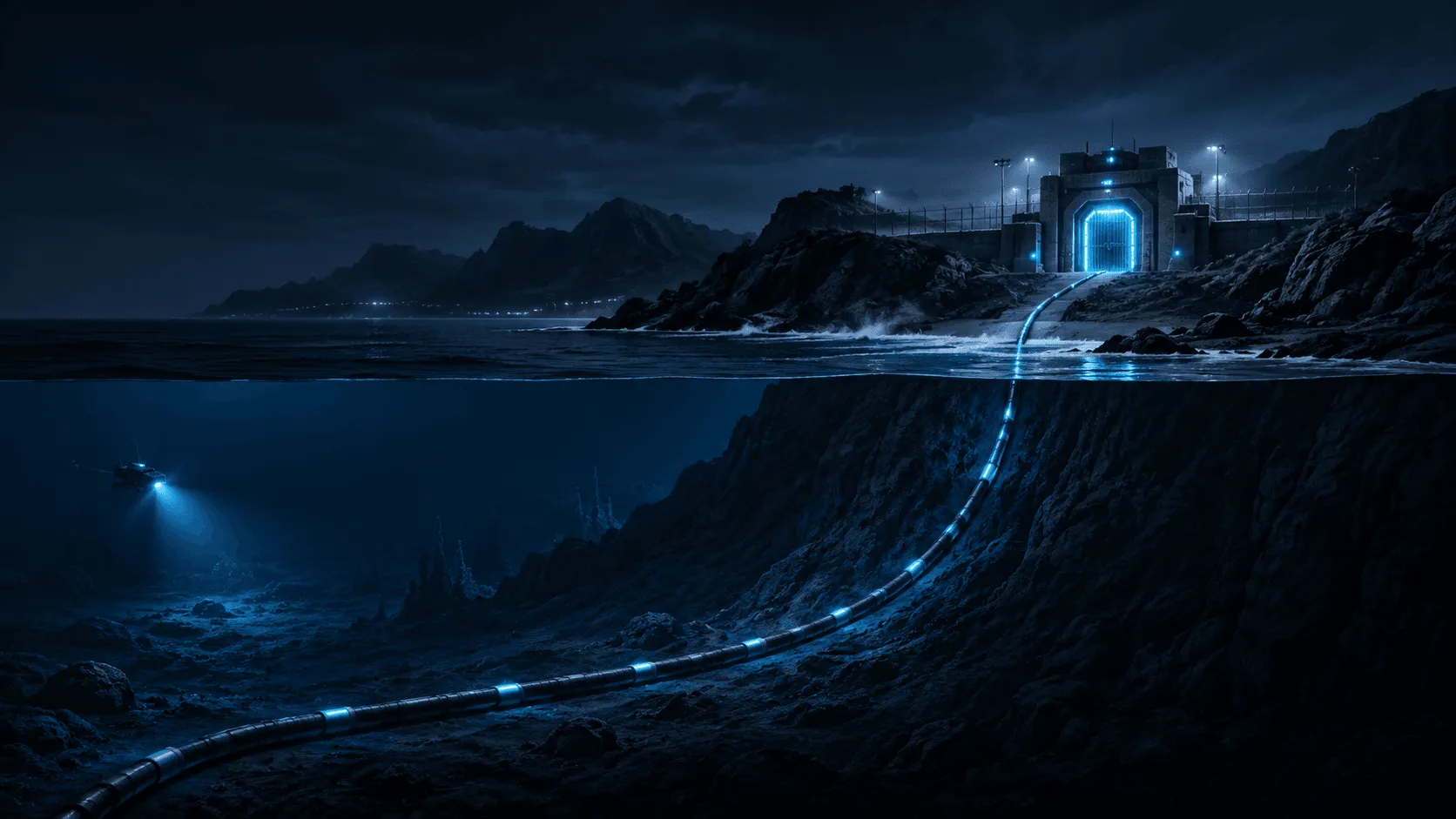
Submarine cables do pass through stretches of the high seas, but in practice, most of their length runs through the exclusive economic zones (EEZs) and territorial waters of various countries. Under the United Nations Convention on the Law of the Sea, freedom to lay cables is recognized to some degree in both the high seas and EEZs—but the moment a cable comes ashore, at the point where the landing station is established, permission from that country's government is required. This landing permit is precisely the physical chokepoint that no cable owner can avoid, and it has become the focal point of geopolitics surrounding undersea infrastructure in the AI era. No matter how much a company invests in a cable, if the country where it lands refuses permission, that route simply cannot exist.
China's HMN Technologies (formerly Huawei Marine) is known for its strong price competitiveness. In the bidding for the East Micronesia Cable, HMN offered a price more than 20% lower than competitors Alcatel Submarine Networks of France and NEC of Japan—but in 2020 the U.S. raised national security concerns, and in 2021 the World Bank-led bidding process itself ended without being awarded to any company. A similar situation played out in the Solomon Islands. HMN won the contract in 2017, but the Australian government intervened, and ultimately the Coral Sea Cable went into operation in 2019 under a different landing arrangement.
What these two cases have in common is a pattern: even when a company wins on price, a political decision over landing permission can overturn the outcome. Laying a cable on the seabed itself is largely free under the UN Convention on the Law of the Sea, but a landing station is a fixed asset located within a sovereign nation's territory, and if there are concerns about communications interception or infrastructure monopolization, the government can refuse permission at any time. The U.S. has been pushing allied countries to exclude HMN through the landing-permit review process; in allied countries including Japan, projects are increasingly steered toward Western and Japanese companies like NEC, while Chinese firms still hold an advantage in price and construction speed. No matter how much ownership a company secures, if landing is refused, the line simply doesn't function.
A Different Vulnerability: The Constraint of Repair Ships
Submarine cables have another weakness besides landing permits. Worldwide, only about 60 specialized ships are capable of both laying and repairing cables, and they must handle roughly 200 faults occurring globally each year. Repair costs per incident are said to range from hundreds of thousands to several million dollars, and the deployment status of this limited fleet of repair ships is itself a factor determining effective influence in particular sea regions.
Japan Is Both a User and a Builder
In April 2024, Google announced it would invest approximately ¥150 billion in laying a new submarine cable between Japan and the U.S. Direct investment by tech giants isn't confined to the other side of the Pacific—it extends to Japan's own coastline as well. Video streaming, cloud services, international video calls—the vast majority of these depend on this physical infrastructure. The fact that foreign non-carrier companies use 75% of international bandwidth reflects Japan's own dependence on foreign capital for its telecommunications lifeline.
At the same time, Japan is also on the "building" side. OCC, NEC Group's dedicated submarine cable subsidiary (headquartered in Yokohama, with manufacturing based in Kitakyushu), has manufactured a cumulative total exceeding 400,000 kilometers of cable and maintains a global market share in the 20% range. Against the manufacturing market share figures noted above (France's ASN at 40%, America's SubCom at 31%, Japan's NEC at 21%), Japan ranks as the world's third-largest manufacturer, placing it in a dual position—dependent on others while also supporting the cable demand of other countries. NEC is reportedly aiming to raise its global market share to 35% by 2030, suggesting Japan's strategy is oriented not so much toward reducing dependence as toward increasing its presence within the supply chain.
This dual position became a policy focus following the direction the Takaichi administration set out on November 7, 2025. The government has announced plans to designate submarine cables as a "specified critical material," on par with semiconductors. Under the critical infrastructure system within the Economic Security Promotion Act, ten companies including NTT and KDDI are already designated as "specified social infrastructure operators," with the Ministry of Internal Affairs and Communications pre-screening equipment procurement in the telecommunications sector. Designation as a specified critical material means the government will provide financial support and treat supply-chain reinforcement as a target for policy—to avoid supply-chain fragmentation and dependence on specific countries—signaling that submarine cables have shifted in status from ordinary commercial infrastructure to security infrastructure.
Of the 25 submarine cables landing in Japan, only 10 routes avoid passing through authoritarian countries, and two are reported to include Chinese corporate investment. The "specified critical material" designation serves as a policy push toward reorganizing these landing routes along geopolitical lines. NEC and OCC's manufacturing capacity is positioned to serve as a receiving base for this reorganization.
The Next Turning Point: Multi-Core Fiber and the Arctic Route
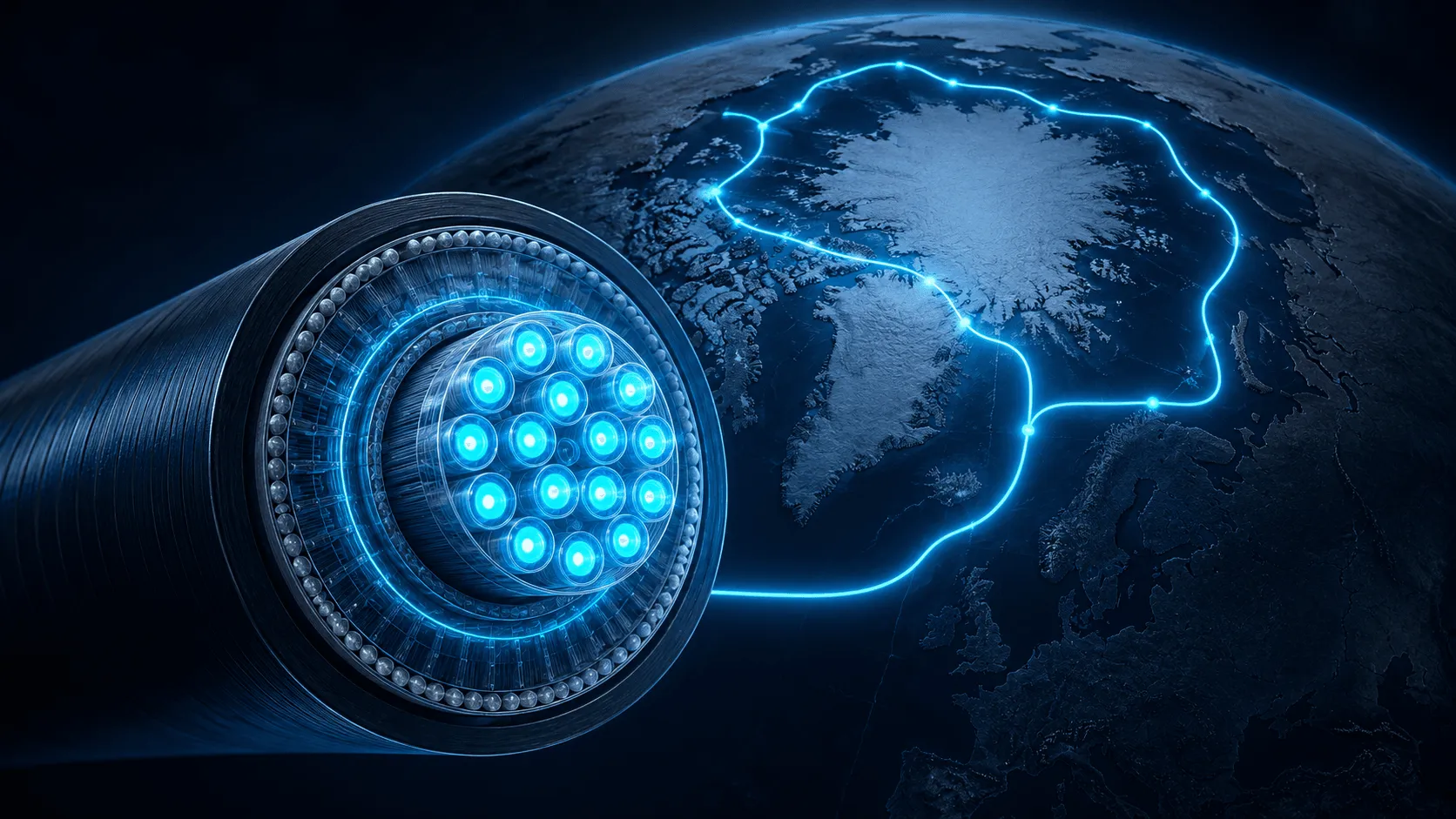
Expanding bandwidth demand is also accelerating the evolution of cable technology itself. Space-division multiplexing (SDM) is a technology that boosts transmission capacity within limited physical undersea space by giving a single cable multiple independent transmission paths (cores). In March 2022, NEC announced that in a long-distance transmission experiment using multi-core fiber, it demonstrated the ability to expand transmission capacity to roughly 1.7 Pbit/s—seven times the conventional level. New cable projects are increasingly including transmission capacity requirements exceeding 60 Tbit/s as standard, and specifications built around AI workloads are becoming the norm even at the bidding stage. Commercialization of SDM technology is expected to fully take off within a few years, but this demonstration result itself offers an early glimpse of which technical specifications will drive the next investment cycle.
NTT, too, announced in March 2026 a 192-core multi-core fiber system that quadruples transmission capacity without changing the cable's overall structure, showing that the race to increase capacity isn't confined to NEC alone. Industry estimates suggest cloud-related submarine cable traffic, including AI, is growing at roughly 30% annually, and capacity expansion in the coming years is increasingly characterized as investment aimed at keeping pace with that growth rate. Nokia Bell Labs forecasts that global AI wide-area network traffic will require an additional one zettabyte of capacity per month by 2033, and this latest technical demonstration is also a step toward the long-term challenge of absorbing that increase.
New routes originating in Japan are also in motion. Far North Fiber is a planned 14,000-kilometer route connecting Japan with Northern Europe and Ireland via the Arctic Ocean sea route, led by a consortium of Finland's Cinia, Far North Digital, and ARTERIA Networks. Ready-for-service is planned for the end of 2029—nearly three years later than the original plan of end of 2026. Because the Arctic route is physically shorter than existing routes connecting Asia and Europe, if realized, it would become a new low-latency path, further redrawing the map of this field.
Over these 17 years, the low-latency, high-capacity demands of AI have driven Google, Meta, and Amazon to transform from "tenants who rent" into "landlords who own." But what changed hands was only the name of the owner—the actual laying and manufacturing remains entrusted to the traditional three companies: France's Alcatel Submarine Networks, America's SubCom, and Japan's NEC. For Japan, the turning point lies in how far it can push up the 21% manufacturing share held by NEC and OCC going forward. When Far North Fiber comes online at the end of 2029, Japan will once again demonstrate its position not only as a "user" but as a "builder"—this time along a new route through the Arctic Ocean.