

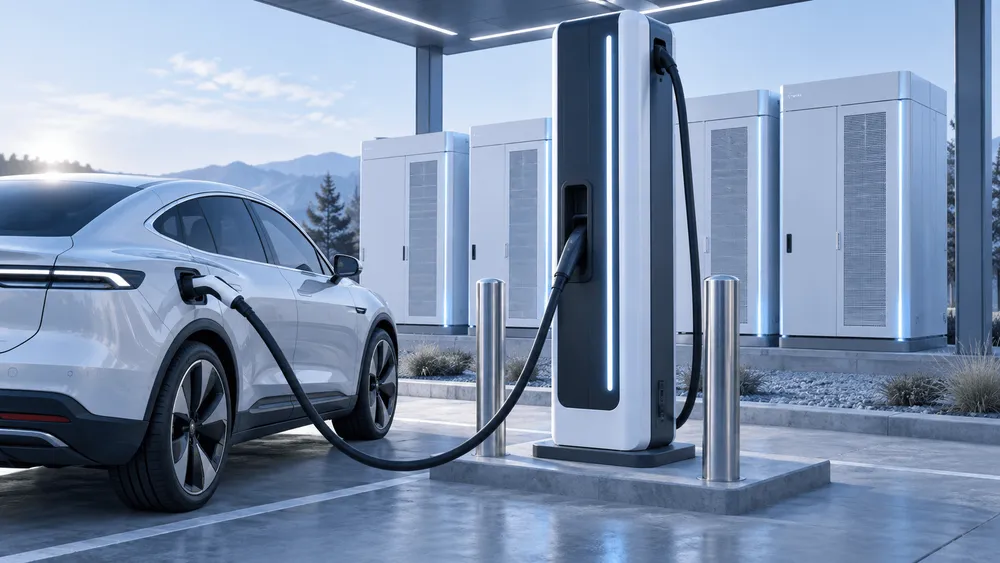
China's Sunwoda has announced a new system that it says can charge an electric vehicle's battery from 10% to 97% in 9 minutes. The company unveiled it on September 17, 2026, in Zaozhuang, Shandong Province, China. It also claims a charging time of 5 minutes from 10% to 70% at room temperature.
At the same event, Sunwoda showed megawatt-class charging infrastructure that pairs chargers with energy storage, and said it plans to build 10,000 sites by the end of 2027. A closer look at the announcement shows that two things need to be considered separately: how fast the battery itself can charge, and whether a charging site can keep supplying high power to many vehicles in succession.
What "97% in 9 Minutes" Actually Means
What Sunwoda announced is a 15C-capable "smart ultra-fast charging battery system." According to Yiche's on-site report, the company claims that at room temperature the battery can go from 10% to 70% state of charge (SOC) in 5 minutes and to 97% in 9 minutes.
SOC indicates a battery's state of charge. "9 minutes" does not mean charging an empty battery to full. It is a manufacturer-stated figure for a specified SOC range, and it should be distinguished from measurements by an independent body.
These two room-temperature figures match the numbers for the second-generation Blade Battery and FLASH Charging that BYD published on March 5. However, this is not a comparative test of the two companies' batteries under identical conditions.
If battery capacity and vehicle models differ, the amount of energy needed to charge the same SOC percentage also differs. The fact that both companies cite 9 minutes does not mean their charging performance is equivalent.
The "15C" label also calls for caution. C-rate expresses the current used to charge or discharge relative to battery capacity. It does not mean that output can be held from the start of charging to the end.
To judge real-world usability, you need a charging curve showing how charging power changes as SOC rises. The on-site reports we could confirm do not give the charging curve, the compatible battery pack capacity, or the specific test vehicle.
More concrete specifications have been disclosed for the equipment side. Sunwoda's presentation slide on charging equipment states that the charging equipment can be configured from 0.8 to 2.4 MW, and that a single connector using a liquid-cooled cable supports up to 1.5 MW.
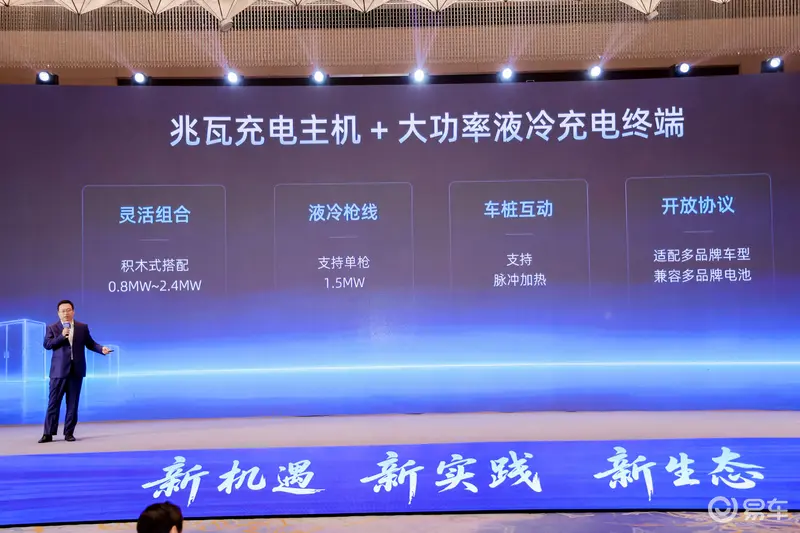
Sunwoda also says the equipment is compatible with vehicles and batteries from multiple brands. But being able to plug into a charger is not the same as every vehicle being able to accept 1.5 MW. Using high-power charging requires that the vehicle's battery, voltage system, and charging controls also support it.
How Long Can the Storage Equipment Keep Running Continuously?
At the launch event, Sunwoda also presented the configuration of the energy storage equipment installed at charging sites, separate from the in-vehicle battery. The capacities and outputs listed on the September 17 presentation slide are the following three types.
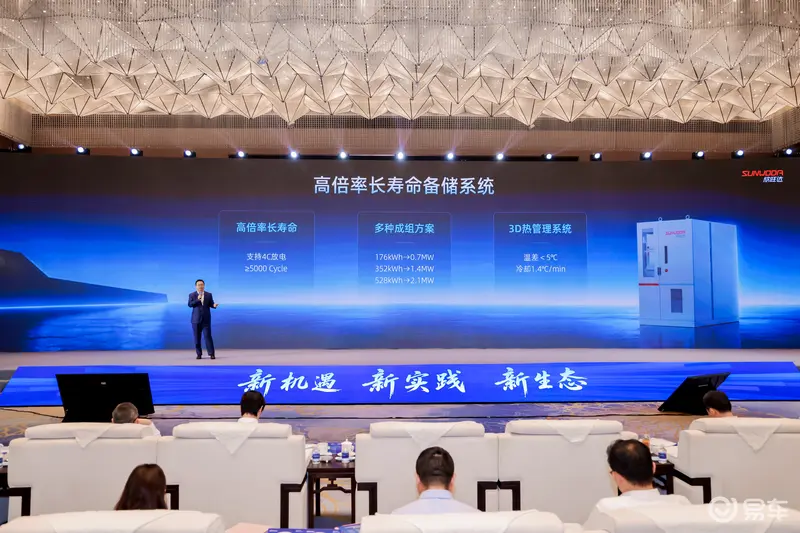
| Storage capacity | Output listed on slide | Time calculated from capacity ÷ output |
|---|---|---|
| 176kWh | 0.7MW (700kW) | about 15.1 minutes |
| 352kWh | 1.4MW (1,400kW) | about 15.1 minutes |
| 528kWh | 2.1MW (2,100kW) | about 15.1 minutes |
In all three configurations, dividing the storage capacity by the stated maximum output gives about 15 minutes. The formula is capacity (kWh) ÷ output (kW) × 60; for example, 176 ÷ 700 × 60 ≈ 15.1 minutes.
However, this is a simple conversion that assumes the entire storage capacity is used, there are no conversion losses, discharge continues at a constant maximum output, and no power is supplied from the grid. It is not a measured continuous operating time.
What the table shows is that output rises in the same proportion as capacity. In other words, rather than a design that adds capacity to sustain the same output for longer, the larger storage units are configured to deliver proportionally more power in the same short period.
The output shown here is the rating of the storage equipment itself, a separate value from the 1.5 MW per-connector maximum mentioned earlier.
A major reason to place storage at a charging site is that it can absorb the gap between the power drawn from the grid and the power delivered to vehicles in an instant.
BYD's official announcement likewise explains that it will co-locate storage systems at charging sites that store power at relatively low output and discharge at high output when needed. Even when the power that can be drawn from the grid at any moment is limited, adding stored power can raise the charging output to vehicles.
However, storage equipment does not create energy by itself.
If the power delivered to vehicles keeps exceeding the power received from the grid, the storage battery's remaining charge declines. Conversely, if it can be replenished during periods of low use or low charging output, it can be ready for the next high-power session.
How long high output can actually be sustained depends on usable storage capacity, losses during power conversion, the power that can be drawn from the grid at the same time, and other factors. The "about 15 minutes" figure is a calculated value; it does not mean a charging site stops after 15 minutes.
For the same reason, the table alone cannot tell us how many vehicles can be charged in 9 minutes. The energy each vehicle needs and the charging output it can accept at the same time vary.
Evaluating a situation such as vehicles arriving one after another on a holiday requires looking not just at the maximum output of each connector but at how the site's overall grid-supply capacity and remaining storage change over time. Charging time per vehicle alone does not reveal waiting times during busy periods.
Ultra-Fast Charging Durability Depends on Warranty Terms
Sunwoda also overhauled its battery monitoring system.
According to on-site reports, the new system combines "Smart Cell 3.0," which has a dedicated chip, an energy control unit, and cloud management. The idea is to pass information from the cells to onboard controls and cloud analysis so that signs of abnormalities or failures can be detected early.
It is important to distinguish a system that monitors a battery from tests that demonstrate the battery's own lifespan and safety.
Having a failure-prediction function does not guarantee that a battery will not degrade or that accidents will not occur. Evaluating long-term use requires data on what charge and discharge conditions a battery was repeatedly subjected to and how much capacity remains after a given period.
On warranty, Sunwoda says that for non-commercial vehicles it places no limit on the number of ultra-fast charging sessions and meets a 10-year, 300,000 km warranty requirement.
The aim of a design that lets users charge this way without worrying about how often they do so is notable. But this announcement alone does not mean the same warranty terms will apply to every vehicle model that adopts the system in future.
In practice, the warranty for each adopting model, including the remaining-capacity criteria and exclusions, will need to be checked.
Performance in cold climates should also be considered separately from the 9-minute room-temperature figure. Evaluating charging time in low temperatures depends on conditions such as whether the battery was preheated before charging and whether the preheating time is included in the charging time.
The information we could confirm does not clarify these test conditions. The room-temperature performance cannot be applied directly to winter use.
The 10,000-Site Plan Raises Questions About Real-Vehicle Performance and Operations
The goal of building 10,000 megawatt-class charging sites by the end of 2027 is also confirmed, as a statement by Sunwoda's head of charging business, in an on-site report published on China Energy News's official account.
However, this is not a count of completed sites. It is a plan to build them over time while recruiting partners.
The vision Sunwoda has shown goes beyond supplying in-vehicle batteries to running a charging infrastructure business that combines storage equipment and chargers.
If it can serve vehicles from multiple brands, it may reduce the need for each manufacturer to build its own charging network. On the other hand, the more vehicle models that can use the sites, the more important output allocation becomes when several vehicles are connected at once, as does operating capacity during periods of concentrated demand.
Without knowing the sites' locations or the power they can receive from the grid, it is hard to judge real convenience from the number of sites alone.
For Japanese users too, it is too early to tie this announcement directly to a purchasing decision.
The announcement materials and on-site reports we could confirm do not identify the first vehicle model to adopt the system, the start of mass production, or the conditions for introduction in Japan. Two things are needed: batteries that can accept high-power charging, and enough charging sites that can deliver it.
If actual charging curves for adopting models are shown, along with data from charging several vehicles in succession, the "9 minutes" figure could be evaluated in a way that is closer to real-world conditions.
If both batteries and charging equipment support it, and short charging sessions can be delivered repeatedly even during peak hours, the way people think about charging on long trips could change significantly.