

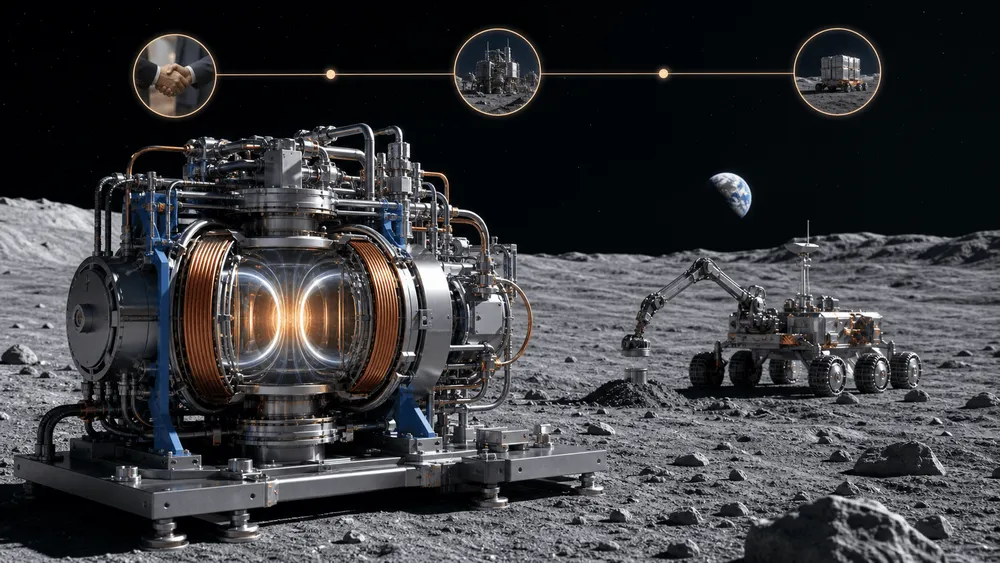
On August 5, 2026, fusion development company TAE Technologies signed an agreement with Black Moon Energy Corporation (BMEC), a company focused on lunar resource development, covering future helium-3 supply and commercialization cooperation. TAE plans to bring its first 50 MWe power plant, "Da Vinci," online in 2031, but what has been agreed upon this time is not the physical delivery of fuel. BMEC, the prospective supplier, has not yet conducted any lunar surface exploration, and its target timeline for large-scale supply is set for the mid-2030s. A gap of several years—along with a lack of measured data—remains between the power generation plan and the fuel procurement plan.
What Was Obtained Is an Option, Not the Fuel Itself
The agreement stipulates that BMEC will supply helium-3 to TAE in the future. However, the two companies have not disclosed the supply volume or price. Quality specifications and the date of first delivery also remain unknown. TAE CEO Michl Binderbauer has explained that what the agreement provides is "an alternative fuel supply option," which will allow the company to choose a cost-competitive fuel cycle in response to long-term changes in the fuel market.
This statement is inseparable from TAE's traditional policy. Since its founding, the company has treated p-B11—a reaction between hydrogen and boron-11—as its primary candidate for commercial reactors. The company states that its field-reversed configuration (FRC) can operate not only with p-B11 but also with deuterium-helium-3 (D-He3) and deuterium-tritium (D-T). This agreement represents a move to extend that range of fuel options into the supply chain. No decision has been announced that Da Vinci will use helium-3.
In the primary D-He3 reaction, a 14.68 MeV proton and a 3.67 MeV helium-4 nucleus are produced. Because the total energy of 18.35 MeV is carried mainly by charged particles, no neutrons are emitted from the primary reaction, unlike in D-T reactions. However, deuterium-deuterium reactions also occur within the plasma, producing neutrons. A D-He3 reactor therefore cannot be unconditionally called "neutron-free fusion."
The Gap Between 2031 and the Mid-2030s
TAE plans for Da Vinci to be its first 50 MWe power plant, expecting to select a construction site within 2026 and begin operation in 2031. Future facilities are envisioned to scale up to 350–500 MWe. Both of these are corporate development plans, not power output figures confirmed through experiments.
Meanwhile, BMEC's announced "Fusion 1" mission plans to have a rover traverse a designated operational area in the Sea of Tranquility for one year, directly collecting and analyzing regolith. Using mass spectrometers and other instruments, the mission will measure helium-3 concentration and volatile components, and will also test autonomous operation across the lunar day-night cycle. According to the joint announcement with TAE, a single exploration mission will be conducted within five years—that is, by August 2031 at the latest. A separate BMEC planning page cites the mid-2030s as the timeframe for becoming a primary supplier.
The number of collection points during the exploration, the total sample volume, driving distance, launch date, and the amount of helium-3 to be returned to Earth have not been disclosed. Therefore, even if Da Vinci begins operating as planned in 2031, there is no guarantee that BMEC's lunar resource assessment and mass-production supply capability will be established beforehand. What the agreement has created is a future transaction pathway—not material that fixes the fuel schedule for the first reactor.
From the planned figure of 50 MWe, a theoretical minimum fuel requirement can be calculated. Even under conditions unattainable in reality—converting the generated 18.35 MeV into electricity with 100% efficiency, burning all input helium-3 completely, and operating continuously for 365 days—the required amount would be approximately 2.7 kg per year. This calculation divides 50 million J/s by 2.94×10^-12 J per reaction, then multiplies by the mass of a single helium-3 nucleus (5.01×10^-27 kg) and the number of seconds in a year (31,536,000). In an actual reactor, conversion losses, unburned fuel, and maintenance downtime would increase the required amount, but TAE has not disclosed its projected fuel consumption.
The 66 kg Per Year Figure Is Not a Lunar Surface Measurement
How much helium-3 could be obtained by processing lunar regolith? A conference paper presented by Aaron D.S. Olson of NASA Kennedy Space Center at AIAA ASCEND 2021 (DOI: 10.2514/6.2021-4237) presents a design figure of 66 kg per year. However, this is not a result derived from actual mining on the lunar surface.
The calculation assumes a helium-3 concentration in regolith of 20 ppb and targets particle sizes under 100 µm. It assumes excavation of 1,258 tons per hour, with 556 tons processed per hour during lunar daytime. It also assumes that regolith is heated to 700°C using 12 MW of concentrated solar power, with 85% of the input heat recoverable. This is a conceptual design showing that, if all these conditions were met, 66 kg could be stockpiled over the course of a year. Even according to NASA's document management information, the review category is listed as "Single Expert"—this is not a peer-reviewed demonstration study.
On Earth, research is progressing using lunar regolith simulants, heating them to extract volatile components. Even so, BMEC has not demonstrated, as an integrated process, the uneven concentration distribution on the lunar surface, continuous excavation in a dusty environment, separation and compression, and return to Earth. Fusion 1 is precisely the mission that will measure concentration and operational conditions going forward. Treating NASA's 66 kg figure as BMEC's production capacity would mean substituting a conceptual design for an actual track record.
What Has Been Peer-Reviewed Is FRC Formation—Nothing Further
TAE's device development does include peer-reviewed experimental results. A paper published by T. Roche and colleagues in Nature Communications in 2025 (Vol. 16, 3487, DOI: 10.1038/s41467-025-58849-5) reports that FRC formation was achieved using only neutral particle beams, on both Norm and its predecessor, Norman.
In the experiment, eight neutral particle beams at 15 keV were used, injecting up to 13 MW. After accounting for duct losses and transmission, the plasma typically absorbed about 8 MW. When the beams were captured by the initial seed plasma, current and pressure increased, and the reversal from open field lines to a closed FRC was completed in approximately 10 ms. While the paper is peer-reviewed, the total number of shots is not specified in the main text.
What this result verified is FRC formation using neutral particle beams. It is not an experiment that measured net energy from D-He3 fusion, 50 MWe power generation, or the suitability of lunar-derived fuel. No new paper, preprint, or simulation results have been attached to this helium-3 agreement either. Therefore, no data currently exists that would allow evaluation of reproducibility or independent verification for the supply and power generation envisioned under this agreement.
To turn this agreement into actual power generation, three things will be needed: the location-specific concentration and recovery efficiency that Fusion 1 measures, the price per kg after return to Earth, and the net electrical output and actual fuel consumption that TAE's device achieves using D-He3. Whether these three sets of measured data will be published before operations begin in 2031 is the material on which judgments connecting fuel options to the power generation business will depend.