

It has emerged that Tesla may be preparing to separate its China business ahead of a potential merger with SpaceX. The Wall Street Journal (WSJ) reported on July 30, 2026, citing people familiar with the discussions. The options under consideration reportedly include spinning off the unit, selling it, or shutting it down. However, neither Tesla nor SpaceX has announced any formal plan, and no buyer, timeline, or scope of the deal has been determined.
China is Tesla's second-largest sales market and, at the same time, its largest vehicle production hub in the world. Shanghai has also begun mass production of the large-scale Megapack battery. Even if the aim is to keep SpaceX's defense contracts at arm's length from any China exposure, misjudging what exactly gets separated could cost Tesla the very mass-production base it needs for its shift into AI and robotics. Whether the merger concept is even feasible depends far more on whether a clear boundary can be drawn around "the China business" than on simply adding up enterprise values.
Sale, Spin-off, or Shutdown—Nothing Yet Decided
According to the WSJ, some Tesla executives have been instructed to prepare to separate the China business in anticipation of a merger with SpaceX. Advisers reportedly examined options including spinning it off as an independent company, selling it to a third party, or shutting it down entirely. The timing remains unclear, and the plans could still change.
This is not a discussion that arose out of nowhere. The WSJ reported that Elon Musk has, in recent years, asked management to draw a "laser" line between the U.S. and China businesses—so that, even if U.S.-China relations deteriorate, at least the U.S. side could survive intact. By separating China's local entity, supply chain, and information systems in advance, the damage from any geopolitical rupture could be contained.
What exactly "the China business" refers to, however, has not been disclosed. Tesla's 2025 annual report lists both the Shanghai vehicle plant and the Megapack factory as major manufacturing facilities. China also has its own sales company and service network. Storage and processing of vehicle data are also subject to Chinese regulation. A plan to transfer equity in the factories and a plan to withdraw from the Chinese market altogether would leave Tesla's parent company with vastly different levels of remaining revenue and manufacturing capacity.
A 22% Sales Share and a 52% Global Delivery Share Aren't the Same "China Ratio"
Of Tesla's 2025 revenue of $94.827 billion, sales in China totaled $20.962 billion—a share of 22.1%, second only to the United States. Meanwhile, according to the Shanghai municipal government, Gigafactory Shanghai shipped 851,000 vehicles that year, accounting for 52% of Tesla's roughly 1.636 million global deliveries.
| Metric | Value (2025 or early 2026) | What the Number Represents |
|---|---|---|
| Sales in China | $20.962 billion, 22.1% of company total | Products/services with China as the point of sale |
| Shanghai vehicle plant shipments | 851,000 units, 52% of global deliveries | Factory shipments including both China sales and overseas exports |
| Shanghai's nominal annual capacity | Over 950,000 units for Model 3/Y | Installed capacity, not actual production volume |
| Shanghai Megapack factory | 20 GWh annually | A battery business separate from vehicles |
The gap between 22.1% and 52% doesn't mean the Shanghai plant is "bigger" than the Chinese market. The former is revenue by point of sale; the latter is unit shipments by factory, including exports—the denominators and product scopes differ. If anything, the two figures together show that Shanghai-built vehicles also support Tesla's sales outside China. Whether Tesla continues sourcing vehicles from Shanghai after selling off the Chinese entity, or shifts supply for Europe and Asia to the U.S. and Berlin, would result in a fundamentally different company after the deal.
Furthermore, whether the separation includes the Shanghai Megapack factory would also change the growth potential of the energy business. That plant began mass production in 2025, and Tesla stated in its Q1 2026 materials that its annual capacity stood at 20 GWh. If the "China business" in the WSJ report is narrowed down to just the vehicle plant, both the battery business and exports get overlooked.
Can Defense Contracts and the China Business Really Sit Under the Same Corporate Umbrella?
According to materials SpaceX disclosed in 2026, roughly one-fifth of its 2025 revenue came from U.S. federal government agencies. Its customers include not only NASA but also defense and intelligence agencies. The government retains the authority to suspend, terminate, or narrow the scope of contracts, conduct audits, and revoke necessary security clearances.
The U.S. Defense Counterintelligence and Security Agency (DCSA) defines Foreign Ownership, Control or Influence (FOCI) as a state in which a foreign stakeholder can affect a company's management or operations in ways that could adversely impact unauthorized access to classified information or the performance of classified contracts. Simply having a Chinese subsidiary does not automatically trigger a FOCI designation. Even so, a company holding a facility clearance must disclose its foreign relationships collectively via SF 328. If Tesla were absorbed into the group, its Chinese subsidiary, local financing, land-use rights, and relationships with Chinese authorities would all become material to SpaceX-side reviews.
This is where the meaning of the "laser" line reported by the WSJ shifts. If the business can be physically and legally isolated, the pathway through which Chinese interests could influence SpaceX's classified contracts narrows. Conversely, if Tesla China were simply placed under the same holding company, sharing funding, executives, and information systems in an integrated structure, it would become difficult to explain any separation design. The direct trigger for the discussions reported by the WSJ isn't the performance of the China business itself—it's concern over placing SpaceX's defense contracts and a China-based operation under the same corporate group.
Data, Debt, and Land-Use Rights That Would Remain Even After Separation
China's automotive data regulations cover not just video and location data collected while a vehicle is in use, but also data generated throughout design, production, sales, and maintenance. Important data must, in principle, be stored within China, and sending it abroad requires a security assessment by bodies such as the Cyberspace Administration of China. So even if the China business is sold, exactly what data Tesla's parent company can receive to improve FSD (Supervised) would be determined by both the licensing agreement and China's data regulations.
The financial dimension is also not trivial. As of the end of 2025, Tesla's outstanding principal on its China working capital facility stood at $4.288 billion, with $1.429 billion undrawn. This borrowing is non-recourse debt secured against the assets of the Chinese subsidiary, carrying interest rates of 2.01–2.11%. In 2025, the facility's committed amount—originally RMB 20 billion—was increased by the same amount again. In any sale or spin-off, Tesla would need to work out with its lending banks whether the facility can be maintained, repaid, or assumed by the buyer.
At Shanghai's two factories, Tesla owns the buildings, while land is held under an initial 50-year land-use right. Moreover, if the buyer is a large enterprise—domestic or foreign—merger filings with China's State Administration for Market Regulation could be required, depending on both parties' China revenue and the structure of the transaction. Separation might simplify review on the U.S. side, but China's data regulations, bank agreements, and merger review requirements would still need to be addressed.
Integration Already Underway at Terafab—and a Choice for Shareholders
The business ties between Tesla and SpaceX have already extended into capital and manufacturing. In March 2026, Tesla invested $2.002 billion in SpaceX stock. SpaceX had acquired xAI in February of that year, and Tesla now holds 18,990,195 shares of listed SpaceX Class A stock—though that stake represents less than 1% of the company.
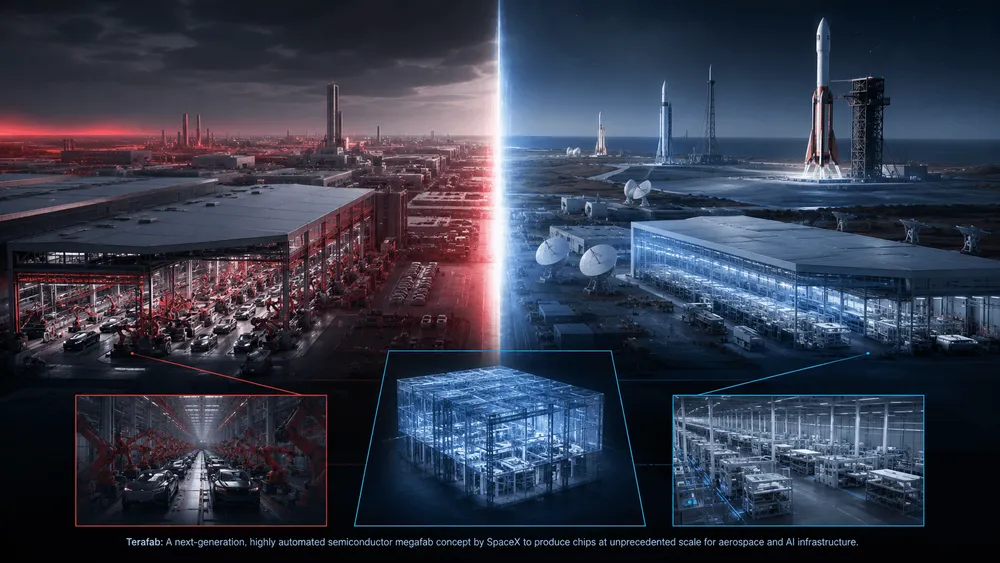
Looking at transaction volumes clarifies the rationale behind the merger idea. In 2025, SpaceX purchased $147 million worth of goods and services from Tesla. xAI, now under SpaceX, purchased $506 million from Tesla that same year, and spent a further $303 million between January and April 2026—of which $269 million was for Megapacks purchased in April. Tesla's Q1 2026 materials describe Terafab, a project it is pursuing with SpaceX, as a massive semiconductor fab concept aimed at vertically integrating logic, memory, and advanced packaging.
Separating the China business runs somewhat counter to this integration logic. In April 2026, Tesla China president Wang Hao told the AP that Shanghai's manufacturing division would also contribute to solving mass-production challenges for humanoid robots. While no specifics were given, a deal that gives up Shanghai wouldn't simply mean fewer vehicles—it would be a choice about which mass-production know-how Tesla retains as it pursues its stated transformation into an AI and robotics company.
Elon Musk serves as Tesla's CEO and a director, while at SpaceX he holds the roles of CEO, chairman, and primary shareholder. If the merger advances to a formal proposal, it will be important to confirm not only the exchange ratio and the valuation attached to the China business, but also whether the review process—including independent director oversight, advisers, and shareholder approval procedures—will be disclosed. The numbers that will underpin any judgment aren't the combined market capitalization after a merger, but who ends up assuming the $20.962 billion in China sales, the 851,000 Shanghai shipments, and the $4.288 billion in China-related financing. Any proposal that leaves out these three figures fails to make clear just what Tesla's mass-production capacity would be traded for.