

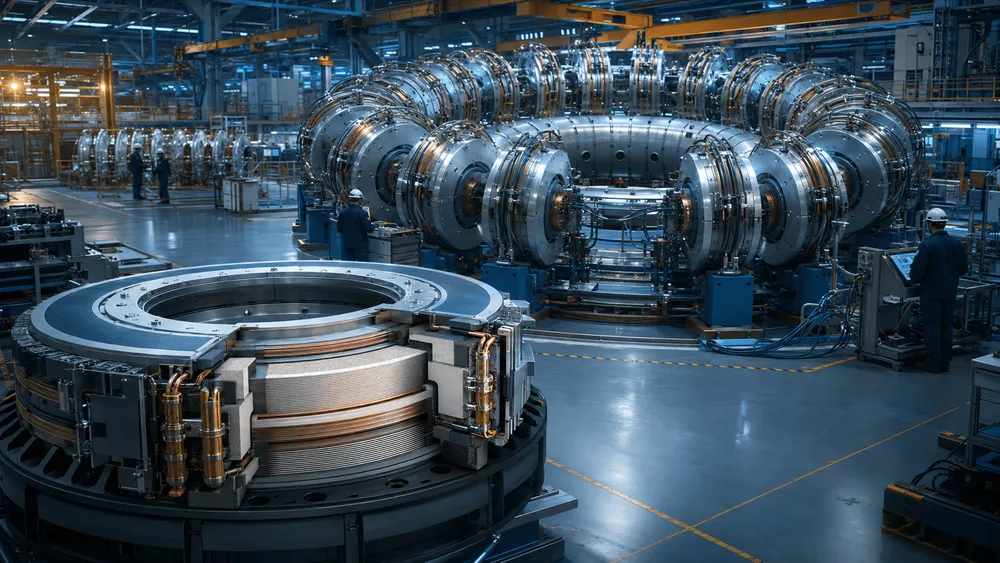
Thea Energy is moving its planar high-temperature superconducting (HTS) magnets from the prototype room to the production line. The US Department of Energy's ARPA-E selected the company for SCALEUP Ready on July 9, 2026, and Thea Energy announced on July 27 that the support amounts to $20 million. The funds are not for operating a fusion reactor, but for expanding manufacturing and testing capacity for modular HTS magnets and establishing what is described as the first production line of its kind in the US. Ahead of Eos, the demonstration machine requiring roughly 300 planar-shaped coils, the development bottleneck has shifted from "getting one unit running" to "matching them all to the same quality."
What $20 Million Buys: A Process for Aligning About 300 Units
ARPA-E's July 9 announcement of SCALEUP Ready selectees named Thea Energy and Xscape Photonics, a company working on optical computing. Thea Energy will expand its manufacturing and testing capacity in Kearny, New Jersey, and establish a domestic production line for modular HTS magnets.
SCALEUP Ready is a framework for advancing organizations that have grown their technology with ARPA-E support toward commercial scale. What was reviewed in this selection was the technology's maturity and whether it could be scaled commercially. Thea Energy's planar coil technology grew out of the agency's BETHE fusion program, and this round of funding is directed less at exploring research principles and more at establishing a process that can be repeated with stable yield.
According to the company, it has updated its coil design more than 100 times over roughly the past two years. The plan for the next machine, Eos, calls for using about 300 units. Aligning hundreds of units to the same specification requires managing not just pass/fail for a single unit, but also manufacturing time, acceptance inspection, and rework rates. These factors have now entered a stage where they determine the schedule and cost of the entire device.
Thea Energy also raised a $100 million Series B in May. The public funding is intended to grow the in-house reactor components the company builds into domestic supply capacity. However, production capacity, cost per unit, and target yield have not been disclosed. The start date of operations and confirmed orders from outside customers also remain unknown. There is still a distance between being selected to "build a production line" and the line actually shipping commercial products stably.
Shifting the Stellarator's Complexity From Magnets to Control
A stellarator creates a twisted magnetic field using external magnets, without driving large currents through the plasma. Compared to a tokamak, which relies on large plasma currents, it is better suited to steady-state operation and more easily avoids the sudden plasma disruptions that current can trigger. In exchange, achieving the three-dimensional magnetic field needed for good confinement has historically required implementing it with intricately curved, high-precision coils.
This manufacturing burden is well documented in history. PPPL's NCSX was canceled in 2008 after cost and schedule projections worsened due to complex component geometry and tight tolerances. Its modular coils required placement precision within ±1.5 millimeters on the device. Germany's Wendelstein 7-X has achieved strong operational results, but its construction—incorporating 50 non-planar superconducting coils and 20 planar coils across five modules—illustrates how a large stellarator can become an assembly of custom-made parts.
Thea Energy combines large planar coils surrounding the plasma with smaller planar-shaped coils arrayed outside them. By running separate currents through each shaped coil, the composite magnetic field creates the required three-dimensional shape. In the DOE's framing, this is a design that moves complexity away from "convoluted coils" and into the control system. Circular, flat coils make it easier to wind REBCO superconducting tape under tension, and the same parts can be produced repeatedly.
Software control offers another advantage. If errors arising from manufacturing or assembly can be measured and the magnetic field corrected using the current in each coil, tolerances for shaping the ideal geometry out of metal parts alone can be relaxed. It also makes planar coils easier to remove during maintenance, opening the way to designs where large reactor sectors can be withdrawn from between the coils. That said, the work of bundling hundreds of power supplies and cryogenic wiring, withstanding electromagnetic forces, and protecting against failures does not disappear—the location of the complexity simply changes.
What Nine Canis Units and a 6T Coil Have Proven
The most concrete public experiment to date is Canis, a 3×3 array of nine small HTS coils. Thea Energy operated the array at 20K and controlled the magnetic field on a plane 25 centimeters from the coil surface to within ±1% of the predicted value. There is now real machine data supporting the basic premise that a group of flat coils can reproduce the non-uniform magnetic field a stellarator requires.
The Canis paper also clearly states the boundaries of the test. These nine units cannot generate net toroidal flux, and they did not reproduce closed magnetic surfaces or quasi-symmetry. While the current and field gradients were made to resemble Eos, the test also did not incorporate structure, cooling, and power supplies at densities comparable to an actual machine. What Canis confirmed, therefore, is the ability to locally shape a magnetic field—not an integrated stellarator capable of confining plasma.
In May 2026, there was a further, larger step forward. Thea Energy announced that it operated a single shaped coil at 20K, targeting the same dimensions, currents, and field conditions as Eos, and controlled a magnetic field exceeding 6T. In other words, control precision was verified with the small array, and current and field were verified with a full-scale coil.
The remaining tests are substantial. It must be confirmed whether the coils can withstand quenches—where part of the high-temperature superconductor transitions to a normal-conducting state—whether control can be maintained despite manufacturing variability and defects, and whether electromagnetic forces and heat can be managed when roughly 300 units are operated simultaneously. Thea Energy itself has listed quench resistance of full-scale coils and additional digital-twin validation among the challenges ahead.
Three Tests That Remain Beyond the Production Line
The US Department of Energy's Fusion Science and Technology Roadmap, compiled in June 2026, listed HTS magnet manufacturing technology as a strategic item for domestic supply chains. What it calls for, beyond expanding manufacturing volume, is characterizing REBCO tape properties under neutron irradiation. Common standards are also needed for critical current, AC losses, and joint performance. Thea Energy's production line increases "how much can be built." Meanwhile, being certified for long-term use in a power-generating reactor requires standardizing "conditions for use," including radiation and failure modes.
The planned power reactor Helios illustrates the scale of this gap. In the pre-conceptual design released at the end of 2025, it uses 12 large circulating coils and 324 shaped coils, keeping the maximum field on the coils at 20T. Design calculations project a thermal output of 1.1GW, net electrical output of 390MW, a capacity factor of 88%, and a coil lifetime of over 40 years. However, these are pre-construction design values, not operational results.
The first question to be answered is the annual capacity of the production line. Yield and per-unit inspection time will directly determine Eos's construction schedule. Next is whether full-scale coils can withstand quenching and neutron irradiation, and coexist with hundreds of power and cooling systems. And finally, whether Eos—targeted for operation in 2030—can have its roughly 300 coils form a single closed magnetic surface and reach long-duration plasma operation. Once that point is reached, planar magnets can be evaluated as a means of solving the stellarator's manufacturing problem.