

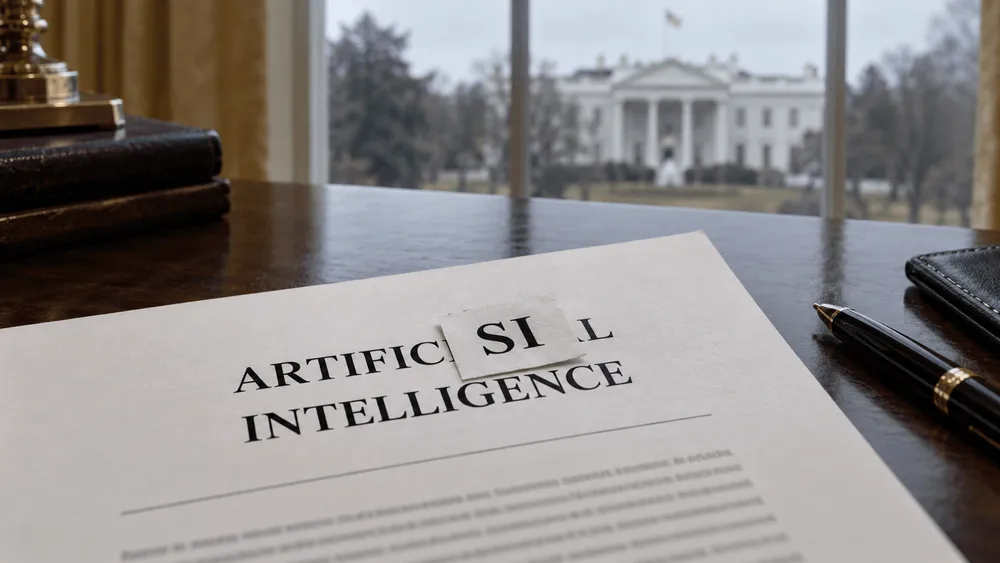
On September 29, 2026, US President Donald Trump signed an executive order directing federal agencies to use the term "Super Intelligence (SI)" in place of "Artificial Intelligence (AI)" in official documents and elsewhere.
The Trump administration explains the new name by saying that today's most advanced AI has moved beyond merely imitating or automating human intelligence and has become a technology that amplifies human ingenuity and creativity.
However, the order does not limit what it calls "SI," for now, to systems with intelligence exceeding that of humans. It applies the definition of "AI" in existing US law to SI as well.
The same term "SI" has also begun to appear in a new government service, "America.gov," which uses Gemini, and in US-China technology talks. While the name is changing, it remains necessary to check separately which technologies are actually covered and how their capabilities and safety will be evaluated.
How far does the US government's "AI to SI" renaming extend?
The executive order, titled "Inaugurating the Era of Super Intelligence," directs federal agencies, to the extent permitted by law, to use "Super Intelligence" and "SI" instead of "Artificial Intelligence" and "AI."
It covers administrative documents that are not statutes themselves, such as agencies' official correspondence, public communications, websites, reports, and policy documents.
In other words, it is not an order prohibiting private companies, universities, or researchers from using the word "AI."
Nor does it require all previously produced documents to be rewritten with the SI terminology.
Section 2(b) of the order states explicitly that rules, presidential actions, contracts, grants, and other documents already issued do not need to be changed. Section 4 further provides that the order does not alter existing agency authorities and that its implementation is subject to current law and available appropriations.
Therefore, even if "SI" appears more often in future US government documents, existing laws and contracts that say "AI" do not become invalid.
The order also includes a process for changing the term in statute itself.
It directs the Assistant to the President for Science and Technology to submit to the President, within 60 days, a legislative proposal establishing federal statutory definitions of "Super Intelligence" and "SI."
That proposal is to consider whether to amend the current legal definition of AI, broaden its scope, or replace it with a different definition, and to set out changes to the "Artificial Intelligence" and "AI" wording in existing law.
Note that the 60-day deadline is for submitting draft legislation to the President. It does not mean a law will be enacted within 60 days.
Despite the name "Super Intelligence," the current scope is conventional AI
The most important provision in the order is Section 3(a).
Unless otherwise provided by law, this section applies the definition of "Artificial Intelligence" in 15 U.S.C. § 9401(3) to the technologies and systems that "Super Intelligence" and "SI" refer to.
US law defines AI as a machine-based system that, for a given set of human-defined objectives, makes predictions, recommendations, or decisions influencing real or virtual environments.
The definition further lists features such as:
- Perceiving real or virtual environments
- Automatically analyzing the information obtained and turning it into models
- Using the models to infer options for information or action
This definition contains no requirement of "intelligence higher than that of humans."
As a result, the executive order has not made SI out of only those systems whose capabilities technically exceed human ones.
At least for now, the structure is one in which technologies and systems that have been treated as "AI" under the law are simply called "SI" in administrative documents.
This needs to be distinguished from "superintelligence" as used in research circles.
For example, in its July 2023 explanation of "Superalignment," OpenAI used superintelligence to mean AI systems far more capable than humans.
OpenAI itself explained at the time that it chose the word "superintelligence" to stress a capability level even higher than AGI.
| Source | What "AI/SI" refers to | Is exceeding human ability a condition? |
|---|---|---|
| 15 U.S.C. § 9401(3) | Machine-based systems that make predictions, recommendations, or decisions toward human-defined objectives | Not a condition |
| Executive order of September 29, 2026 | For now, technologies and systems within the above AI definition are called SI | Adds no new capability condition |
| OpenAI's 2023 Superalignment | Envisions future AI far more capable than humans | Presupposes a high capability level |
In other words, even with the same words "Super Intelligence," the SI the US government has now adopted as administrative terminology and the "superintelligence" traditionally used in AI research are not necessarily defined by the same standard.
How the administration positions the technology and which systems are subject to regulation and policy under the legal framework need to be read separately.
Separately from the renaming, a system for measuring model capabilities is advancing
A mechanism for deciding which AI models the government will address based on their capabilities was already in progress before this renaming.
In the executive order Trump signed on June 2, 2026, relevant agencies were instructed to develop classified benchmarks for evaluating AI models with advanced cyber capabilities.
With the involvement of the National Security Agency (NSA) and others, criteria are to be drawn up for designating models that exceed a certain capability level as "covered frontier models."
This is not merely a change of name. It is a system for actually measuring how much cyber capability a model has and selecting the models the government will treat specially.
The same order also establishes a voluntary framework under which AI developers provide models under development to the government.
For models that fall within the framework, developers may give the government access up to 30 days before releasing them to other trusted partners.
However, this is not a system requiring every AI company to submit its model to the government 30 days before public release.
The text clearly describes it as a voluntary framework, and it does not authorize creating a system that would make prior government approval or licensing mandatory for developing or releasing models.
The June order deals with concrete mechanics: which capabilities to measure and which models the government will examine closely.
The September 29 order, by contrast, changes the term agencies use from AI to SI.
The two need to be considered separately.
Also, building an evaluation system for cyber capabilities is not the same as being able to assess every risk associated with AI.
When examining the safety of models called "SI" going forward, it will be necessary to look not just at the name but at which capabilities were tested and under what conditions.
America.gov, which uses Gemini, also uses the term "SI"
Another executive order on America.gov, signed on September 29, already uses the term "super intelligence."
America.gov is being built as a common portal through which US citizens access federal government services.
The concept is that users log in through a single entry point, search for information by asking questions in everyday language, and, where technically and legally possible, proceed directly with administrative procedures.
Google announced the same day that it would become a technology partner for America.gov and use Gemini.
This means the technology the US government has begun calling "SI" is not limited to an abstract future technology.
AI technology like the currently available Gemini is also beginning to be handled under the name SI within the administrative system.
However, Google providing Gemini to America.gov does not certify that Gemini has reached "superintelligence that surpasses humans" in the research sense.
An administrative name and an evaluation of a model's capabilities are separate matters.
The America.gov order requires that the SI used in the service ensure accuracy, reliability, and transparency.
It also provides that:
- Each agency continues to control its own records, systems, and legal authority
- No more personal information than necessary is collected
- Secure identity verification is used
- It is possible to check afterward who accessed what information
- Existing channels such as in-person, phone, mail, and agency websites remain available
Building a conversational AI-based portal is not designed to replace agencies' own decision-making authority or all existing procedures.
There are also conditions on which government services are covered.
As a general rule, federal services that have more than 100,000 users over a 12-month period and can be used or applied for online fall under America.gov.
IRS tax filing services and services provided by the Department of War and intelligence agencies are excluded.
The Office of Management and Budget (OMB) is to issue a document setting out the implementation method within 90 days.
This does not mean all government services will move to America.gov within 90 days.
What matters for users is which services are actually connected and how far accurate guidance and lawful administrative procedures can be provided.
In US-China talks, too, "SI" rather than "AI"
The name "SI" had begun to be used in diplomacy even before the September 29 executive order.
According to the White House's account of the US-China summit, published on September 25, Trump and Chinese President Xi Jinping agreed to use the name "Super Intelligence" rather than "Artificial Intelligence" for the emerging technology in question.
The two countries also agreed to establish a "U.S.-China Super Intelligence Dialogue" to exchange views on the risks and benefits of SI.
The next round of talks is scheduled to be held by November 2026, and the two sides are also to set up a bilateral communication channel for notification in the event of an SI-related incident.
However, this is the US government's published account of the summit.
It does not show that the word "AI" has been changed to "SI" in all Chinese government documents, nor that the incident-notification mechanism has already been put into actual operation.
Also, sharing the name "SI" does not mean the two countries have settled on detailed common criteria for which capabilities count as "Super Intelligence" or what events will be treated as "SI incidents."
Here too, the name and the actual system design need to be considered separately.
What to watch next: the legal definition of "SI"
The element of this executive order that may carry the greatest significance is the new definition proposal due within 60 days.
At present, what the government calls "SI" covers roughly the same scope as conventional AI.
But if the new legislative proposal gives "Super Intelligence" its own definition, the scope could change.
Will the existing AI definition be kept as is? Will a specific capability level be added as a condition? Or will it be defined as a broader concept than AI?
The executive order asks the Assistant to the President for Science and Technology to consider these questions.
If exceeding human ability were added as a condition of SI, a further question would arise: on what basis is something judged to have "surpassed humans"?
Conversely, if the government keeps calling roughly the same things as conventional AI "SI," as it does now, a gap will remain between the "superintelligence" used in research circles and "SI" as administrative terminology.
What has been decided so far is the name the US government will use.
Which technologies that name will cover, and what capability standards will anchor the policies and safety measures applied to it, will depend on the legal definition and evaluation methods yet to be presented.