

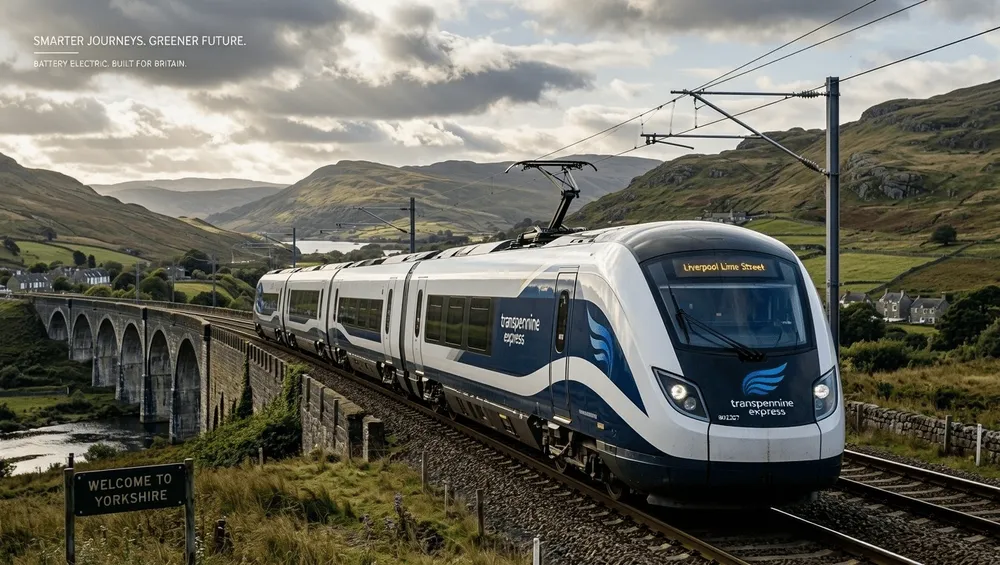
Northern England's rail network has long suffered from chronic delays, sudden service suspensions, and a convoluted fare system. The lines connecting major cities like Manchester and Leeds—cities that once thrived on coal mining and cotton weaving and laid the foundations of the British Industrial Revolution—have historically lagged behind London and the south in modernization investment. In particularly difficult sections crossing the Pennines, constraints on tunnel clearances and the need to reinforce viaducts have repeatedly delayed overhead wire installation, leaving old diesel trains as a permanent fixture of daily operations.
As a means of breaking this infrastructure deadlock, the UK government and train operators have turned to introducing battery-hybrid trains on mainline routes. French rolling stock giant Alstom and operator TransPennine Express (hereafter TPE) formally signed a major contract on September 11, 2026, covering the manufacture and maintenance of 29 battery-electric multiple units (BEMUs).
However, summaries circulating in some overseas tech media—describing the trains as running "entirely on battery power" or as "a direct evolution of Hitachi's 2024 trial"—diverge from the engineering reality and procurement structure. Cross-referencing the confirmed documents officially released by the UK Department for Transport (DfT), Network Rail, Alstom, and TPE reveals a clear boundary between established contract facts and undisclosed technical constraints.
The Reality Behind the £1 Billion Contract and Derby Factory Production
The procurement contract's framework is not merely a clean-tech proof of concept—it is structured as a commercial arrangement mediated through a rolling stock leasing company (ROSCO). Rock Rail, a rail vehicle investment company, will purchase the trains and lease them to TPE on a long-term basis. According to publicly released materials from the DfT and Alstom, the "Adessia Stream" trains being introduced under this contract are set to directly replace some of the Siemens-built Class 185 diesel trains currently operated by TPE.
- GBP figures (as published by DfT/TPE/Network Rail)
- EUR figures (as published in Alstom's official release)
データを表で見る
| GBP figures (as published by DfT/TPE/Network Rail) (millions) | EUR figures (as published in Alstom's official release) (millions) | |
|---|---|---|
| Vehicle manufacture/delivery | 800 | 930 |
| Maintenance/depot upkeep | 200 | 230 |
| Total contract value | 1,000 | 1,200 |
There are discrepancies in currency representation across primary sources regarding the contract value. Alstom's official announcement states a total of €1.2 billion (approximately €930 million for train manufacturing and approximately €230 million for the maintenance contract), while the joint announcement from the UK Department for Transport (DfT), TPE, and Network Rail cites "approximately £1 billion." According to breakdown reporting from UK rail industry publications Modern Railways and Rail UK, this £1 billion figure corresponds to roughly £800 million for the vehicles and roughly £200 million for maintenance facilities and charging infrastructure.
Manufacturing will take place at Alstom's Litchurch Lane factory in Derby, in the English Midlands. Alstom positions this facility as "the only complete rolling stock factory in the UK capable of handling design, engineering development, manufacturing, and testing all in one place." Given that fluctuations in domestic demand for new rolling stock have recently made maintaining operations at this site a politically sensitive issue, the DfT has framed this order as part of a broader effort to revitalize UK manufacturing.
Furthermore, the DfT and Network Rail emphasize that this fleet will be the first new rolling stock to operate under "Great British Railways" (GBR), the planned framework aimed at unifying track infrastructure and operations management. In a UK rail network that has long been buffeted by the fragmentation of infrastructure ownership and operating rights since privatization, this project is positioned as a symbolic case for the new system's push toward stronger public control.
The Reality of the Bi-Mode Design Combining Overhead Wires and Batteries
There are instances of misunderstanding suggesting that these trains are "fully electric" vehicles that run primarily on battery power. However, according to reports from specialist publications such as Modern Railways and primary source materials, the Adessia Stream's operating mode is a bi-mode design (BEMU) that combines overhead line electrification (25kV AC, 50Hz) with onboard batteries.
The UK government and Network Rail are currently advancing a major modernization project across the Pennines called the Transpennine Route Upgrade (TRU). On sections where TRU completes electrification, the trains will raise their pantographs and draw power directly from the 25kV AC overhead lines. When entering coastal end-of-line sections or branch lines without overhead wires, the trains will switch their power source to onboard batteries. Alstom's claim of "zero carbon emissions during operation" refers specifically to sections where the trains are running in battery mode—it does not mean the entire operating route is powered solely by batteries.
Regarding basic vehicle dimensions, Alstom has announced that a five-car formation will measure 121 meters in total length, with a top speed of 110 mph (approximately 177 km/h). According to supplementary information from Modern Railways, each individual carriage body measures 24.2 meters. The plan calls for approximately 300 seats per formation, including First Class catering facilities.
| Vehicle Component | Specification/Published Figure | Source/Verification Status |
|---|---|---|
| Formation type | Fixed 5-car formation (121m total length, 24.2m per car) | Alstom official announcement, Modern Railways |
| Maximum operating speed | 110 mph (approx. 177 km/h) | Alstom official announcement |
| Total seating | Approx. 300 seats (including First Class catering facilities) | Alstom official announcement |
| Primary power supply method | 25kV AC overhead wire + underfloor/onboard batteries | Modern Railways, various primary sources |
| Platform compatibility | Design target of level boarding at 85% of existing domestic stations (total number of target platforms not disclosed in confirmed public materials) | Alstom published figure (design-stage claim) |
On the other hand, core specifications that are critically important for technical evaluation remain entirely undisclosed in any primary source. Specifically, the following figures have been excluded from public disclosure:
- Total installed battery capacity (kWh) and net usable capacity
- Guaranteed operational range on battery power alone (kilometers)
- Total vehicle weight per formation and axle load limits
- Fast-charging rate (in C-rate or kW) while running under pantograph or during station stops
European rail technology specialist media outlet Railvolution states that it formally inquired with Alstom about these detailed technical figures but had not received a response as of publication. Fundamental engineering data underlying operational practicality—such as battery performance limits, thermal management systems, and the extent to which range degrades in cold winter conditions—remains in undisclosed territory.
Regarding the lineage of the Adessia platform, Alstom explains that it is an evolution of the "Aventra" electric train, which has accumulated over 180 million miles of passenger operation in the UK, built on a three-year research program and £35 million in self-funded investment. However, this is a claim made by the vendor regarding its own design assets, not data verified by a third-party body regarding the reliability of a battery-equipped mainline high-speed train.
Onboard amenities include Wi-Fi at every seat, air conditioning, power outlets and USB-C ports, real-time journey information displays, security cameras, dedicated bicycle racks, three wheelchair spaces, two accessible toilets, and pushchair storage space. Furthermore, Alstom claims that by aligning door heights with platform level, the trains will achieve unassisted level boarding at 85% of existing UK platforms, reducing dwell times. However, the total number of target platforms that forms the denominator for this 85% figure is not indicated in any confirmed public materials. This, too, is a design-stage target, and the extent to which the gap between platform and train body is actually eliminated in practice must await measurement after service begins.
An Eight-Year Development Timeline from Contract to Service
While reports of the contract's signing might give the impression that new trains will immediately enter service, the actual schedule extends over a long period. According to the published timeline, manufacturing is scheduled to begin in 2028.
| Development/Introduction Phase | Scheduled Timing | Announcing Body | Details |
|---|---|---|---|
| Contract signing | September 11, 2026 | Alstom, DfT, TPE | Vehicle procurement contract (£1 billion/€1.2 billion framework) and 8-year maintenance contract signed |
| Manufacturing begins | 2028 | DfT, TPE | Assembly of car body structures and electrical equipment begins at Derby's Litchurch Lane factory |
| Vehicle delivery | By winter 2032 | TPE (Alstom states "from 2032") | Completion delivery and acceptance testing of all 29 formations |
| Commercial service begins | Winter 2034 | DfT, TPE (based on timetable change) | Passenger service between major northern cities begins with the December timetable change |
TPE has set the completion date for delivery of all 29 formations as winter 2032, while Alstom describes it as "deliveries beginning from 2032 onward." Furthermore, following delivery, after crew training and compatibility testing with ground infrastructure, passenger service is set to begin "by winter 2034." Modern Railways notes that commercial operation will align with the nationwide timetable change in December 2034.
In other words, approximately eight years of development and verification will elapse between the September 2026 contract signing and the first passengers boarding. As of now, not a single unit of the Adessia Stream destined for TPE has been manufactured—the trains have not even entered body assembly, let alone testing on tracks. All currently published performance and reliability figures represent finalized contract specifications and design projections, not values observed through actual operation on rail lines.
The contract includes an initial eight-year maintenance agreement following delivery, with an additional eight-year extension option attached. Alstom and TPE state that this maintenance work will sustain over 100 dedicated jobs in the UK.
Additionally, as a means of enabling long-distance operation, the installation of ground-based charging infrastructure at terminal stations is planned. Alstom will install dedicated charging infrastructure at three stations—Kingston upon Hull (Hull), Scarborough, and Saltburn—to replenish power during turnaround stops. Alstom describes this as "a first for UK mainline railways," following on from a similar system previously introduced in Ireland. However, these charging facilities are not currently operational either; they represent infrastructure investments that will be designed and constructed in line with the vehicle delivery schedule.
Facts About Operating Routes and the Preconditions for Journey Time Reductions
Regarding the new fleet's operating scope, some reporting contains factual inaccuracies. A description in an Electrek article stating that the trains would run "between Liverpool and Cleethorpes via TransPennine" does not appear anywhere in any primary source.
The UK Department for Transport (DfT) has officially announced that the planned deployment routes are clearly limited to the following three operating patterns:
- Liverpool Lime Street ↔ Scarborough
- Manchester Airport ↔ Saltburn
- Manchester Piccadilly ↔ Hull
Alstom and TPE also list Liverpool, Manchester, York, Hull, Scarborough, and Saltburn as the cities served. According to Modern Railways' reporting, the Cleethorpes route is planned to continue using some of the existing Siemens-built Class 185 diesel trains, which will be retained and extended in service—it is not included among the routes where the new BEMUs will be deployed.
Regarding the "reduced journey times" and "increased capacity" emphasized in press materials, it's necessary to accurately parse the causal relationships involved. Announcements from DfT and Network Rail indicate the following reductions:
- Manchester ↔ Leeds: reduction of up to 10 minutes
- Manchester ↔ York: reduction of up to 14 minutes
These figures are not achievable solely through the acceleration performance or top speed of the newly ordered BEMUs on their own. They represent "up to" figures for the program as a whole, premised on the completion of the ongoing Transpennine Route Upgrade (TRU)—including track alignment improvements, signaling system renewal, and electrification of key sections.
Furthermore, the goal of "increasing daily seat capacity across the Pennines by several thousand and boosting capacity by 30% from the early to mid 2030s" is, according to DfT's published materials, an overarching ambition of the TRU program as a whole, with the new train fleet positioned as something that "will help deliver" this goal—not as an independently guaranteed supply figure. Notably, TRU's public materials do not present absolute figures for daily seat counts either before or after the comparison, so this is not an independently warranted contractual supply figure.
Regarding punctuality and ride quality, DfT and the operator use qualitative language such as "faster, more reliable transport" and "quiet, smooth running." However, within the scope of primary sources, no specific numerical benchmarks—such as mandated mean kilometers between failures (MKBF), guaranteed availability rates, or delay penalty clauses—have been disclosed for this new fleet.
Distinguishing from Hitachi's 2024 Retrofit Trial
Understanding this deployment plan requires avoiding confusion with data from an earlier, separate battery train trial. An Electrek article frames the situation by citing the fact that TPE has been conducting battery-powered trials on intercity trains since 2024, implying that Alstom's new trains directly build on that concept. However, this conflates two entirely distinct projects run by two competing manufacturers.
The trial conducted in 2024 was a "retrofit" project involving conversion of existing rolling stock, jointly carried out by Hitachi Rail, rolling stock leasing company Angel Trains, and TPE. The target vehicle was the Class 802 "Nova 1," a five-car Hitachi-built intercity train. Hitachi and its partners removed one of the three diesel engines installed in the formation and replaced the vacated space with a single battery system rated at up to 700 kW peak output. Hitachi positioned this as "the first attempt in the UK to replace a diesel engine with a battery on an intercity express train," announcing it on May 24, 2024.
The trial runs took place over roughly eight weeks from late August 2024, primarily on the York-Manchester Airport and Leeds-Liverpool Lime Street routes. As reported by rail specialist publication Rail magazine, these trials were conducted entirely as non-commercial test runs and did not carry fare-paying passengers.
According to a trial completion report published by Hitachi Rail on November 8, 2024, the results achieved were as follows:
- Fuel consumption and cost reduced by 35-50% (exceeding the pre-trial projection of up to 30% reduction; however, the absolute values for the fuel amounts and costs being compared are not indicated in any confirmed public materials)
- Speeds exceeding 75 mph (approximately 120 km/h) achieved while running in battery-only mode
- All operating time and acceleration performance requirements for existing diesel operations were met
- The weight and dimensions of the replacement battery converged with those of the existing diesel engine and fuel tank
Hitachi's report also includes a record stating that "in a single test run, the train completed a distance of 70km running solely on battery power." However, the standard control mode for normal operation was a hybrid arrangement (station approach mode), in which the train would run on zero-emission battery power for only one mile (approximately 1.6km) before and after each station—reducing noise and air pollutants—before switching back to the diesel engine for the suburban sections. This is not an operational format in which the entire journey is completed on battery power alone.
Based on this measured data, Hitachi has published a projection stating that if a new intercity train were designed from the ground up with all diesel engines eliminated, it could achieve a battery range of 100-150km. However, this is a future concept figure calculated independently by Hitachi and does not represent the performance figures of Alstom's newly ordered Adessia Stream train.
Hitachi's trial batteries were co-developed with Sunderland-based Turntide Technologies, and Hitachi states it invested £17 million (over £15 million as announced in August 2024) in the northeast England supply chain. In contrast, Alstom's Adessia Stream is an entirely separate new-build platform designed and manufactured at the Derby factory, and there is no factual connection through which Hitachi's trial data or Turntide-manufactured batteries were diverted or applied to Alstom's vehicle design.
Comparing the technical specifications and verification stages of both projects highlights a structural difference between a test vehicle with measured real-world data and a confirmed contract vehicle that has yet to be manufactured.
| Item | Alstom Adessia Stream (TPE new-build order) | Hitachi Class 802 "Nova 1" (retrofit trial) | Nature and Disclosure Status of Data |
|---|---|---|---|
| Vehicle format | New-build battery-electric train (BEMU, 5-car formation) | Retrofit of existing bi-mode train (1 engine replaced) | New-build platform vs. existing diesel conversion |
| Number of formations | 29 formations | 1 formation (trial-only vehicle) | Commercial mass-production contract vs. single demonstration trial |
| Maximum speed | 110 mph (approx. 177 km/h) | Over 75 mph (measured battery-running figure) | Published target specification vs. measured test-track record |
| Propulsion method | 25kV AC overhead wire + battery | 2 diesel engines + 1 battery | Full overhead/battery bi-mode vs. hybrid |
| Battery capacity | Undisclosed (Railvolution is inquiring) | Peak output 700 kW (capacity undisclosed) | Both companies withhold detailed total capacity (kWh) figures |
| Battery range | Undisclosed | 70 km (measured record from a single test run) | Alstom: undisclosed; Hitachi: measured value from a specific trial |
| Fuel/CO2 reduction effect | Claims zero emissions during battery-mode sections | Measured 35-50% fuel consumption reduction (absolute values undisclosed) | Design claim premised on future operation vs. verified value from test running |
| Planned commercial service start | Winter 2034 timetable | No commercial service (trial completed November 2024) | Future confirmed contract vs. completed research and development |
| Manufacturing/development site | Derby Litchurch Lane factory, UK | Newton Aycliffe factory, UK / Hitachi | Completely independent, separate corporate supply chains |
Employment Projections and Positioning Relative to European Precedents
Regarding the economic impact of this project, there is some variance in the detailed figures published by the parties involved. While overseas media has uniformly reported that the project will "create over 6,000 permanent jobs in the UK," the detailed employment estimates published by each organization break down as follows:
Alstom's press release explicitly states that the project will support "over 350 highly skilled jobs" at the Derby factory and support "over 5,500 jobs" across the UK supply chain as a whole. Adding these together comes to approximately 5,850. Meanwhile, the UK Department for Transport's (DfT) announcement includes phrasing in some headlines and body text referring to "6,000 UK jobs" or "a further 6,000 jobs across the UK supply chain," while its bullet-point summary states "almost 6,000."
These employment figures do not mean that 6,000 new full-time positions will be directly hired all at once at the Derby factory. Rather, they represent estimates of supply-chain-related jobs sustained and supported throughout the contract period, and are best interpreted as an estimate of industrial ripple effects.
Regarding targets for developing young talent, Alstom has stated it will take on "at least 36 apprentices and 36 T-Level (technical education) trainees" during the contract period, while materials from DfT and Modern Railways list rounded figures of "40 apprentices and 40 trainees." Regarding direct procurement spending with UK suppliers, Alstom has announced it expects to spend at least £360 million, and the DfT also cites a similarly sized figure of approximately £360 million as a broader regional economic benefit. Furthermore, Alstom has pledged, through its own regional contribution framework, to benefit over 1,000 local residents annually—though these are corporate CSR targets, not independently audited results.
Finally, it's worth putting into perspective Alstom's claim of being a "pioneer in battery trains" relative to its actual track record and the genuine novelty of this particular contract.
Alstom has recently rolled out battery-electric and hydrogen fuel-cell vehicles into commercial service across continental Europe in succession. In February 2026, the "Coradia Continental BEMU," developed for German transport operator VMS (Verkehrsverbund Mittelsachsen), entered commercial service. Furthermore, in July of the same year, France's first regional battery-electric train entered commercial operation. Alstom claims this makes it "the first rolling stock manufacturer to have commercial operating experience with both hydrogen trains and battery trains."
However, these earlier vehicles that entered service in Germany and France are mid-to-low-speed regional transit vehicles designed for suburban commuter service or non-electrified local lines. Alstom itself has no prior commercial operating experience with a battery-electric train like the Adessia Stream now contracted for the UK—one designed to switch between 25kV AC overhead pickup and battery power while cruising at high speed (up to 110 mph, approximately 177 km/h) on a busy mainline connecting major cities.
It is precisely this "adaptation to high-speed mainline operation" that represents the essential technical hurdle behind this procurement being described as a "UK first." How much additional battery weight can the vehicle accommodate? How can battery degradation resistance be assured on a mountainous mainline with intense acceleration and deceleration cycles? And can rapid charging at turnaround stations withstand the pressures of schedule disruption? As the project moves toward the start of construction in 2028 and commercial launch in 2034, the currently undisclosed detailed engineering data and on-the-ground infrastructure compatibility will serve as the true measures of the plan's practical viability.