

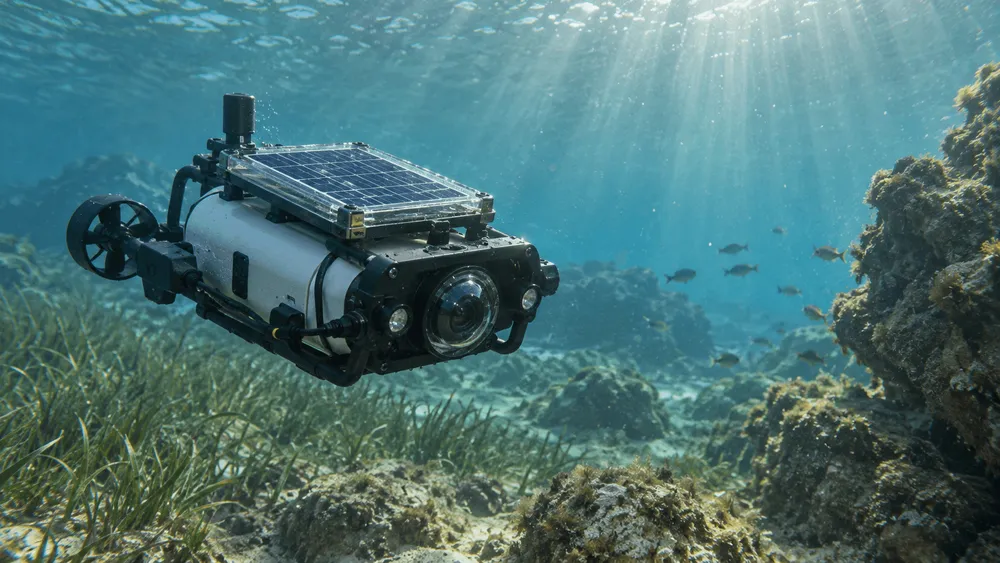
A research team including scientists from Yunnan University operated a perovskite solar cell module at a depth of 10 meters in the South China Sea, storing 324 mWh of electricity in a lithium-ion battery over two hours.
Underwater, red and infrared light are absorbed rapidly, meaning that conventional solar cells designed for land use lose access to much of the light they rely on. The research team tuned the material's absorption properties to match the blue-green light that penetrates water relatively well, and confirmed that the cell could generate power underwater and even light an LED.
However, this is not a demonstration of an "underwater power plant" capable of supplying homes or electrical grids. What's envisioned instead is a small power source for charging low-power sensors, cameras, and communication equipment in the field.
What Does "34.71% Efficiency Underwater" Actually Mean?
According to a paper published online in Joule on September 11, 2026, the solar cell developed by the research team had a bandgap of approximately 1.96 eV.
Bandgap refers to the energy difference that electrons must cross when light is converted into electricity. By adjusting a material's composition, researchers can also control which wavelengths of light it absorbs most efficiently.
Water strongly absorbs long-wavelength light. The paper explains that light above 630 nm is difficult to use underwater, and at depths of 5 to 10 meters, mainly the blue-green range of 400–600 nm remains.
For this reason, the research team chose a wide-bandgap perovskite that efficiently absorbs shorter-wavelength light reaching underwater depths, rather than a solar cell designed to use the broad wavelength range available on land.
Small-area cells recorded a peak power conversion efficiency of 17.08% under AM 1.5G conditions simulating standard sunlight on land, with third-party certification confirming 16.79%.
By contrast, under laboratory conditions replicating the light environment at 10 meters depth, efficiency reached 34.71%.
Comparing these numbers alone might suggest the cell generates more power underwater. However, the 34.71% figure is based on the weaker light with an altered wavelength distribution that reaches a depth of 10 meters.
It does not mean that 34.71% of all solar energy incident at the water's surface was converted into electricity.
Conversion efficiency indicates what proportion of the light reaching the cell can be converted into electricity. The actual amount of power obtained, meanwhile, also depends on how much light reaches the cell in the first place.
Without distinguishing between these two factors, the high efficiency figure of 34.71% can easily be misunderstood.
An Additive Supports Both Efficiency and Stability
Widening the bandgap introduces another challenge.
When defects increase in the light-absorbing layer or halide ions become more mobile, the generated charge can be lost along the way, and the material itself tends to become unstable.
To address this, the research team added polyhexamethylene guanidine hydrochloride during the crystallization stage.
According to the authors' analysis, this additive interacts with uncoordinated lead ions within the crystal and forms hydrogen bonds with halide ions as well. This reduces defects and raises the energy barrier required for ion migration.
The additive also adjusts the material's electrical properties to make it easier to extract electrons, while suppressing non-radiative recombination—a process in which charge is lost at interfaces without emitting light.
However, stabilizing the material inside the cell and protecting the cell from seawater over the long term are separate challenges.
In an actual underwater module, encapsulation becomes essential. While this material design suppresses degradation factors within the cell itself, long-term durability in the marine environment—including damage to seals, pressure changes, ocean currents, and biofouling—has not been demonstrated.
What Was Actually Demonstrated at 10 Meters: 324 mWh of Stored Energy
The research team submerged a module with a light-receiving area of 115 cm² near Weizhou Island in the South China Sea.
They varied the depth—2 meters, 6 meters, and 10 meters—generating power for two hours at each depth to charge a lithium-ion battery. The stored energy obtained was as follows:
| Depth | Energy stored over 2 hours |
|---|---|
| 2 m | 1,416 mWh |
| 6 m | 752 mWh |
| 10 m | 324 mWh |
The energy stored over two hours in actual sea conditions dropped by 77.1%, from 1,416 mWh at 2 meters to 324 mWh at 10 meters.
The 77.1% figure is the reduction rate in stored energy, calculated as (1,416 − 324) ÷ 1,416, for the same light-receiving area and two-hour duration.
It does not mean that the cell's own power conversion efficiency dropped by 77.1%. Nor were conditions such as sunlight intensity, water quality, and wave state necessarily identical across the three tests.
The 324 mWh obtained at 10 meters is equivalent to 0.324 Wh—not a large amount of energy.
Still, for underwater sensors where battery replacement or laying power cables is difficult, the ability to gradually replenish power using ambient light carries meaning.
Cameras and communication equipment, if designed to operate intermittently after charging rather than continuously, could potentially make use of this approach.
This underwater test can be described as an early-stage demonstration showing the potential of such applications in an actual marine environment.
The 5.49-Year Figure Is Not a Record of Continuous Underwater Operation
The durability figures presented in the study include results from multiple tests conducted under different conditions.
The actual underwater power generation test lasted two hours.
Meanwhile, in a laboratory simulating the light environment at 10 meters depth, the solar cell was operated continuously at its maximum power point for 1,160 hours, with no significant performance degradation observed.
The figure of 48,094 hours, or approximately 5.49 years, is a T80 lifetime—the time extrapolated from accelerated degradation testing at 25°C for the output to drop to 80% of its initial value.
This does not mean the cell was actually operated continuously underwater for five and a half years.
Additionally, the result showing that approximately 96% of initial efficiency was retained after 300 days was measured for cells stored in a nitrogen atmosphere at room temperature—different conditions from actual operation in seawater.
| Figure | Test conditions | What it shows |
|---|---|---|
| 2 hours | South China Sea, depths of 2, 6, and 10 m | Power storage and LED operation are possible in actual seawater |
| 1,160 hours | Simulated 10 m light, maximum power point tracking | No significant degradation observed under controlled light conditions |
| 48,094 hours (~5.49 years) | Extrapolated from accelerated testing at 25°C | Estimated time to drop to 80% of initial output |
| ~96% after 300 days | Nitrogen atmosphere, room temperature storage | Storage stability under conditions avoiding moisture and oxygen |
This distinction matters when considering practical applications.
In actual seawater, microscopic cracks in the seal or pressure changes could allow water to penetrate the interior. If microorganisms or algae attach to the surface, the amount of light reaching the cell would also decrease.
Even if the cell itself remains stable under simulated light, achieving the same lifespan in the marine environment is not guaranteed.
What's Needed Next: Standardized Testing and Long-Term Underwater Durability Evaluation
In a research summary from Cell Press, corresponding author Wen-Hua Zhang stated that the team plans to investigate operational limits at greater depths and to establish standardized testing methods for underwater solar cells.
Currently, there is no sufficiently established common procedure for evaluating conditions such as light spectrum, water temperature, and turbidity at various depths under unified standards.
Evaluation methods that allow different encapsulation techniques to be compared under identical conditions are also needed.
While Yunnan University's researcher page mentions a Chinese patent related to solar cells for underwater environments, holding a patent alone does not mean mass production or commercial operation has been achieved.
Determining practical feasibility will require long-term underwater testing spanning multiple seasons.
The question of how much battery capacity is needed to prepare for nighttime or turbid water conditions must also be examined.
Furthermore, because the material contains lead, the environmental impact if the seal fails, as well as recovery methods after use, remain important issues.
Only once manufacturing costs, maintenance, and countermeasures against biofouling are all factored in can this approach be meaningfully compared with periodic battery replacement or power supply via undersea cables.
This underwater test at a depth of 10 meters over two hours demonstrated the potential to power small devices using the blue-green light that remains available underwater.
What will determine future practicality is not simply the peak conversion efficiency figure. What matters is whether the same module, installed underwater for extended periods, can maintain its encapsulation performance and power output while withstanding seasonal changes, biofouling, pressure, and exposure to seawater.