

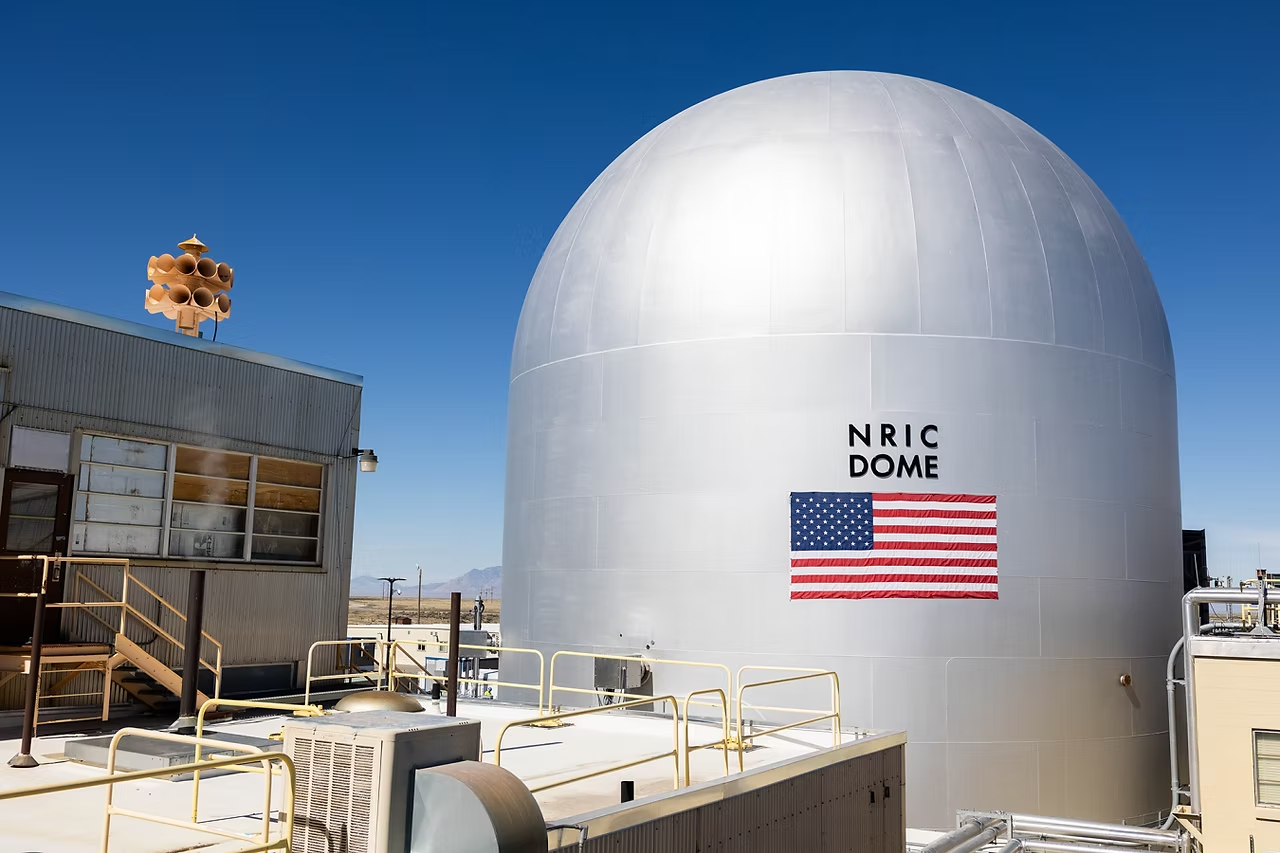
On October 7, US-based Deployable Energy announced that its transportable small reactor, the "Unity Nuclear Battery," has been selected for full-power demonstration in 2027 at DOME, a test facility at Idaho National Laboratory (INL). Unity, which aims for 1 MW of electrical output, reached criticality, the point at which a fission chain reaction becomes self-sustaining, in June. The next round of testing will raise power and is also meant to verify transport of a reactor fueled at the factory and its relocation after operation. To deliver electricity continuously to industrial sites and remote locations, a small core is not enough: the whole sequence of removing heat and handling fuel also has to work.
From zero-power criticality to a power-generating reactor
Unity reached criticality on June 30, 2026. The following day, July 1, the US Department of Energy (DOE) announced that a fueled, zero-power criticality demonstration had been completed. According to Deployable Energy, it got there roughly 150 days after the project with INL began. That figure reflects how quickly the company reached a criticality demonstration; it does not mean a commercial reactor supplying electricity was completed in that time.
A zero-power criticality test is the stage at which developers confirm that a fission chain reaction can be sustained in the core without producing enough heat to generate power. In a March briefing document from the National Reactor Innovation Center (NRIC), Unity's zero-power test in a water tank was described as validating computational models of neutron behavior and confirming a core design that combines low-enriched fuel with moderation by water. The full-power test in 2027 moves on from there to how heat is actually extracted and to operation with the equipment combined.
Mistaking this announcement for a first criticality or the start of commercial operation would obscure how far development has come. The confirmed milestones are as follows.
| Date | Event | Position in development |
|---|---|---|
| June 30, 2026 | Unity achieves zero-power criticality | Fission chain reaction in the core confirmed |
| September 30, 2026 | INL announces selection for DOME | Slot secured for 2027 full-power testing |
| October 7, 2026 | Deployable Energy announces the selection and test schedule | Demonstration plan including transport and relocation presented |
| 2027 | Full-power testing planned at DOME | Operation at higher power and overall system performance to be verified |
The INL announcement on September 30 and the company announcement on October 7 report the same test selection. The criticality already achieved and the full-power test still to come need to be read separately.
4.95% enrichment, and the division of labor between water and helium
The Unity "nuclear battery" refers to a small reactor that produces heat through fission and extracts electricity from it. The fuel Deployable Energy has disclosed is uranium dioxide enriched to 4.95% uranium-235. The NRC also describes Unity as a gas-cooled microreactor with 1 MW of electrical output that uses conventional low-enriched uranium fuel.
Inside the reactor, light water, meaning ordinary water, serves as the moderator. It slows the neutrons produced by fission, making further fission more likely. Helium is used as the coolant that carries heat away. Rather than sharing the same job, water and helium each have a distinct role: one sustains the chain reaction, the other removes heat. In the NRC's description, the helium primary cooling system is actively cooled during operation.
The 4.95% enrichment matters for fuel supply. According to DOE, fuel used in existing commercial reactors is enriched to no more than 5% uranium-235. High-assay low-enriched uranium (HALEU), which many advanced reactors require, is enriched to above 5% and below 20%. Higher enrichment makes it easier to shrink a reactor or extend the interval between refuelings, but a supply system for that fuel must also be built.
In terms of enrichment class, Unity makes a choice close to that of existing commercial reactors. It can be read as a design that tries to realize a small reactor without depending on a ramp-up in HALEU production. However, even at the same enrichment, fuel form and use differ from reactor to reactor. Manufacturing fuel for Unity and confirming that it performs as fuel do not follow automatically, and adopting low-enriched fuel is a separate challenge from making the whole reactor practical.
Behind 1 MW of electricity, how to handle 2 MW of heat
According to design values NRIC presented in March 2026, Unity has a thermal output of 3 MW against an electrical output of 1 MW, meaning 2 MW of heat must be handled in forms other than electricity. This is a rough figure obtained by putting the document's "3 MWth" and "1 MWe" in the same unit and subtracting under steady-state assumptions: 3 − 1 = 2 MW. It is not a number for output or efficiency measured in the 2027 tests.
Electrical output is the magnitude of the power generated, while thermal output is the magnitude of the heat produced by fission. When heat is converted to electricity, not all of it becomes power. Going by Unity's design values, a mechanism is needed to either use a considerable amount of heat in addition to generating power or release it to the surroundings. Even if the core can be made small, that does not necessarily eliminate the equipment needed to dispose of heat on site.
Deployable Energy has outlined ways to cool the heat with liquid, to cool it with air, and to use the heat for cooling facilities. The idea is to choose how to dissipate heat depending on conditions on land, at sea, or in remote locations. So in evaluating a plan to deliver a 1 MW power source, one also has to look at how heat is handled outside the reactor. Whether the full 2 MW difference can be put to effective use, and how large the necessary equipment will be, cannot be determined from this design value.
By confirming operation including this heat handling, Unity moves from a demonstration of the core toward a demonstration of a power source usable in the field.
Fueling at the factory, and running it again after operation
The 2027 demonstration Deployable Energy plans starts with loading fuel into the reactor at the factory and transporting it in that state. After it is installed at DOME and run at full power, the reactor will be relocated to another location within INL, and the process will continue through fuel disposition. The company says the series of tests will yield data to make manufacturing, transport, and operation repeatable.
If fuel is loaded at the factory, reactor preparation can be concentrated on the factory side before delivery to the site of use. This is also consistent with the concept of shipping standardized units to various locations. However, being able to transport a reactor before operation is not the same demonstration as being able to run a reactor again after it has operated. This time both are in the test plan, and the aim is to confirm the steps after delivery as well.
The relocation destination is strictly within the INL site. A successful demonstration would not mean the reactor can be freely moved to any location. Nor does the "fuel disposition" in the announcement mean the problem of permanent disposal of spent fuel has been solved. The plan is to verify, as a single reactor system, everything from loading fuel and operating to how it is handled after the test.
The company's technical description also includes refueling every five years and a policy of handling waste centrally at an off-site facility. These are design aims intended to reduce the burden of handling fuel and waste on site. They do not mean five years of full-power operation has been demonstrated, nor do they promise five years without maintenance. A system meant to supply power over a long period needs not only the process of bringing equipment in but also the process of handling equipment and fuel after operation.
Shortening the development process at DOME, and conditions for commercialization
DOME is a facility for testing fueled small reactors, repurposing the containment structure of the former experimental breeder reactor EBR-II. According to INL, it opened in April 2026 and can accommodate experiments of up to 20 MW thermal. Both the quantity and the unit differ from Unity's 1 MW of electrical output. By using equipment at a national laboratory in sequence, developers can reduce the burden of building a nuclear facility from scratch solely for demonstration.
Deployable Energy is covering the cost of the tests itself. It was competitively selected from a call issued in July, but to keep its test slot it must meet milestones related to technical readiness, fuel procurement, and regulatory preparation. Even with the prospect of access to the facility, the responsibility remains to bring the reactor to a state where it can be taken into testing.
NRIC's call for applications says DOME is currently hosting Radiant's Kaleidos demonstration reactor, and that the next available slot begins in July 2027. Unity is the test subject following Radiant, but the month Unity will begin operation cannot be pinned down from the slot information. Testing at a shared facility proceeds by aligning each company's technical readiness with the facility's schedule.
Licensing for commercialization also proceeds separately from selection for full-power testing. As of October 8, 2026, the NRC describes activities related to siting, construction, and operation of Unity as "pre-application engagement." Deployable Energy says the NRC will continue to observe the demonstration, but that participation does not in itself mean permission for commercial operation.
What the 2027 test will ask is whether the reactor can deliver the designed output while handling heat, and carry out everything from fueled transport to relocation after operation. If that data can be fed into standardized manufacturing and operation and into review for commercialization, remote sites and industrial facilities would gain a basis for deciding whether to use factory-built reactors as continuous power sources.