

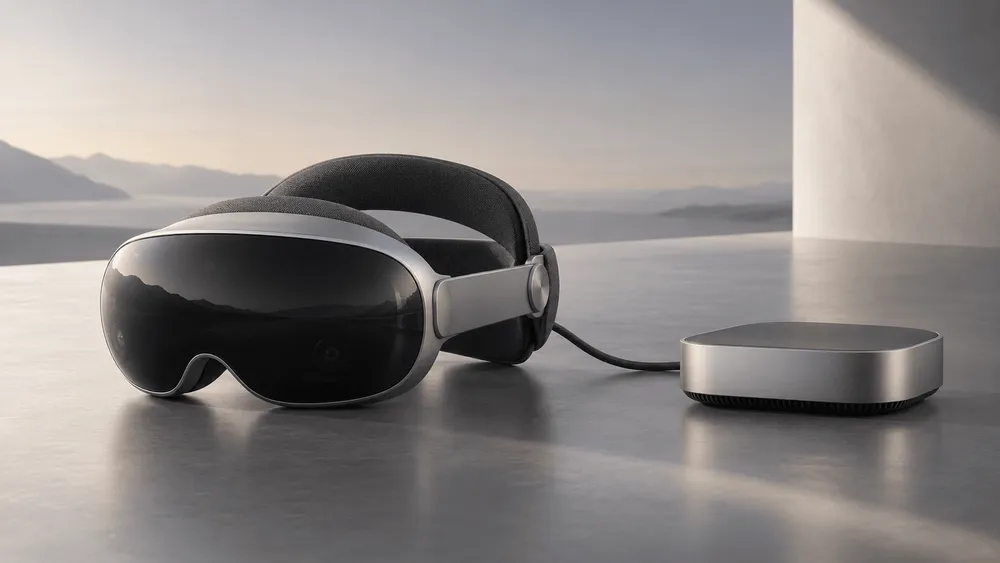
Apple is exploring designs for a lighter Vision Pro headset codenamed "N224," Bloomberg's Mark Gurman reported on September 27. Among the options under consideration is moving the compute unit outside the headset itself, in addition to switching to different materials. The current Vision Pro already has an external battery, but its computer stays on the head—so this proposal would go a step further in rethinking that layout. If realized, it could reduce the weight the face has to support, but it would also require redesigning how the headset connects to external hardware and how processing tasks are divided.
Four design options are on the table, and a launch timeline remains unclear
According to Gurman's report, Apple is weighing four different design approaches for N224. These include testing materials such as plastic or titanium, as well as an external unit that would combine the compute chip and battery. At the same time, some executives reportedly prefer a more integrated design and are not in favor of an external unit.
The shape of the new device is still undecided. Whether Apple lightens the headset through materials or by moving key components off the head would result in very different devices for users to carry. What this report reveals is less about a finalized product spec and more about how far Apple is willing to go in rethinking the headset's structure.
The report points to a possible release window of late 2028 to early 2029, but this is merely a projection from the reporting—not a confirmed launch date. Apple has not announced a target weight, price, or chip for the device. It would be premature to assume a cheaper Vision Pro is definitely coming.
Note that the original report is behind a paywall and could not be fully verified. Details about N224 here are limited to information that is consistent across multiple articles citing the original report.
The current Vision Pro already uses counterweights for balance
Apple has already adjusted weight distribution to improve the fit of the Vision Pro. The Dual Knit Band introduced alongside the M5 model in October 2025 has tungsten weights embedded in the lower strap. Apple describes these as counterweights designed to improve comfort, balance, and stability.
Adding weight to a device you're trying to make lighter might seem contradictory. But total weight and where that load lands on the face or head are two separate issues. A design that balances weight through the band works differently than reducing weight by cutting components altogether. Apple's own explanation illustrates this distinction well.
The official spec sheet lists the M5 Vision Pro's weight at 750–800g. That figure includes the Light Seal and Dual Knit Band, and varies depending on configuration. There's also a separate 353g external battery. So you can't treat the headset's listed weight as the total weight of everything you carry, nor can you simply add the battery weight and treat that as the load on your face.
If N224 moves the compute unit outside the headset, the potential gain is a reduction in components that remain on the head-worn portion. However, it's unclear which components would move and to what extent. This doesn't necessarily mean the current band's counterweights would become unnecessary, or that weight could be reduced to some specific target.
Before comparing to Meta's roughly 100g device, align what's actually being measured
In a Japanese-language announcement on September 24, Meta described its upcoming "Meta VR Glasses," slated for spring 2027 release, as weighing approximately 100g. In this design, sensors and displays stay on the glasses, while compute, battery, and storage are offloaded to an external pack. The two are connected via a fiber-optic cable, and the external pack is designed to attach to a pocket or bag.
Apple's 750–800g figure for the Vision Pro (M5) includes the worn components such as the band, while Meta's roughly 100g figure for the VR Glasses excludes the external unit.
Breaking down Apple's spec sheet and Meta's announcement by what's included in the weight and where functions are located yields the following:
| Comparison Point | Apple Vision Pro (M5) | Meta VR Glasses |
|---|---|---|
| Product stage | Currently shipping M5 model | Planned for spring 2027 release |
| Stated weight of worn component | 750–800g | ~100g |
| What's included in weight | Includes Light Seal and Dual Knit Band; varies by configuration | Glasses only; excludes external pack |
| External hardware | 353g battery | Pack containing compute, battery, and storage |
| Compute location | M5 and R1 chips housed in headset | Main processing offloaded to external pack |
This table categorizes official materials confirmed as of September 28, 2026, by worn component versus external hardware. Meta's announcement doesn't specify the weight of the external pack, so the total weight difference between the two systems as carried by a user can't be calculated from these figures alone. This is also a comparison between a shipping product and a pre-release spec—not a like-for-like measurement of wearing comfort under the same conditions.
Still, the design difference is clear. Vision Pro moves the battery off the head but keeps the compute unit on it, while Meta separates the compute unit as well. Meta's figure is better understood not simply as the result of using lighter materials, but as reflecting a design that deliberately minimizes what sits on the face.
Whether Apple adopts this approach remains unknown, but it does offer a concrete point of comparison for thinking through the N224 report. Lightening the head-worn portion raises questions about where to house the external unit and how to route the cable. Usability—whether for watching a movie or working at a desk—isn't determined by the weight of the glasses portion alone.
Even if compute moves off-head, responsiveness can't be sacrificed
In the current Vision Pro, a dedicated R1 chip works alongside the M5 to process sensor input. According to Apple, R1 processes input from the cameras and delivers new images to the displays within 12 milliseconds. For a device that shows the surrounding world through cameras, how quickly the image responds to head movement is a design requirement on par with display resolution.
This raises a separate question for any design that moves compute off the head: where does camera data get processed, and what data gets sent over the cable? Without deciding which processing stays on the head and which gets offloaded, component placement alone doesn't tell the full story of how the device would actually function. This is a design consideration that follows logically from the current model's architecture—not a claim that N224's internal specs have been revealed.
The 12-millisecond figure for the current model also isn't a benchmark for communication speed with an external unit. There's no indication that R1 itself would simply move outside the headset, or that the same architecture would carry over to a new model. When lightweight-design figures eventually emerge, they'll need to be evaluated alongside how image and sensor responsiveness is maintained.
Additionally, a compute unit moved outside the headset would still consume power and generate heat—just externally. Lightening the worn portion doesn't eliminate the need for that processing or heat dissipation. Meta's announced split-architecture design is one implementation example, but it's not grounds to assume Apple would adopt the same division of labor or cooling approach.
N224 can only really be evaluated once we know not just the weight of the worn component, but also the size of the external unit, how it connects, and how responsive the image feed is. If those pieces come together well, lightening the headset could become more than just a smaller number on a spec sheet—it could be a real usability improvement for the Vision Pro, one that determines whether you can keep it on through an entire movie or work session.