

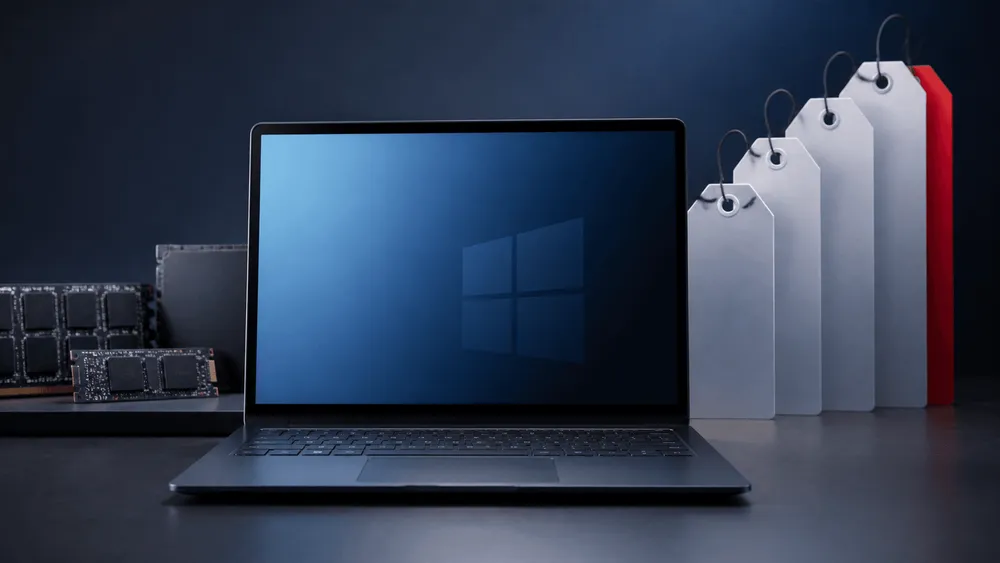
Taiwan's Economic Daily News reported on August 10 that Microsoft raised the Windows OEM license fees it charges PC makers by an average of 7-10% starting in July 2026. PC makers have reportedly already begun factoring the new fees into product pricing. Since component costs, particularly memory, have already risen sharply, it's not possible to isolate the Windows-related portion from retail prices. Nevertheless, the fact that software costs are now piling on top of hardware price increases that manufacturers have been absorbing carries real significance.
A 7-10% adjustment applies to every PC that ships with Windows
According to PC brand executives interviewed by Economic Daily News, Microsoft revises Windows OEM license fees annually. Past increases were mostly in the single digits, but starting in July 2026, the average reached 7-10%—a larger annual adjustment than in previous years. However, Microsoft has not disclosed the specific rate of this adjustment, which regions are affected, or the amounts involved in individual contracts.
OEM licenses apply when manufacturers preinstall Windows on new PCs for sale. Microsoft's 2025 annual report includes Windows Pro and non-Pro licenses sold through the OEM channel under "Windows OEM and Devices revenue." Even when consumers don't pay separately for the OS at the point of sale, that cost is baked into the PC maker's cost structure.
Pricing isn't uniform across all models either. An executive interviewed by Economic Daily News explained that prices vary depending on the CPU tier installed, with OS fees differing across Core i3, i5, and i7 models. The rate of increase also reportedly varies by product. From the 7-10% average alone, it's impossible to calculate exactly how much more a specific notebook PC will cost.
That same July 2026, Microsoft 365 commercial products also saw price revisions. The official FAQ lists device-based licenses for Windows E3, E5, and Windows Enterprise among the affected products. However, these are commercial licenses that businesses contract for, and they follow a different sales channel from OEM licenses bundled with new PCs. The official Microsoft 365 announcement doesn't confirm that OEM fees rose by 7-10%.
Not the same figure as the roughly 5% increase in PC hardware prices
In Taiwan, ASUS and Acer are expected to raise PC prices as early as Q3 2026. Economic Daily News reported the moves by both companies as roughly 5% or a single-digit percentage increase. Some ASUS Taiwan products have already risen by a cumulative approximately 30% from Q4 2025 through May 2026, and company executives anticipated further single-digit fine-tuning in Q3.
This roughly 5% figure refers to the outlook for PC hardware prices in the Taiwanese market, and it's a different base from the 7-10% increase in Windows OEM fees. According to Economic Daily News, PC makers have already reflected the new OEM fees in pricing, but component costs like memory have moved so dramatically that consumers and businesses can barely perceive the change. Without disclosure of the absolute amount of the license fee and manufacturers' pass-through policies, it's impossible to know exactly how much the OS fee has pushed up the price of a given PC.
Therefore, it would be inaccurate to attribute the rise in PC prices to Windows alone. Economic Daily News reports that since late 2025, surging AI server demand has caused shortages and price increases not only in memory and SSDs but also in CPUs. Memory costs in particular account for the majority of the increase and are the primary driver behind 2026 PC price hikes. The Windows OEM fee is an additional cost layered on top of that.
How the price increases manifest also varies by manufacturer and product tier. If a manufacturer cuts into its profit margin to absorb part of the cost, the pass-through to retail prices is delayed; if it changes the configuration, memory or storage capacity may drop even at the same price. Simply tracking price-tag numbers risks missing the substantive price increase. When buying, it's necessary to compare not just historical prices for the same model number but also memory and SSD capacity.
What 65 million units and a 4% decline reveal about the weight of high component costs
Global PC shipments totaled 65 million units in Q2 2026, down 4% year-over-year. According to Counterpoint Research, this marks the end of five consecutive quarters of growth dating back to Q1 2025. While corporate replacement demand tied to the Windows migration and AI PC adoption remains, the sharp rise in memory prices is constraining manufacturers' production plans and cooling demand among price-sensitive consumers.
Manufacturer responses aren't limited to price hikes alone. Counterpoint also noted a trend toward stripping down entry-level configurations and prioritizing premium models with higher profit margins. The outlook is for continued price increases across companies in the second half of the year, with average selling prices rising. It's becoming a market where options narrow more sharply the cheaper the configuration.
Microsoft, too, has acknowledged the impact of high memory costs on its Windows business. During its April 29, 2026 earnings call, the company attributed the slight increase in Windows OEM revenue for the January-March quarter to manufacturers and distributors building up inventory in anticipation of price increases. It forecast that Windows OEM revenue would decline in the high-teens percentage range year-over-year in the April-June quarter as that effect reversed.
Microsoft broke down the factors behind this decline into three roughly equal impacts of about 6 percentage points each: the reversal of demand that had been boosted the previous year by the end of Windows 10 support, inventory drawdown, and PC price increases and market contraction driven by memory costs. While these figures are all estimates, the fact that Microsoft itself—the seller of the OS—cites memory costs as a primary pressure moving PC prices is notable. The OEM fee revision reported here adds a fresh burden on top of already weakening demand.
Before buying, focus on actual selling prices and configurations rather than the adjustment rate
For PC buyers, there's no meaningful way to simply add the 7-10% figure to a budget calculation. The original license fee amount is undisclosed, and it varies by CPU tier, Windows edition, and individual manufacturer contracts. To gauge the actual impact, it's more reliable to track actual selling prices for identical configurations within the same region and check whether memory or SSD capacity has been reduced following the price increase.
For corporate procurement, the validity period of quotes also becomes more important. The timing at which new cost structures surface will vary depending on when manufacturers exhaust existing inventory or renew individual contracts. When comparing multiple models together, unless factors such as whether it's Windows Pro or non-Pro, and whether the CPU tier is the same, are aligned, it becomes impossible to separate the impact of the license fee revision from differences in product configuration.
Only if Microsoft or PC makers disclose the absolute amount and scope of the OEM fee will it finally be possible to verify the exact pass-through amount attributable to Windows. Until then, the roughly 5% price change shown in Taiwan for Q3, along with how identical models move in other regions, serve as the most practical basis for judgment. If, as reported, component costs remain elevated while OS costs rise on top of them, choosing a PC in the latter half of 2026 will require comparing price and specifications together.