

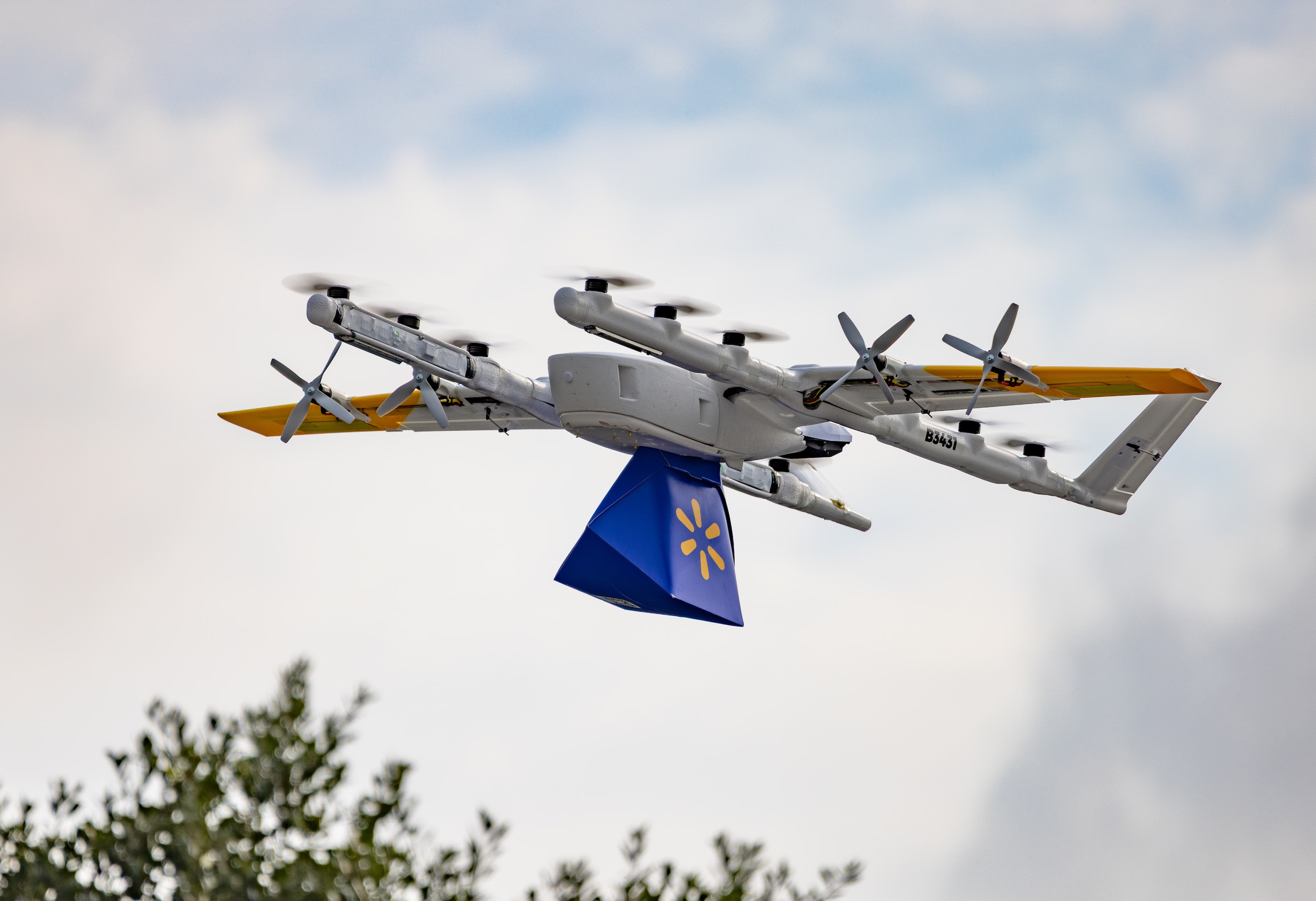
Wing, the drone delivery company under Alphabet, announced on November 6, 2026 that it will invest up to $125 million over the next two years to manufacture its next-generation drones in the United States. The 15,000-square-foot (about 1,394 square meters) manufacturing facility in Fort Worth, Texas, is expected to create up to 100 jobs. According to Wing, the facility can produce tens of thousands of drones a year. The company plans to operate more than 270 delivery hubs by 2027, and the disclosed production capacity appears large enough to support that expansion. If aircraft supply is unlikely to be a near-term constraint, attention shifts to the state of the rules that would allow flights beyond the operator's visual line of sight (BVLOS).
Up to $125 million for a 15,000-square-foot facility
According to Wing's announcement, the investment will total up to $125 million over the next two years and will go toward direct manufacturing costs in the US. The Fort Worth facility covers 15,000 square feet and is expected to create up to 100 manufacturing jobs. The Dallas Morning News, in an article republished on Yahoo Finance, reported that the facility opened in early 2026, so the new investment amounts to an expansion of a production setup centered on an existing site.
That said, the "up to $125 million" figure is a ceiling, not a confirmed total outlay. If the money were spent evenly over two years, it would come to a maximum of $62.5 million a year, but the actual timing and amount of the investment have not been disclosed. Likewise, the "tens of thousands of drones a year" that Wing describes refers to the facility's production capacity, not a commitment to build that many. Actual output will depend on delivery demand, hub openings, and aircraft deployment plans.
Understanding this investment also requires a look at the scale of Wing's business. The company was born in 2012 at X, Alphabet's research and development arm, and in 2019 became the first drone delivery operator to obtain an FAA Part 135 air carrier certificate. It now delivers from more than 70 hubs in major US metropolitan areas and aims to extend its service to more than 40 million people by 2027. CEO Adam Woodworth has indicated that the US market will be the center of future growth, and the manufacturing investment can be seen as supporting that expansion.
At an assumed 20,000 drones a year, about 74 per hub for 270 hubs
How much headroom does manufacturing capacity give Wing's expansion? The company's delivery service works by having drones take off from hubs set up at retail stores and other locations and deliver goods to nearby homes. The number of drones deployed would presumably rise with the number of hubs, but the specific relationship has not been published. In January 2026, Wing and Walmart announced the addition of 150 stores and said they would expand their joint delivery network to more than 270 hubs in 2027. However, it cannot be confirmed whether that 270-plus figure is counted on exactly the same basis as the 70-plus hubs Wing operates today.
Even so, the published numbers allow a rough comparison of manufacturing capacity and hub plans. Assuming "tens of thousands of drones a year" means 20,000, and using 270 hubs for 2027, capacity works out to about 74 drones per hub per year. The calculation is 20,000 ÷ 270 = 74.07, rounded down. But 20,000 is not a confirmed figure, and 270 is the lower bound of the plan, so the result is only a rough guide to scale. If the actual number of hubs grows, the per-hub figure shrinks; if capacity exceeds 20,000, it rises.
Let's also estimate the number of drones needed under an assumption of 20 drones per hub. Suppose Wing opens roughly 200 new hubs, the gap between the current 70-plus and the planned 270-plus, which is in the range of the 150 additional stores announced. The fleet required would then be 3,000 to 4,000 drones. That is only 15% to 20% of the assumed annual capacity of 20,000. Because Wing has not disclosed how many drones it actually deploys per hub, or the lifespan and replacement frequency of its aircraft, this estimate cannot pin down the required production volume. Still, it suggests that even under an assumption of relatively large deployments, there may be some margin in manufacturing capacity.
Of course, sufficient capacity does not mean it can be used immediately. Parts procurement, factory utilization, quality control, and maintenance systems all affect how many aircraft can actually be supplied. And if delivery demand grows faster than expected, the production needed for fleet renewal and additional deployment will rise as well. What these numbers allow us to say is limited: if the facility reaches its announced capacity as planned, aircraft supply seems unlikely to be the main near-term constraint. Wing has not given a specific explanation of why it is securing capacity well above what hub expansion would require. In this announcement, the company emphasized strengthening its US manufacturing base and maintaining American competitiveness in aviation, rather than supply plans for individual hubs.
Is the next constraint regulation or delivery demand?
Even if manufacturing capacity has headroom, it cannot be said with certainty that flight regulation will be the next constraint. Wing already provides delivery service from more than 70 hubs and has grown under the existing system. The company says it has made more than 1 million home deliveries in the US since the start of 2026. Having built up that record without waiting for final rules, it is possible that business expansion will be determined by other factors, such as delivery demand, partnerships with retailers, and operating approvals in individual airspaces.
On the other hand, Wing itself regards the development of BVLOS rules as an important factor in future expansion. The company referred to its hub expansion plan through 2027 and to BVLOS rules expected to be published soon, saying the drone delivery industry is about to enter a full-scale growth phase. According to UAV Coach, the proposed "Part 108" aims to move from a system that relies on individual permission (waivers) to a framework that allows BVLOS flights within approved areas under certain conditions. If such a system is put in place, the burden of the permitting procedures required for each hub could be reduced, which might make it easier to expand delivery networks. However, no quantitative data has been confirmed on how much of the procedure would be cut or how much the time to open a hub would shorten.
The move toward finalizing the rule is also not necessarily smooth. According to UAV Coach, the FAA sent the final Part 108 rule to the White House regulatory review office on July 10, 2026. But as of an article dated September 16, the review was still ongoing, and an FAA official said the agency hoped to publish it within the year. Even after a final rule is published, a certain period may be set before it takes effect, and operators will need to prepare for the new system. The latest status of the review as of November has not been confirmed.
Whether the view that flight regulation will be the next constraint is valid can be tested by what happens next. The first thing to watch is when the final Part 108 rule takes effect and whether the pace of hub openings changes afterward. If Wing does not bring forward its 270-plus hub plan for 2027 after the new rule takes effect, and no increase in its expansion target is seen, the view that regulation was the main constraint would weaken. However, the reason for leaving the plan unchanged might lie in demand or investment decisions, so the number of hubs alone cannot determine the impact of regulation.
Another piece of evidence is the factory's actual production record and the number of drones deployed per hub. If the aircraft needed to open 150 to 200 new hubs exceeded 10,000, new deployments alone would use more than half of the assumed 20,000-drone annual capacity. That would be roughly 50 to 67 drones per hub, and once replacement demand for existing aircraft is considered, the possibility that manufacturing capacity becomes a constraint could not be ignored. Note, however, that the 10,000 benchmark is not half of a published capacity figure but simply half of the assumed 20,000. If Wing discloses its actual production numbers and the number of drones deployed, this estimate can be checked against reality.
This picture is also instructive for companies running drone delivery businesses in Japan. Building mass-production capacity alone does not guarantee that a delivery network will grow; alignment with operating rules, permits, and delivery demand matters as well. Wing's investment can be read as an effort to build its manufacturing base in advance, so that a shortage of aircraft does not hold back expansion when changes in the regulatory environment make it easier to add hubs. The key evidence for judging the meaning of that investment will be the final content and effective date of Part 108, which the FAA had aimed to publish within the year, and the actual pace at which Wing opens hubs.