

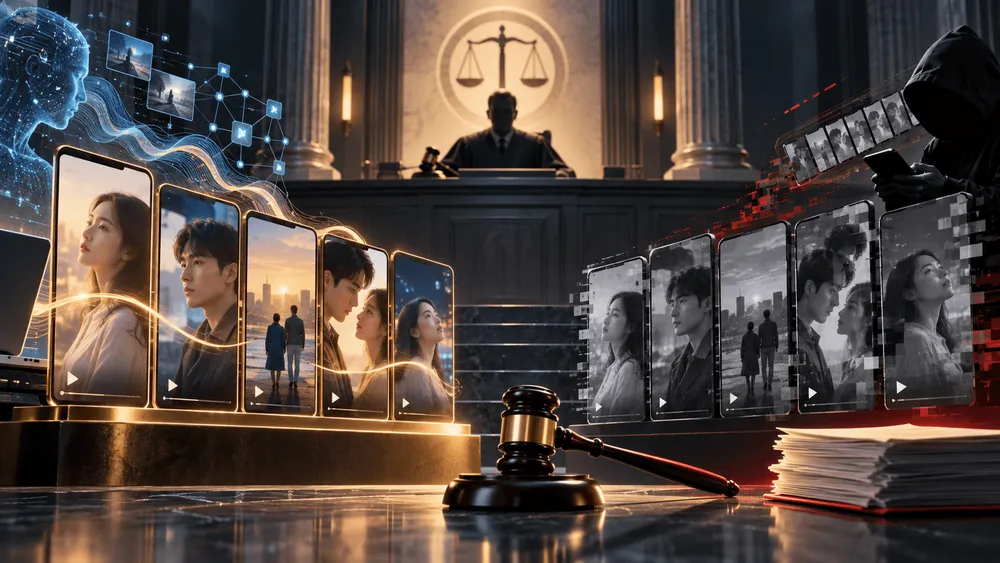
A district-level people's court in Wuhan, Hubei Province, China, has recognized a serialized short drama produced using generative AI tools as eligible for copyright protection, ordering a company that reposted it without authorization to pay 20,000 yuan (roughly ¥400,000, at 1 yuan = ¥20) in damages. According to a case summary published by the court, when exercising discretion to determine statutory damages for the infringement, the court took into account both the computational resource costs tied to token consumption during production and the licensing fees for commercial AI tools.
The ruling was handed down on August 20, 2026, and since neither party appealed, it is now final. While generative AI content is sometimes viewed as something produced "at the push of a button" and therefore belonging to no one, this ruling demonstrates that such works can be protected as copyrighted material if the specific creative judgments made by humans throughout the production process can be concretely proven.
However, it would be premature to interpret this judicial decision as meaning that prompts entered into AI or API usage fees can now be claimed directly as damages. It's necessary to distinguish between the facts the court weighed in recognizing copyrightability and how it determined the damages amount.
An AI Short Drama Copied in Full, One Day After Release
The dispute unfolded in China's rapidly growing market for vertical-format short dramas. In early 2026, the plaintiff, a culture and media company (referred to as Company A in court documents, a pseudonym), combined multiple generative AI tools to produce a 47-episode short drama titled "Cloud Above XX" (a pseudonym), with a total runtime of about one hour. After completing the required filing with China's National Radio and Television Administration, the work was released on the short-drama streaming app Hongguo Duanju and on WeChat's Channels (Shipinhao) feature.
The incident occurred immediately after release. The day after the drama went live, the defendant, a technology company (referred to as Company B, a pseudonym), copied all 47 episodes in their entirety and posted them to its own WeChat Channels account. The title was changed to "Woman XXX" (a pseudonym), and commercial ads were inserted into the playback screen, generating revenue. Company A sued Company B in the Wuhan Jiang'an District People's Court, alleging infringement of its right of network dissemination (equivalent to Japan's right of public transmission).
According to the case published by the Wuhan Jiang'an District People's Court and the local newspaper Changjiang Daily, this case marks the first finalized ruling in Hubei Province involving copyright infringement of an AI-generated short drama. The court found Company B liable for copyright infringement, ordering it to cease the infringing conduct and pay a total of 20,000 yuan to cover economic losses and reasonable costs incurred in protecting the plaintiff's rights.
データを表で見る
| Total Damages Awarded (Chinese Yuan (RMB)) | |
|---|---|
| 2023 Beijing Image Case | 500 |
| 2026 Wuhan Short Drama Case | 20,000 |
In a prior 2023 case concerning a single still image, the damages awarded amounted to 500 yuan. In contrast, this lawsuit, which concerned a 47-episode video work, resulted in 20,000 yuan. However, because the scale of the works, the production processes, and the extent of human involvement differ significantly between the two cases, the amounts cannot be simply compared.
Not a One-Click Generation: A Three-Stage Production Process
Behind the court's recognition of the drama as a protectable "audiovisual work" was the plaintiff's detailed proof of the actual production process. What mattered was not treating the AI's output as a mere mechanical product, but examining how concretely the production staff had controlled the final expression.
The court examined the plaintiff's production process in three stages: "preparation," "generation and intermediate processing," and "final editing."
In the first preparation stage, the production staff themselves conceived the script's plot, designed the overall structure, and wrote the dialogue and text. The court found that concrete human choices and judgments had already been made at this initial conceptual stage, laying the foundation supporting the work's creativity.
In the second generation stage, staff individually crafted prompts for storyboard shots tailored to each cut, specifying conditions to keep characters' appearances consistent and the mood of the background art. The court also gave weight to the fact that staff selected suitable material from multiple AI-generated outputs, discarding results that fell short of expectations and repeating the generation process.
In other words, the court determined that AI did not autonomously create the entire work; rather, it functioned as a production tool used by humans who repeatedly gave instructions, made selections, and applied corrections.
In the third finishing stage, the generated video clips were arranged on a timeline, detailed elements were corrected, and music, sound effects, and subtitles were adjusted to match the pacing of the footage.
The court found that, through this series of processes, the staff had continuously made creative judgments and performed editing work. It concluded that even when AI tools are used, as long as human creative intent and concrete choices are reflected in the final audiovisual expression, the work satisfies the originality requirement under copyright law.
Token and AI Usage Fees Factored Into Damages
What drew particular attention in this ruling was the approach taken to determining the damages amount.
In copyright infringement lawsuits, when the actual losses suffered by the plaintiff, the profits gained by the defendant through infringement, or the licensing fees that should have been paid cannot be calculated based on evidence, courts sometimes determine an amount based on a statutory damages framework.
In this case as well, because neither party could sufficiently prove specific loss or profit figures, the court determined the damages amount by weighing multiple factors.
The Wuhan Jiang'an District People's Court explained that it took into account costs specific to producing AIGC (AI-generated content). Specifically, it considered the computational resource costs associated with tokens consumed during production, along with paid licensing fees for commercial AI tools, as part of the production costs.
Changjiang Daily reported that this marks the first judicial decision in which computational costs tied to token consumption were factored into the calculation of copyright infringement damages.
However, AI-related costs were not the only factor the court considered. It also weighed the drama's total runtime, the scale of its spread on the platform, the fact that it was reposted immediately after release, the duration of the infringement, and the degree of intent or negligence on the defendant's part.
The 20,000 yuan awarded includes not only compensation for economic losses but also reasonable attorney's fees and other costs incurred in protecting the plaintiff's rights.
Meanwhile, the case summary published by the court did not disclose a breakdown of how much of the 20,000 yuan corresponded to token consumption versus AI tool licensing fees.
It's worth noting that the court did not assign legal value to the token unit price itself through any specific formula; it merely considered it as one of several factors constituting production costs.
| Comparison Point | 2023 Beijing Image Case (Li v. Liu) | 2026 Wuhan AI Short Drama Case |
|---|---|---|
| Court of Jurisdiction | Beijing Internet Court | Wuhan Jiang'an District People's Court |
| Type of Work | Artistic work (single still image) | Audiovisual work (47-episode serial short drama) |
| AI Used | Stable Diffusion | Multiple commercial generative AI tools |
| Human Creative Involvement | Prompt design, parameter adjustment, trial and error | Script writing, storyboard prompts, material selection, video/audio finishing edits |
| Authorship Attribution | The human who entered and adjusted the prompts (AI itself denied authorship) | Plaintiff company that led production and made creative judgments (corporate authorship) |
| Damages Awarded | 500 yuan (economic loss and reasonable expenses) | 20,000 yuan (economic loss and reasonable expenses) |
| Notable Factors in Damages Calculation | Plaintiff work's recognition, defendant's removal of attribution | In addition to conventional factors, computational costs from token consumption and tool licensing fees were considered |
What Progressed and What Stayed the Same Since the Beijing Image Case
To understand the significance of this ruling, it helps to compare it with the November 2023 Beijing Internet Court decision, known as the "Spring Breeze Image Case," which became a landmark precedent in China regarding copyright for AI-generated works.
In the Beijing case, a portrait image of a woman, generated using Stable Diffusion through repeated input of prompts and negative prompts and parameter adjustments, was recognized as copyrightable as an "artistic work."
The Beijing ruling established the view that AI itself cannot be an author under current copyright law, and that rights belong to the human who used the AI with creative intent.
The Wuhan ruling follows this same basic principle. The framework remains unchanged: AI is merely a tool that humans use to express their own thoughts and feelings, and what instructions the human gave, which outputs were selected, and how they were edited remain the key factors in determining copyright protection.
On the other hand, the scope of the production process at issue expanded significantly in this case.
While the Beijing case examined prompt input and parameter adjustment for a single still image, the Wuhan case covered an entire video production process, from script writing through video generation, audio production, and timeline editing.
What distinguishes this ruling is that it concretely demonstrated, for works combining video, audio, and text, at which stages human creative judgment must occur for the work to be protected as an audiovisual work.
There are also differences in the approach to determining damages.
In the Beijing case, the damages awarded were 500 yuan. In the Wuhan case, costs actually incurred in digital production—such as token usage fees generated through API calls and monthly or annual licensing fees paid for cloud-based generative AI tools—were also factored in.
For creators and production companies that incorporate generative AI into their everyday production processes, there is practical significance in the fact that such costs were considered as part of production costs even in court.
Preserving Evidence, and the Limits of a Local Court Ruling
In publishing this case, the Wuhan Jiang'an District People's Court also pointed out the importance, for creators using generative AI, of preserving evidence of their production process.
For those seeking to assert rights over AI-generated works, it is important to systematically retain materials such as project proposals, script drafts, initial versions and revision histories of storyboard prompts, generation logs and input/output records from AI tools, project files from editing software, and timestamps or platform dashboard screenshots proving the date and time of initial publication.
Without such evidence, it becomes difficult to prove the extent of human involvement in the creative process during production, and there is a possibility that copyrightability itself may not be recognized.
This ruling alone does not mean that one-click generated content involving little to no human creative judgment, or generated content for which no record remains of what choices or corrections were made, will automatically be treated as eligible for copyright protection.
At the same time, the court also cautioned platform operators and general users. The idea that "content generated by AI can be freely used by anyone" is not necessarily correct; reposting or using without authorization a work in which human creative involvement is recognized could result in liability for copyright infringement.
Platforms are also expected to promptly verify and remove content when they receive reports of rights infringement.
That said, this ruling alone does not warrant the conclusion that "token costs for AI-generated works are now recognized as damages throughout all of China."
This case was heard by a local first-instance court, the Wuhan Jiang'an District People's Court, and it does not carry the status of a "guiding case" published by the Supreme People's Court, which would be widely referenced across judicial practice nationwide.
Furthermore, no unified standard has yet been established regarding what kind of evidence or calculation methods should be used to reflect token consumption and AI tool licensing costs in damages amounts.
What matters most right now for creators and companies producing works using generative AI is to properly preserve production records—prompts, generation histories, editing processes, and usage fees. Beyond that, it will be necessary to watch how higher courts and courts in other regions rule on similar issues going forward.