

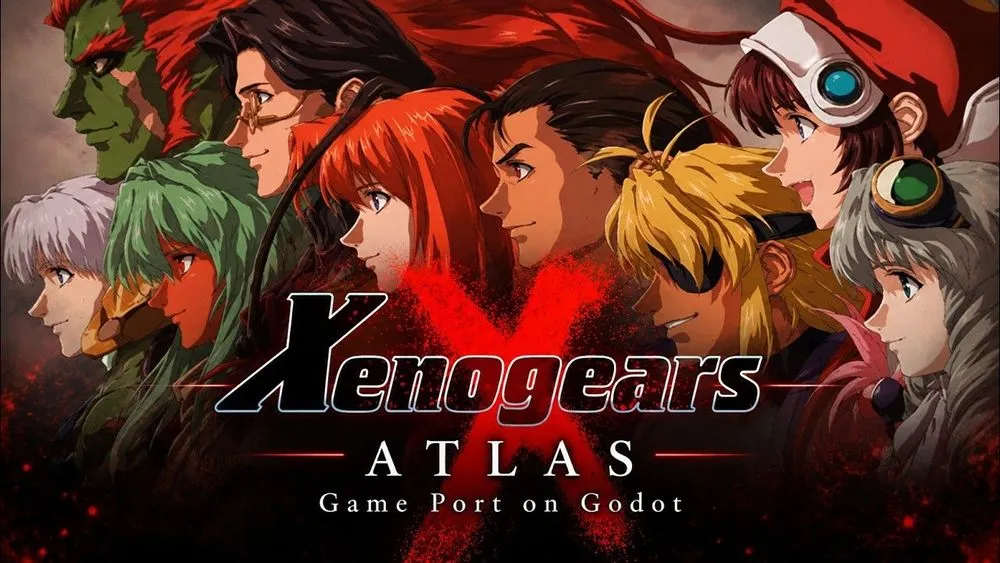
An unofficial project called Xenogears Atlas, which is rebuilding Xenogears in the Godot game engine, has released development footage centered on Lahan Village. The developer is reading the data from the original disc and trying to bring its terrain, conversations, and event sequences back to life on PC. The project is still at the stage of shaping the opening hours, but its approach shows a level of care that goes beyond simply letting players walk through a nostalgic place again. It is an attempt to carry over the feel of that journey, including the "pause" before a character speaks.
Bringing Back the Feel of the Journey From Lahan Village
In a Reddit post on September 8, 2026, the developer, Ok-Bed3203, reported progress covering the intro, Lahan Village, and the road to Citan's house. The developer explains that conversations and item handling work, as do stats and equipment. However, some details remain unanalyzed.
The description of the development video, published earlier, introduces Lahan Village and its building interiors, exploration that uses the original game's camera behavior, and cutscenes that follow the event commands. Some entries, including the Gear appearance scenes, battle-related presentation, and the opening sequence, are marked as work in progress. Recreating the village should be kept separate from a finished game, battles included. In fact, in a reply to the post, the developer said they would start on the battle engine next.
The most striking part is the explanation of how conversations are displayed. The developer writes that, to check the rhythm of the original conversations, they are handling the process that assembles text according to timers. Some parts of the window's appearance will be adjusted later, but the priority for now is to understand the state of the original.
Even with identical lines, the impression of a scene changes if the speed at which characters appear or the time before the next action differs. The joy of walking through Lahan Village again is tied to the wish that the time spent there be preserved too. Atlas's focus on fidelity to the original answers those expectations.
Running the Original Data in Godot
Atlas combines data extracted from the original disc with analyzed game logic to rebuild scenes inside Godot. The developer lists walkable terrain, character animation, and the triggers that start music as targets. Camera movement and cutscene timing are included as well.
Extracting map shapes and character images alone does not make a game run. Under what conditions does a conversation start, where do characters move, and when does the game advance to the next scene? The processes that dictate these things must be understood and made executable in a new engine. In the reconstruction Atlas describes, the original data serves as the standard for both appearance and behavior.
Moving to Godot does not mean obtaining the original development environment as-is. The developer studies the original engine's processes and checks the rebuilt scenes against the original. The project also states a policy of not adopting anything that cannot be confirmed from the data. This is a development standard, however, not a claim that the accuracy of every scene has been verified by third parties.
This order also makes sense for future high-resolution work. If the original behavior is understood first, it becomes easier to see what changed when images are replaced. The developer explains that no image-quality improvements are being made at this stage, with priority on running the game faithfully to the original.
The video description also lists understanding and documenting how the original engine worked as a goal. The process of making the game playable again also becomes knowledge for later study of how the work functions. The preservation Atlas aims for includes both the results visible on screen and the knowledge that drives that screen.
How Does It Differ From Noah?
A prior example of analyzing Xenogears's processes and running them in another environment is "Noah." That project reimplements the game's logic in C++, based on the US version. It explains that its goal is not to reproduce the same machine code as the original program, and that it is designed with multiple environments in mind.
Atlas reconstructs the original's behavior in Godot, while Noah reimplements the game's logic in C++. Both are in development, and neither can be treated as a finished PC version.
| Point of comparison | Xenogears Atlas | Noah |
|---|---|---|
| Implementation | Analyzes the original data and logic, rebuilding scenes in Godot | Reimplements the US version's logic in C++; sound chip is emulated |
| Reported progress | Early sections such as Lahan Village; battle implementation still ahead | Partly playable, but some points cannot be progressed past due to unimplemented features |
| Environment | Planned for PC; announcement lists no detailed supported environments | README states it runs on Windows and Linux |
| Original data | Original game required; policy is not to distribute game files | Users supply the original; no game data bundled |
The comparison is based on Atlas's video description and developer posts, and Noah's README, checked on September 10, 2026. It lines up approaches and self-reported progress, and is not a comparison measuring completeness or performance. No code sharing or collaboration between the two has been confirmed, so they are treated as separate efforts.
Given Noah's existence, what is new here cannot be summed up as "a way to run it on PC has finally appeared." Atlas shows a path for reassembling the original's scenes in Godot, along with early progress on it. How far that method can reproduce the original is what to watch.
The terms of use should also be checked separately from the development footage. Atlas states that it is a non-commercial fan preservation effort, unaffiliated with and unendorsed by Square Enix. The original game is required, and the policy is not to distribute game files. This announcement gives no release date for a finished version and no word on Japanese-language support, so it is not yet at a stage where you can play the whole game on your own setup.
Hopes for Disc 2, and What Is Being Protected Now
The developer says they would like to work on Disc 2 as well, while noting that there is still a long way to go before that. Once the analysis stabilizes, they want to build a framework for collaborative work and take on additional content. For now, that is a future idea. Restoring the original's processes and creating new scenes are separate tasks, and nothing has been decided about a "complete version that fills in Disc 2."
Still, the effort to carry the original into the future is stirring. Xenogears was released on February 11, 1998. Square Enix's official product page also records Game Archives releases for PS3 and PSP in 2008 and for PS Vita in 2012. So the original did not stay confined to the first PlayStation. This attempt aims to carry a work that has been handed down that way to still newer environments.
From the meeting of Fei and Elly to a story that stretches back to the age of myth. The grand questions of reincarnation and rebirth, which remain in the official description, are one reason the game is so unforgettable. And at the entrance to that story is time spent walking through a village and talking with people. Precisely because the project tries to preserve both the grand plot and the small gestures, a reconstruction that begins in Lahan Village is meaningful.
Our site's name, "XenoSpectrum," also carries affection for this work, which is why we want to pay attention to a project that handles the original with such care. Yasunori Mitsuda, in connection with the 2018 20th anniversary concert, expressed a wish for a time to reaffirm the work together with everyone and share memories. Just as there is a path back to memories through music, there is a path through reading and preserving how the game works. Of course, his words were about the concert and do not indicate any relationship with Atlas.
The mountains Atlas must climb next are implementing battles and the world map, and connecting scenes so the journey can be played through. We hope that beyond those steps, a new door into that world opens, both for people experiencing Fei's story for the first time and for those who have waited a long time.