

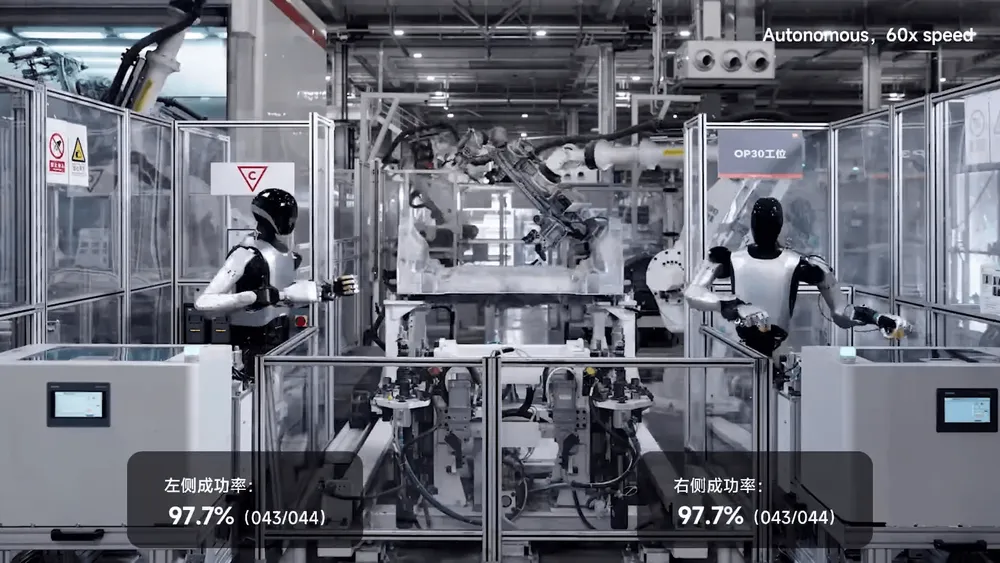
Xiaomi's humanoid robot has raised its success rate for nut-feeding tasks at the company's electric vehicle (EV) factory to 98%. That's a 7.8-point improvement from the 90.2% figure announced in March, and the robot has simultaneously taken on two additional tasks: sorting center console side covers and folding parts boxes. What catches the eye is the claim that it's now "within 1 point of human-level pass rates"—but to evaluate this as production equipment, we need to know the sample size behind that success rate and the operating hours involved. Intervention counts and costs are also indispensable. How far has four months of progress actually gone toward meeting the conditions required to move from a research demo to a mass-production process?
From 90.2% to 98%: Failure Frequency Dropped by Roughly 80%
The starting point Xiaomi presented was a demonstration from March 2026. The humanoid robot ran autonomously for three continuous hours in the nut-feeding process at the EV factory, handling the task of simultaneously supplying parts to both sides of the vehicle body with a 90.2% success rate. The takt time—the interval at which the line sends out products—was as short as 76 seconds, and the robot kept pace with it. The robot picks up nuts from an automatic feeder and places them into a positioning jig; the subsequent fastening is handled by conveyance equipment and dedicated machinery, so the robot's responsibility is limited to the pickup and alignment steps, which still involve some variability.
In the July 14 update, the success rate for this task rose to 98%. The difference is 7.8 points, but the scale of improvement looks larger when viewed from the failure side. Assuming the same evaluation method, the failure frequency dropped from 9.8% to 2.0%—a roughly 79.6% reduction. Whether the evaluation conditions were truly consistent hasn't been confirmed, but based on the published figures, the improvement on the failure side is greater than the gap in success rate alone would suggest.
The scope of work has also expanded. In the general assembly area, the robot added two tasks: arranging center console side covers in a specified order, and folding and collecting empty parts boxes once emptied. Xiaomi states both tasks achieve a 90% success rate. This marks a shift from placing small, rigid nuts in fixed locations to handling large, irregularly shaped parts that are prone to deformation—a change that raises the level of control difficulty considerably.
However, the July announcement doesn't disclose the number of trials used to calculate the 98% figure, the duration of continuous operation, or whether the same 76-second takt time from March was maintained. Xiaomi described the side-cover task as running for a "long time" and released unedited continuous footage, but the exact duration cannot be confirmed from the published materials. While the direction of improvement is clear, its sustainability in a mass-production process remains unmeasured.
Large, Deformable Parts Are Hard to Handle with Fixed Motions
The center console side cover changes shape and posture the moment it's lifted. Pulling it out from deep inside a box can catch on the edges, and shifting one's grip shifts the center of gravity too. The robot must read the part's position visually while also sensing the force applied at its fingertips, making fine posture adjustments whenever it catches on something. When reaching for a distant part, it must simultaneously coordinate the arm's trajectory with the balance of its upper body and legs.
This is where Xiaomi-Robotics-0, the vision-language-action model that formed the foundation of the March factory demonstration, comes into play. This 4.7-billion-parameter model uses Qwen3-VL-4B-Instruct to process images and instructions, while a Diffusion Transformer factors in the robot's joint states to generate the next sequence of actions. The design involves pretraining on roughly 200 million robot trajectory timesteps and over 80 million vision-language data points, followed by task-specific fine-tuning.
If the robot's hands stop while waiting for inference, the line's takt time is disrupted. To address this, Xiaomi adopted asynchronous processing, inferring the next action sequence while executing the current one. By layering force sensing, whole-body control, and reinforcement learning on top of a model that connects vision to action, the system compensates for deviations that fixed, predetermined trajectories cannot absorb.
Connectivity with factory-side systems is also essential. The robot receives production instructions, part numbers, and storage locations, and synchronizes work status across multiple units. In cases of dangerous conditions or unrecoverable anomalies, a pathway remains for humans to switch to remote operation. This isn't so much a limitation of autonomy as it is a process design choice aimed at avoiding production stoppages. When a humanoid robot enters a factory, what's being evaluated isn't just the robot body and its AI, but the entire production cell—including jigs, communications, and recovery procedures.
The box-folding task still reveals current limitations. When folding the second face, the robot must first reorient the box, turning the fastener to face forward before operating it. A skilled human worker can locate the fastener by touch and release it without changing the box's orientation. Xiaomi intends to refine its biomimetic multi-fingered hand to eliminate this extra motion. Since the July materials don't specify how many hours of data or how much fine-tuning went into these two new tasks, it's not yet possible to judge whether the system has reached a stage where it can transfer directly to unfamiliar tasks.
Within 1 Point of Human Performance, Yet the Failure Rate Is Still Double
Xiaomi described the 98% figure as being within 1 point of the 99% pass rate achieved by human workers. Assuming the same number of trials and evaluation conditions, this means the robot fails 2 times out of 100 attempts while a human fails 1 time. Though the success rate gap is just 1 point, the failure rate is double. Moreover, the published materials contain no breakdown of what happened after a failure—whether the robot recovered on its own, a human intervened, or the part was discarded.
Comparing this with publicly disclosed results from other companies reveals what kind of evidence is still missing from Xiaomi's disclosures.
| Demonstration | Task | Published Operational Data | What Remains Unclear |
|---|---|---|---|
| Xiaomi | Nut-feeding for EV body, side cover sorting, parts box folding | March: 3 hours, 90.2%, minimum 76-second takt. July: nut-feeding at 98%, new tasks each at 90% | Trial count for July figures, operating duration, takt time, intervention rate, cost |
| BMW / Figure 02 | Supplying sheet metal parts before welding | 10 months, over 90,000 parts, approx. 1,250 hours, involved in production of over 30,000 BMW X3 units | Success rate, intervention count, cost per task |
| AgiBot G2 | Inspection process on a tablet mass-production line | Cumulative 64 hours, 64,828 tasks, 99.99% success, 22-second takt, 2mm precision variance | Cost, detailed definitions of failure and intervention |
Rankings can't be determined by the magnitude of the numbers alone. BMW's Figure 02 is a bipedal robot handling sheet metal parts, while AgiBot G2 is a wheeled robot moving tablets in and out of inspection equipment—both differ from Xiaomi's task of handling deformable parts in terms of difficulty and failure conditions. Still, one shared evaluation principle emerges: for long-term deployment, operating hours and throughput need to be disclosed; for demonstrating reliability, definitions of failure and intervention counts need to be made public.
In BMW's demonstration, safety fencing and zoning were reworked to accommodate the robot's introduction, and 5G communications within the factory were also improved. Simply deploying a high-performance model isn't enough. Only when a robot can stop safely, recover quickly, and stay synchronized with existing equipment can it truly be counted as production capacity.
China's Evaluation Criteria Now Span from Success Rate to Economic Viability
In June, China's Ministry of Industry and Information Technology launched a special 2026 initiative to train and verify humanoid robots and embodied AI in real-world environments. The metrics for measuring achievement explicitly include not only the success rate of actual tasks but also efficiency improvement rates, safety and reliability, and economic viability. The initiative also sets a goal of compiling over 100 high-value use cases by the end of 2026, paving the way for deployment capacity at the scale of 10,000 units.
While policy is refining its evaluation criteria in greater detail, the number of products on the market has also surged. According to the Ministry of Industry and Information Technology, China had over 140 humanoid robot manufacturers and more than 330 products by 2025. Simply demonstrating a working prototype is no longer enough to distinguish between companies. What will drive the selection process going forward is how many times a robot can perform the same task in a factory, at what speed, with how little human assistance, and whether it can operate more cheaply than existing dedicated machinery or human labor.
The figures we'd want to confirm in Xiaomi's next disclosure are clear: the sample size and evaluation rules behind the 98% figure, the duration of continuous operation while maintaining the 76-second takt, mean time between failures, recovery time from remote intervention, the amount of training data required to transfer to multiple processes, and the total cost per successful operation. Only once these figures are disclosed—and it's confirmed that under a 76-second takt time, the intervention rate, downtime, and cost per success all fall within levels the factory can tolerate—can four months of improvement be translated into productivity as genuine mass-production equipment. A 98% success rate is a promising milestone, but making a deployment decision requires knowing "how long it keeps running, how many minutes it takes to recover when it stops, and how much it costs."