

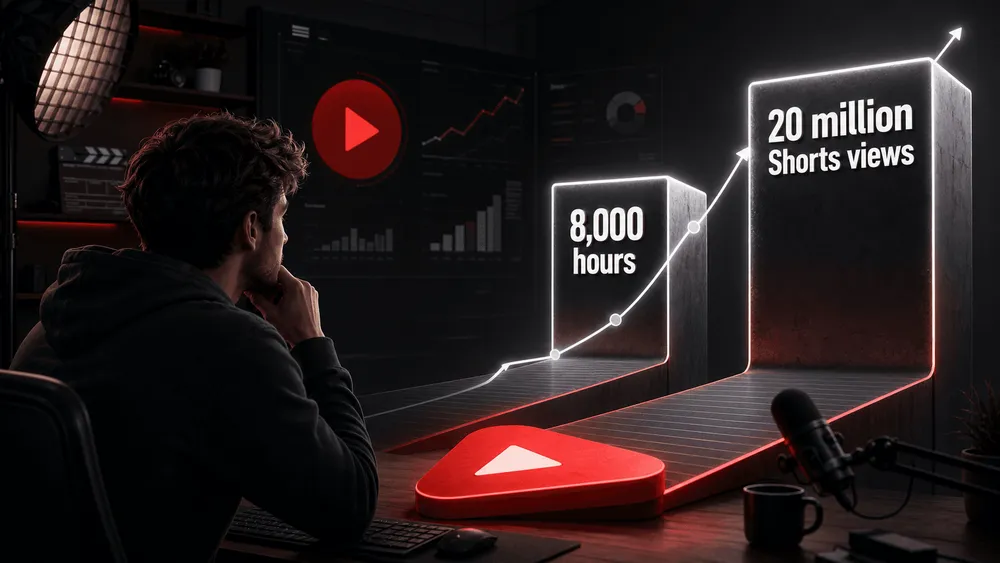
YouTube will revise its YouTube Partner Program (YPP) monetization criteria starting February 1, 2027. The watch-time record required for new applicants to receive ad and YouTube Premium revenue share will double to 8,000 hours for long-form videos and rise to 20 million views for Shorts. Channels already enrolled in YPP, however, are exempt from the new application thresholds. That said, Shorts will now require an ongoing 90-day performance benchmark, effectively creating a system where the revenue gate can open and close by format even after a channel has joined.
First Doubling of Watch-Time Requirements Since 2018
New creators will need to meet one of two thresholds: 8,000 hours of long-form watch time over the past 365 days, or 20 million qualified Shorts views over the past 90 days. Currently the requirements are 4,000 hours or 10 million views—meaning both pathways are doubling. The announcement specifically addresses changes to watch time and view counts but does not mention the current 1,000-subscriber requirement.
This marks the first major shift in YouTube's monetization criteria since 2018. Back then, YouTube added the requirements of 4,000 hours over the previous 12 months and 1,000 subscribers, applying them to existing channels as well after roughly a one-month grace period. According to YouTube, 99% of affected channels had earned less than $100 in the prior year, and 90% had earned less than $2.50 in the most recent month.
The 2027 revision differs in scope. The 8,000-hour/20-million-view thresholds apply only to newly applying channels and will not remove existing YPP participants under the new standards. While the path to review will be longer for newcomers, creators who have already joined and are earning from long-form content will retain their status.
The eligibility criteria for direct fan monetization features and early access to Shopping remain unchanged. Under the current system, channels can apply once they reach 500 subscribers, have published 3 videos in the last 90 days, and have either 3,000 hours of watch time over the past 365 days or 3 million Shorts views in the past 90 days. This creates a two-stage path where smaller channels first access features like memberships and Super Chat before working toward ad and Premium revenue share—a path that will grow even longer after 2027.
Not Removal, But a Pause on Shorts Revenue
To continue receiving ad and subscription revenue share from Shorts, channels will need to maintain 10 million qualified views over a rolling 90-day period starting February 1, 2027. If a channel falls below this threshold, it remains in YPP and continues earning from long-form content. Once the channel surpasses 10 million views again, Shorts revenue sharing resumes automatically.
This is a separate condition from the 20-million-view threshold required for new entrants. While reaching 20 million views is necessary to newly enter ad revenue sharing via Shorts, maintaining 10 million views after joining is sufficient to continue receiving Shorts revenue. YouTube suggests the impact will be minimal for creators who are already earning substantial revenue from Shorts.
Under the current Shorts ad revenue model, YouTube creates a Creator Pool from feed ad revenue after processing music licensing costs, then distributes funds based on each country's proportion of qualified views. Creators receive 45% of their allocated share. Under the new system, channels falling below 10 million views will be excluded from this calculation during that period. Channels whose growth depends on seasonal trends or one-off viral moments will find it harder to predict continuity in their revenue.
Premium Lite Gets a 60% Dedicated Pool
YouTube is expanding Premium Lite to all countries where YouTube Premium is offered. Premium Lite allows ad-free viewing for most videos, and as of 2026 also supports downloads and background playback for most content. Music content and Shorts are excluded from these additional features.
Creator payments are determined in two stages. First, after accounting for operational and promotional costs as well as payments to music partners, 30% of net subscription revenue from standard Premium and 60% from Premium Lite go into plan-specific dedicated pools. Second, funds are allocated to individual creators based on subscriber watch time and view counts, with a 55% distribution rate for long-form content and 45% for Shorts. The 60% figure does not represent the share a single creator receives directly.
The global rollout of Premium Lite is also a strategy to expand revenue sources beyond advertising. YouTube states that when users subscribe to Premium, partners earned more revenue on average in 2026 compared to when those same users were watching ads instead. However, country-specific pricing for Lite and the completion date for the rollout were not included in this announcement. The rate at which users migrate from standard Premium to Lite will also affect the total size of the pool.
Expanding Revenue Streams, Remaining Gaps
YouTube states that YPP now has over 3 million participants and that it has paid out more than $100 billion to creators, artists, and media companies over the four years through 2025. Shorts now surpass 200 billion daily views, while TV viewing exceeds 1 billion hours per day. This announcement narrows the entry point to monetization while simultaneously expanding separate revenue pools by viewing format.
For Shorts channels that don't reach 10 million views, YouTube says it will offer bonuses through YouTube Shopping, incentives for brand deals, and revenue boosts for creators who originate and grow trends. This provides an alternative to relying solely on ad revenue, though specific amounts and start dates have not yet been announced. Eligibility conditions and available countries also remain unpublished. Whether this system will allow creators to forecast revenue in advance—compared to view-based distribution—remains to be seen once details are released.
For creators planning their 2027 business strategy, it will be necessary to cross-reference the new terms presented in YouTube Studio with incentive conditions to be announced later. For channels whose 90-day Shorts performance hovers around the 10-million-view threshold, the question becomes whether long-form content, fan monetization, or Shopping can numerically offset any interruption in revenue.