

Every time you open a foldable phone, a single line shows up on the screen. Many people who saw it in review videos told themselves it was tolerable if it was only visible when light reflected off it. But this line is neither an individual defect nor a quirk of how the phone is used. It is a structural weakness that has not gone away across generations of hinge design. With the Galaxy Z Fold8, released in August 2026, Samsung stepped away from the approach of refining how the hinge folds and instead replaced the material of the layer that supports the screen. We break down how the design has evolved to see what changed to get closer to solving a seven-year-old problem, and what was sacrificed along the way.
What the Crease Really Is: Why Changing the Hinge Never Made It Disappear

The inner display of a foldable is built not on a rigid glass panel but on a soft resin film called polyimide, with an OLED layer stacked on top. Imagine folding a plastic file folder in the same spot hundreds of times: even after you let go, a white mark remains and it never fully returns to flat. The same phenomenon occurs inside the display, at a far thinner scale. This resin does not crack when bent repeatedly, but once the strain at the fold exceeds a certain limit, it undergoes "plastic deformation," failing to return completely to its original flat shape even after the bending stops.
In 2019, Samsung described the original Galaxy Fold as built to withstand 200,000 folds as a benchmark of durability. Assuming 100 openings and closings a day, 200,000 folds works out to roughly five and a half years. However, what the Washington Post review reported was that the testing robot folded the phone 200,000 times without "any problems," which is a statement about resistance to breakage, a different standard from whether a crease forms. Market research firm TrendForce analyzes the physical cause of this kind of crease as localized tensile stress caused by a shift in the panel's internal "neutral plane," along with the resulting microcracks and permanent deformation. Not breaking and not leaving a mark were, from the start, separate challenges.
The crease itself was already an open secret at the time of the original Galaxy Fold, released in 2019. The phone launched with a protective polymer layer added on top and a metal support plate underneath, after a wave of incidents before release in which reviewers mistakenly peeled off the screen protector. Even so, the Washington Post review said you would simply have to "come to terms with" the crease in the inner display. Adding protective layers had already been tried with the first model, and the support structure behind the crease remained unchanged.
The Evolution of the Hinge: Why Changing the Angle Never Fixed It
The next change targeted something closer to the surface. With the 2020 Galaxy Z Fold2, Samsung adopted Ultra Thin Glass (UTG) for the inner main screen. The official announcement pitched it as offering "a more premium, refined feel" and made no explicit claim about addressing creases. UTG is a protective glass laid over the OLED layer, and Samsung's announcement said nothing in particular about the support structure beneath the OLED, which is believed to be behind the crease.
The next change targeted the hinge's "curvature." The waterdrop hinge that Samsung Display announced in 2023 designs the moving parts so that, when folded, the screen forms a gentle teardrop-like curve, spreading bending stress that had been concentrated at a single point over a wider area. This design change is said to have reduced the load on the panel and the visibility of the crease, but changing the hinge curvature alone does not alter the support structure that causes the crease.
| Year | Measure | Nature of the approach |
|---|---|---|
| 2019 | Original Galaxy Fold (protective polymer layer + metal support plate) | The crease remained even with added protective layers |
| 2020 | Ultra Thin Glass on the Galaxy Z Fold2 | Added protective glass to the main screen (no explicit claim of addressing creases) |
| 2023 | Waterdrop hinge | A geometric measure that loosens the hinge curvature to distribute stress |
| 2026 | Flex Titanium (Galaxy Z Fold8) | A materials measure that puts titanium alloy in the support layer directly beneath the OLED for the first time |
As the table shows, neither the protective layer added to the original model, nor the 2020 UTG, nor the 2023 waterdrop hinge touched the support structure itself, which is believed to be the cause of the crease. The reasoning is that enlarging the bending radius reduces the difference in stretch between the inside and outside of the film when folded to the same angle, spreading strain that had been concentrated at one point over a wider area. The limits of this approach are the reason for the next generational shift.
Improvements from 2019 to 2023 were limited to adding protective layers and adjusting the hinge shape. With the 2026 Galaxy Z Fold8, Samsung went further, putting titanium alloy for the first time into the support layer directly beneath the OLED. It came at a new cost, however: the phone does not include the multi-angle standing function known as Flex Mode.
The Galaxy Z Fold8's Solution: Rethinking the Support Layer by Replacing It with Titanium
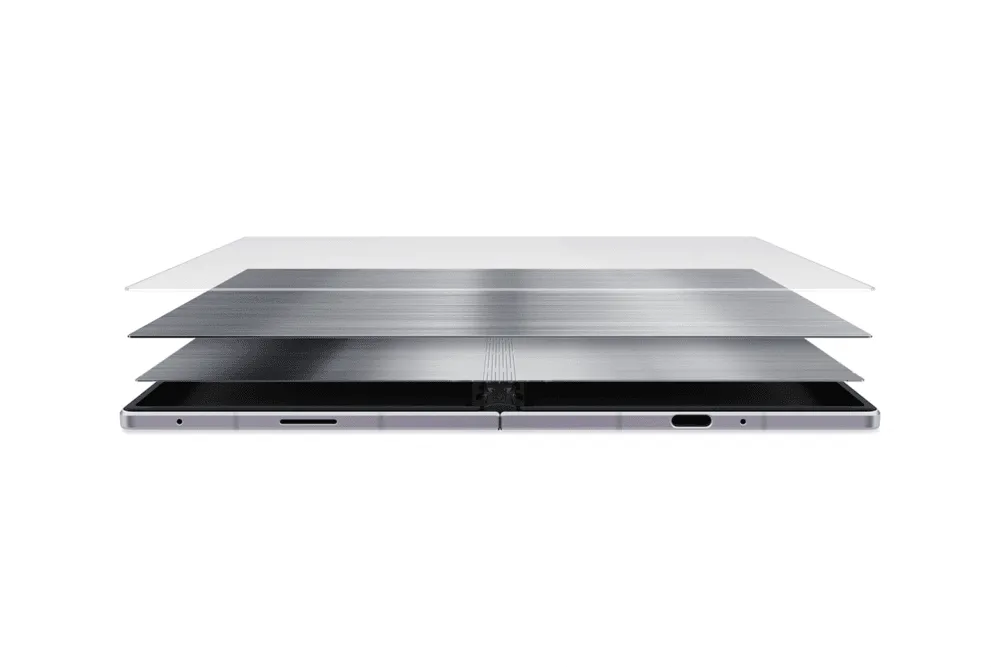
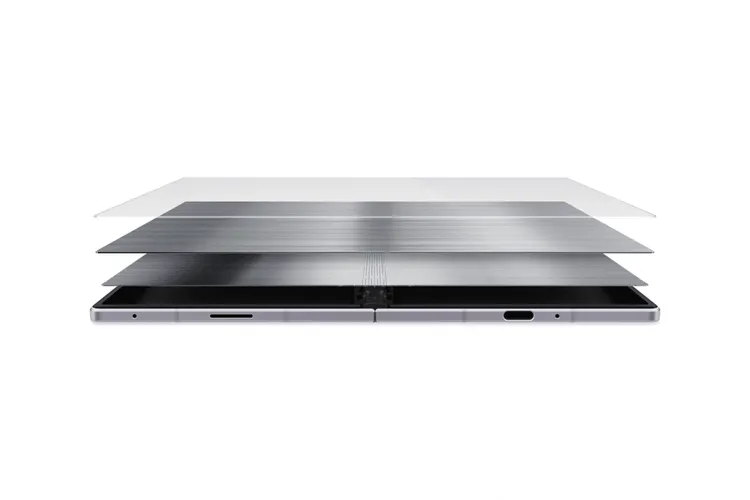
"Flex Titanium," adopted in the Galaxy Z Fold8, changes the material of the support layer beneath the OLED panel itself. Where the earlier hinge improvements worked on how the screen bends, Flex Titanium works on the side that gets bent. A titanium alloy film less than 30% the thickness of a human hair is placed directly beneath the OLED panel, with a titanium plate perforated by countless microscopic holes layered underneath. The titanium alloy film has 20 times the mechanical rigidity of the polymer film used until now.
Samsung officially states that this structure improves durability and reduces crease visibility. The holes in the finely machined plate are designed to keep the folding area flexible while reducing the air gap that formed between the display module and the adhesive.
Supporting from below with a rigid layer likely makes the load on the crease less prone to concentrating at one point. The earlier approach of loosening hinge curvature to spread stress and this new approach of stiffening the support layer itself address different variables. Still, Samsung itself limits its wording to "reducing crease visibility" and does not claim it disappears. The US outlet Android Police's review said it "almost removes the crease" and reported no change in the crease over 10 days of use with repeated opening and closing.
The Galaxy Z Fold8 was announced on July 22, 2026, with preorders opening in Japan on July 23 and sales starting on August 7. In the US, the 256GB model is priced at $1,899.99 (roughly $1,900 in some outlets), and in Europe at €2,000. Converted at the September 4, 2026 exchange rate (1 dollar = 156.23 yen), around $1,900 comes to roughly 297,000 yen. The inner display also gets a strengthened anti-reflective coating that Samsung says cuts reflections and glare by up to 50% compared with the Z Fold7.
The Crease Improvement Bought by Sacrificing the Multi-Angle Stand
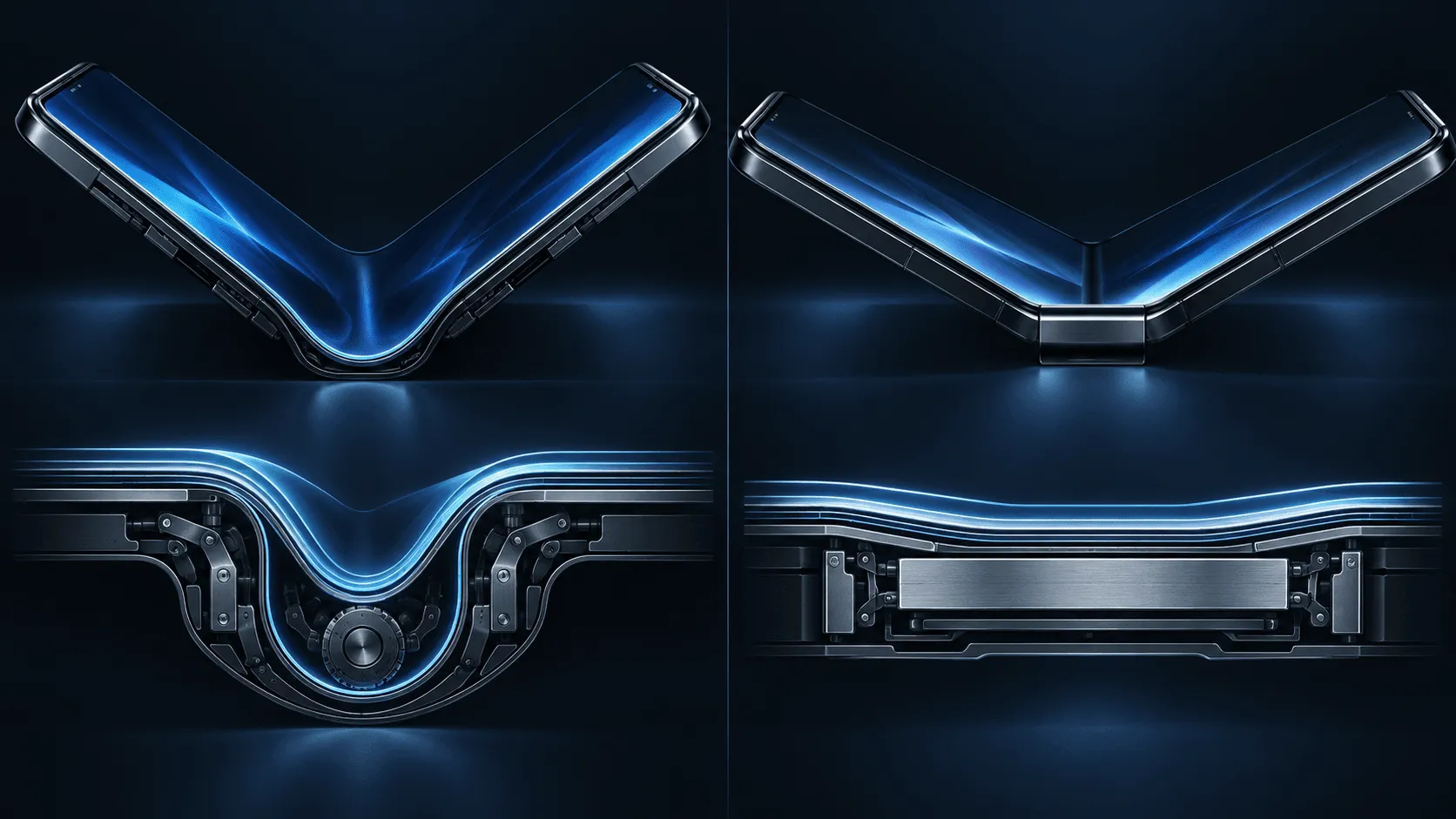
Flex Titanium's effect also shows up in evaluations from outlets that tested the device. The folding action is reported to feel more "decisive," and the visibility of the crease is reported to have improved significantly over the previous generation. Before release, Ice Universe, known for Samsung-related leaks, had pointed out via Tech Advisor that the new hinge might make it difficult to hold the screen at certain angles.
What post-release testing has confirmed is that the Galaxy Z Fold8 does not include "Flex Mode," the function that lets you leave the screen propped open at any angle. The higher-end Galaxy Z Fold8 Ultra and earlier models do have it. For uses that depended on freely fixing the angle, such as video calls or placing the phone on a table, you may now need extra support. Samsung has not explained the omission, and various views have been reported, including trade-offs with the new hinge structure and cost considerations, but nothing is confirmed.
iFixit, which tore the device down, also pointed out another weakness. The Galaxy Z Fold8 has an IP48 dust rating, a standard that only blocks objects of 1 millimeter or larger. UV-reactive powder (about 0.04 mm) and sea sand (about 0.16 mm) are smaller than that threshold and get into the hinge's moving parts. iFixit reported that after folding, a "thoroughly unpleasant, gritty sound" was produced and the phone could no longer open and close normally.
So while the surface weakness of the crease was reinforced with materials, a different kind of durability, sealing of the moving parts, remains unresolved. In environments such as beaches where fine dust and sand fly around, this looser standard translates directly into a risk of failure. The more complex internal structure also affects repairability, and iFixit gave a provisional repairability score of 4 out of 10 (an assessment made while parts supply and repair manuals were still undetermined). iFixit said it calculated this score on the assumption, based on trends in past models, that replacing the display would require replacing the entire hinge mechanism.
How Is Apple Trying to Get Past the Same Wall?

Whereas Samsung has tackled the crease on the "structure" side, with the hinge and the support layer, Apple's still-unannounced foldable device is, according to reports, aiming to work on a different place. As noted above, TrendForce sees the physical cause of the crease as localized tensile stress from a shift in the panel's internal "neutral plane," along with the resulting microcracks and permanent deformation. According to reports based on the contents of Apple-related patents, what Apple appears to be considering is variable-thickness Ultra Thin Glass (UTG), with the crease area made thinner and the surrounding area thicker.
Separately, as a general technology trend for next-generation foldable panels, adoption of a new type of optically clear adhesive (OCA) that acts like a flexible cushion has also been reported. Combining the two would appear to create a design that absorbs stress within the glass. The idea is to deliberately create areas of differing thickness so that force on the crease is dispersed across the whole surface, which differs in aim from Samsung's method of catching it with a rigid metal plate. This device has not been officially announced, and everything, including its name, remains speculation based on reports and patent analysis.
| Aspect | Samsung (Galaxy Z Fold8, confirmed information) | Apple (unannounced, rumor stage) |
|---|---|---|
| Where the fix is applied | Support layer under the display | The glass layer itself |
| Method adopted | Titanium alloy film + micro-machined plate | Variable-thickness UTG (based on patent analysis). Flexible OCA reported separately as an industry-wide technology trend |
| Confirmation status | On sale, confirmed specs | Unannounced; based on patent analysis and industry research |
| Known trade-offs | No Flex Mode (multi-angle stand); cause unconfirmed | Unconfirmed (cannot be verified because the product does not exist) |
This comparison shows that, for the same physical weakness (the accumulation of strain in a multilayer structure from repeated folding), design philosophy diverges by company over where to take up the stress. Samsung chose to stiffen the supporting layer, at the cost of cutting freedom of movement. If Apple really adopts a method of absorbing stress on the glass side, it may be able to avoid sacrificing the hinge's multi-angle stand.
On the other hand, a separate issue may arise in the impact resistance of the variable-thickness glass itself, but since the device does not yet exist, this cannot be verified at present. Which design is better in the long run can only be compared after Apple's device is actually announced and subjected to teardowns like iFixit's and endurance tests running to tens of thousands of cycles. If you are considering buying a foldable, it is worth checking what the "crease improvement" in the spec sheet costs you.