

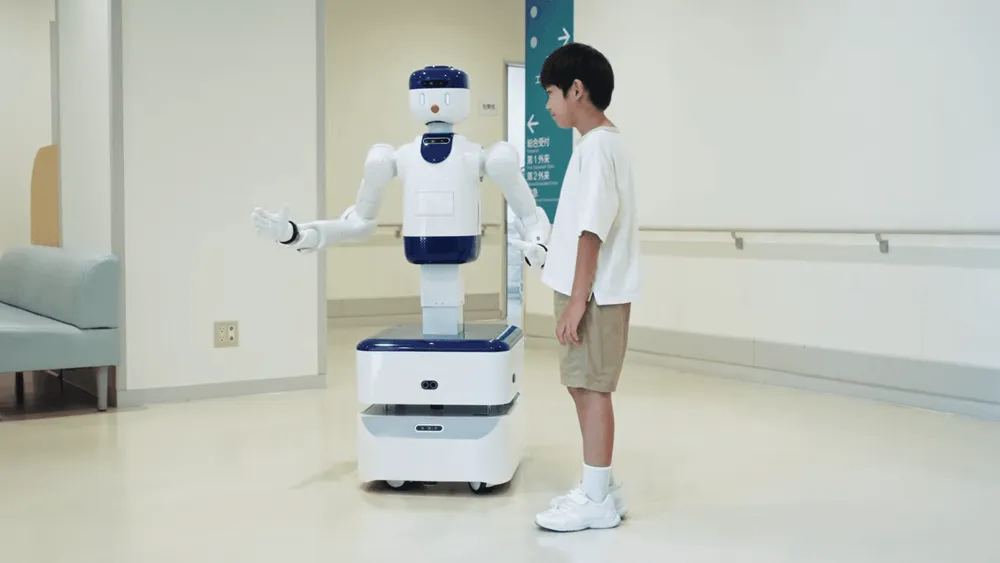
On a night in March 2026, a humanoid stood in the first-floor lobby of University of Tsukuba Hospital. It was the "G1," made by China's Unitree Robotics, standing 127cm tall and weighing 35kg. Over three days, from 7pm to 9pm after outpatient hours ended, the robot performed autonomous walking, obstacle avoidance, conversational wayfinding, and object transport. Zero falls. Zero contact with people.
The company behind this pilot was ZEALS, a startup known for chat commerce. The company had only just launched its robotics division, "Omakase Robotics," in November 2025, and was exploring how far a humanoid could operate within the many constraints of a hospital environment.
Five months later, on August 5, ZEALS held a press conference in Tokyo and officially unveiled its self-designed humanoid, "D1." CEO Masahiro Shimizu presented a live demo alongside the announcement, laying out a compact design optimized for Japan's indoor environments, along with goals of mass-producing 100 units within the fiscal year and accumulating 10,000 hours of cumulative operating time.
However, D1 is built on a fundamentally different design philosophy from the G1. It does not walk on two legs.
What the US and China's Design Philosophy Has Assumed
The race to develop humanoids has accelerated rapidly since 2024. Tesla's Optimus stands 173cm tall and weighs 57kg. Figure AI's Figure 03 stands 173cm and weighs 70kg. Agility Robotics' Digit stands 175cm and weighs 65kg. All of these have dimensions close to the human body and move via bipedal walking.
Underlying this design philosophy is the premise that human living spaces are built to fit the human body—the logic that two legs are advantageous for climbing stairs, stepping over obstacles, and walking on uneven terrain. Tesla has set a target price of $25,000 per unit by 2030, and Figure AI is running a pilot deploying 50 units on a BMW assembly line. In China, Unitree is reported to have already deployed over 1,000 units to warehouses and cleanrooms as of Q1 2026.
| Model | Height | Weight | Locomotion | Continuous Operation | Price Range |
|---|---|---|---|---|---|
| Tesla Optimus Gen 3 | 173cm | 57kg | Bipedal walking | ~12–16 hours | Unpublished (estimated $150,000–$200,000) |
| Figure 03 | 173cm | 70kg | Bipedal walking | ~10–14 hours | ~$250,000 (Q1 2026 estimate) |
| Unitree G1 | 127cm | 35kg | Bipedal walking | ~2 hours | ~$16,000 |
| Agility Digit | 175cm | 65kg | Bipedal walking | ~6–8 hours | ~$8,000/month lease |
| ZEALS D1 | 129.3–159.3cm | 110kg | Wheeled base (AMR) | ~8 hours | From 5 million yen (~$34,000) |
As this table shows, D1 stands apart from other companies in terms of locomotion method. And as Shimizu's remarks at the press conference make clear, this choice is not the product of compromise but a deliberate strategic decision.
Not "Giving Up on Bipedalism," But "Focusing on the Arms"
At the press conference, Shimizu explained the reasoning behind adopting a semi-humanoid form in terms of two factors: safety and data efficiency.
When operating a bipedal robot in indoor spaces where people come and go, it is difficult to completely eliminate the risk of falling. Even though the G1 achieved zero falls over three days in the PoC at University of Tsukuba Hospital, that was in a limited area at night, and there is no guarantee the same result would hold in a crowded ward during the day.
The logic of data efficiency is more structural. Controlling bipedal locomotion requires enormous computational resources and training data. Rather than allocating resources to challenges like walking stabilization, balance recovery, and handling steps, D1 offloads locomotion to a wheeled AMR (autonomous mobile robot) base, freeing up computational resources and data collection costs to concentrate on arm manipulation.
Looking at D1's specifications, the consequences of this decision are clearly visible. The robot has 21 total degrees of freedom, broken down as follows: neck (2), arms (7×2), grippers (1×2), lift mechanism (1), and base (2). Each arm can carry a payload of 5kg. Torque sensors are mounted on every axis of the arm, and the robot stops moving the instant it detects contact with a person or object.
The base measures 48cm wide and 55.5cm deep, with a minimum passage width set at 65cm—dimensions that allow it to navigate the corridor widths and elevator openings typical of Japanese hospitals and hotels. Its top speed is 1m/s, with positioning accuracy of ±5cm. Its step-climbing capability is limited to 1cm or less, but it is designed to be able to board elevators.
"Semi-humanoids made overseas are too big," Shimizu said. "Since Japanese indoor spaces are narrow, we made it a compact 48cm wide for maneuverability. This kind of maneuverability will be in demand worldwide too."
What It Means for a Chatbot Company to Build a Robot
The fact that ZEALS is developing a humanoid robot becomes less surprising once you know the company's history.
Founded in 2014, ZEALS initially began with robotics development but pivoted to the chatbot business in 2016. The company pioneered the chat commerce market in Japan, and in 2022 raised a total of 5 billion yen from investors including Salesforce Ventures and Japan Post Capital. It now provides conversational AI for customer service to over 400 enterprise companies and has accumulated more than 450 million conversation records.
In November 2025, the company launched Omakase Robotics, moving in earnest to bring conversational AI into physical space. In January 2026, it began offering "Omakase OS," middleware for robotics. This was followed by the PoC at University of Tsukuba Hospital in March, leading up to the D1 announcement in August.
This trajectory shows that ZEALS is not a hardware company, but one built around designing interactions in the field. At the press conference, Shimizu stated flatly: "The US has software, China has hardware, but Japan has the field."
A Flywheel Powered by Field Data
D1's technology stack is composed of three layers: the hardware, "D1"; the middleware, "Omakase OS"; and the intelligence foundation, "Omakase Zen."
Omakase Zen is a mechanism for continuously improving manipulation capability based on data collected through field operation. "The data flywheel—the cycle of creating data while operating in the field—is the single most important thing in physical AI," Shimizu said.
The current AI model builds on Physical Intelligence's "π" series and NVIDIA's "GROOT" as a base, with repeated post-training and verification. Whereas large language models could be trained on text from across the internet, the foundation models governing robot movement require data that doesn't exist online—footage from the field, the amount of force applied, the angle at which an object is handed over.
ZEALS's careers page states the core of this strategy even more candidly: "Our moat is data. Through our partnerships, we will structurally monopolize channels for real-world data collection via field labor." The company is building a system, deploying Forward Deployed Engineers in the style of Palantir, to bridge the field and engineering.
What "Semi-Domestic" Means, and Its Cost
D1 is not entirely made in Japan. Components such as motors and batteries are sourced overseas, and the hands are made in China. However, the design is done by ZEALS, and assembly takes place domestically in Japan. Regarding this "semi-domestic" positioning, Shimizu cited "speed and price" as the reasons.
Insisting on fully Japanese-made parts and domestic production would delay development by several years and drive up the price significantly. The starting price of 5 million yen is set at roughly half the reported market average of 10 million yen. Monthly operating costs start at 200,000 yen.
This pricing needs to be understood in the context of Japan's humanoid robot market. According to estimates by Fortune Business Insights, Japan's humanoid robot market was worth approximately $290 million in 2026 and is projected to grow to $3.99 billion by 2034 (a compound annual growth rate of 43.7%). In the caregiving sector, a shortfall of 570,000 caregiving workers is projected by 2040, meaning the need for robot deployment in medical and caregiving settings is structurally expanding.
At the same time, a path toward full domestic production has also been laid out. Based on the data and operational know-how gained through D1's social deployment, the company plans to work with domestic parts manufacturers and research institutions to gradually localize production of key components.
The Intent Behind Measuring Success in Operating Hours
ZEALS's choice to use "field operating hours," rather than units sold, as its metric for social deployment is an unusual choice within the robotics industry.
The problem of robots being delivered and then simply sitting unused has recurred repeatedly in Japan's deployment of service robots. Many of the guide robots and food-serving robots introduced to facilities in the 2010s saw declining utilization rates due to operating costs and poor fit with on-site operations, and were not uncommonly removed altogether.
ZEALS aims to mass-produce 100 units within fiscal 2026 and reach a cumulative operating record of 10,000 hours. That works out to about 100 hours per unit per year, or roughly 1.5 hours of operation per day. Against an 8-hour battery capacity, this target may look modest, but considering the work of integrating the robot into actual operations, establishing collaborative procedures with staff, and handling troubleshooting, it is a realistic figure for an initial stage.
To support this goal, partnerships have been established across four areas. In healthcare, CUC, the Sakurajuji Group, and CHCP will lead use case development. Mitsui Sumitomo Insurance has developed dedicated insurance covering personal injury, property damage, and cyber risk. JA Mitsui Lease, Mizuho Lease, and Mitsubishi HC Capital are considering introductory packages that reduce upfront costs. GMO AI & Robotics Shoji and Quick will provide deployment and operational support.
Reservations opened on August 5, and the first lot for October delivery has already sold out.
The Hurdles to Clear Before Field Data Accumulates
There are clearly unverified premises in D1's approach.
First is how far wheeled-base locomotion will actually hold up in real-world settings. With step-climbing capability limited to 1cm or less, the robot's ability to handle the several-centimeter steps and thresholds common in Japanese facilities will be limited. While it is said to be able to board elevators, moving between buildings or operating outdoors has not been factored in.
Second is the time it will take for the Omakase Zen data flywheel to actually start turning. Regarding tasks involving the dual arms, ZEALS states that it will "not rush toward full automation, but rather repeat cycles of field data collection, compatibility verification, learning, evaluation, and improvement, gradually expanding the range of tasks it can handle." Automating actions like turning a doorknob or handing over a tray will require enormous amounts of field data and iterative model improvement.
Third, the PoC at University of Tsukuba Hospital was conducted using the Unitree G1 (a bipedal machine), and there is not yet any track record of D1 itself being verified in a real-world environment. D1's safety has been presented as a design specification, but long-term operating data from actual hospitals and care facilities has yet to accumulate.
In closing the press conference, Shimizu said, "We will also face up to questions of cost-effectiveness and safety. If we can work solidly together with our partner companies, we believe we can achieve real social deployment." Whether humanoids become a genuine force in the field will be determined not by the demo at a press conference, but by the quality of the operating hours yet to accumulate.