

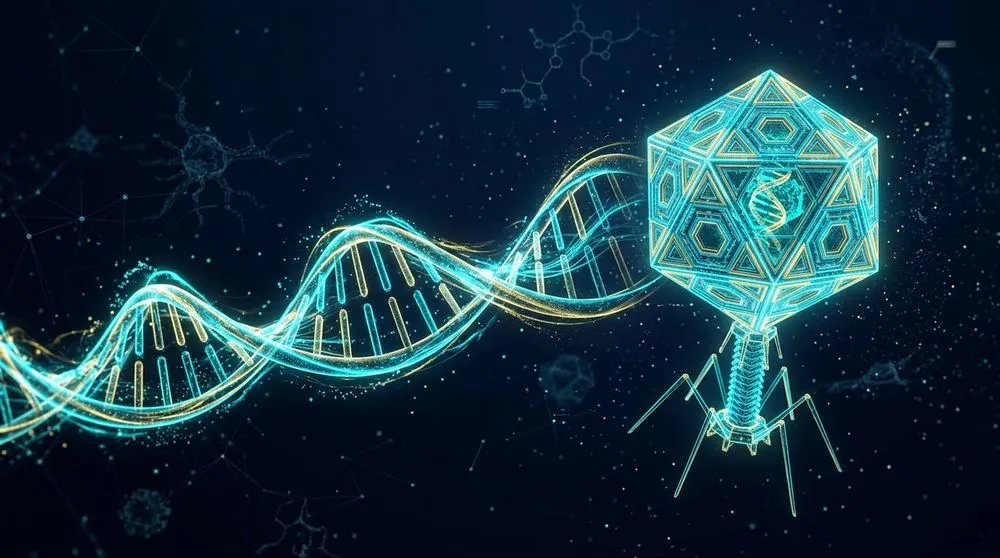
In 1977, Fred Sanger determined the complete sequence of the bacteriophage ΦX174. This circular DNA, consisting of 5,386 nucleotides, was the first DNA genome humanity ever fully read. In 2003, Craig Venter's research team chemically synthesized the same ΦX174 genome and succeeded in producing functional virus particles within 14 days. It marked the dawn of an era in which genomes could be "written."
More than 20 years later, in September 2025, a collaborative research team led by Associate Professor Brian Hie of Stanford University's Department of Chemical Engineering and the Arc Institute once again chose this historic virus as their stage. This time, they did not "write" it—they had AI "design" it.
Their findings were published in Science in 2026 (DOI: 10.1126/science.aec2657). Lead author Samuel King and colleagues generated 16 functional bacteriophages from AI-generated genome sequences, showing that some possessed killing power exceeding that of natural ΦX174. It is the world's first report of a functioning biological entity emerging from an AI-designed genome.
The "Next Wall" Left by Successful Protein Design
The fusion of AI and biology has already reached one major milestone. The 2024 Nobel Prize in Chemistry was awarded to Demis Hassabis and John Jumper of DeepMind for developing AlphaFold, which predicts protein structures, and to David Baker for creating RFdiffusion, which designs proteins. As this award demonstrates, it is now essentially academic consensus that AI can solve protein folding and design entirely new proteins from scratch.
However, proteins are only part of a genome. Biological function does not arise from a single gene product but from the totality of elements woven together—interactions among multiple genes, regulatory sequences, replication origins, and packaging signals. There is a qualitative gap between designing a single protein and designing an entire genome in which these elements must work together correctly.
In the field of DNA language models, this gap had remained unexplored. Whether sequences generated by a model would actually function inside a living cell—no one had ever verified this experimentally.
Evo 2: A "Reader of 9.3 Trillion Letters"
Evo 2, developed by the Hie lab, is a DNA foundation model whose preprint was released in February 2025 and later published in Nature. With 4 billion parameters, it was trained on 9.3 trillion nucleotides spanning all domains of life, including bacteria, archaea, eukaryotes, and phages. Its context window reaches 1 million base pairs—enough to "read" roughly one-third of the entire human genome at once.
However, in its raw form, it could not design a specific phage like ΦX174. Although the base model was trained on more than 2 million phage genomes, it lacked the ability to controllably generate sequences resembling ΦX174. The research team addressed this through supervised fine-tuning. They further trained the model on 14,466 sequences from the family Microviridae (clustered at 99% identity to eliminate redundancy), enabling it to generate sequences that were close to, but not identical with, ΦX174-like sequences when prompted accordingly.
This fine-tuning defines the boundary between imitation and design. If a generated sequence is too close to the wild type, it lacks novelty. If it is too distant, it fails to function. Through careful prompt design and adjustment of sampling parameters, the team aimed for this narrow band.
285 Designs, 16 Survivors
The generated candidate genomes were first screened through bioinformatics filters: validity of gene arrangement, conservation of the spike protein that determines host specificity, and evolutionary diversity. Hie acknowledges that "the model still hallucinates," but says he felt genuine promise once the generated sequences "deceived the first bioinformatics screening tools."
The experimental procedure is, in principle, simple. The base sequences output as text files by the AI are ordered from a commercial DNA synthesis company. The resulting linear DNA is circularized via Gibson assembly and introduced into E. coli strain C via heat shock. Inside the cell, proteins are translated and, if they self-assemble correctly, phage particles are completed. The completed phage then lyses and kills the very host bacterium that assembled it.
The evaluation criterion is straightforward: if the culture medium remains turbid, the bacteria are alive (the phage is nonfunctional); if it becomes clear, the bacteria are dead (the phage is functional). The team tested 285 designs in parallel using 96-well plates, observing decreases in OD600 within two to three hours.
As a result, 16 phages survived and were confirmed to be capable of propagation through sequence verification—a success rate of about 5.6%. This number may seem low, but as an experimental result for AI's first attempt at genome-scale design, it substantially exceeds conventional expectations.
| Item | Conventional Phage Therapy Development | This Study (AI-Generated Design) |
|---|---|---|
| Source of phages | Search and isolation from natural environments | De novo generation by AI model |
| Response to resistant bacteria | Search for new natural phages, or laboratory evolution | Generation of diverse cocktail designs; resistance overcome in 1–5 passages |
| Genomic novelty | Within the range of naturally occurring variation | 67–392 novel mutations; 13 genomes contain mutations not found in nature |
| Throughput from design to verification | Case-by-case | Parallel screening of 285 designs in 96-well plates |
Phages That Surpass Nature, Mutations That Don't Exist in It
All 16 functional phages carried sequences different from natural ΦX174. Compared to their closest natural genomes, they harbored 67 to 392 novel mutations. The most heavily mutated, Evo-Φ2147, carried 392 mutations, with an average nucleotide identity of 93.0% to phage NC51—by some taxonomic thresholds, this qualifies as a new species.
Thirteen of the genomes contained mutations found nowhere in any known natural sequence. This means AI extracted functional solutions from regions of sequence space that natural evolution has never sampled.
Several phages showed a competitive advantage over ΦX174 in growth competitions and exceeded it in lysis speed. Evo-Φ36 is particularly noteworthy. This phage incorporates the DNA packaging protein J from phage G4, which is phylogenetically distant from ΦX174. G4's J protein is 25 amino acids long, shorter than ΦX174's 38 amino acids. In past rational design attempts, this substitution failed to function. Cryo-electron microscopy analysis revealed that the shorter J protein adopts a different orientation within the capsid, stabilized by a combination of compensatory mutations. This is evidence that AI possesses the ability to coordinate multiple mutations in concert.
Suppressing Resistant Bacteria with "Cocktails"
The greatest challenge in phage therapy is the acquisition of phage resistance by bacteria. The research team created three strains of resistant E. coli carrying mutations in the waa operon, which modifies the lipopolysaccharide receptor for ΦX174. ΦX174 alone could not infect any of these three strains.
When a cocktail of AI-generated phages was administered, lysis was restored within one to five passages across all resistant strains. Sequence analysis revealed that the successful phages were mosaic genomes combining two to three genetic elements derived from AI designs through recombination. Mutations were concentrated in surface-exposed regions that interact with bacterial receptors. The diverse design population provided multiple attack pathways that were difficult for the bacteria to evade simultaneously.
The GRAM Project, published in The Lancet in 2024, predicts that antibiotic resistance will cause more than 39 million direct deaths worldwide between 2025 and 2050. Phage therapy is one of the most promising countermeasures to this crisis, but it has traditionally depended on luck—whether a suitable phage happens to exist in nature. Custom AI-based design has the potential to break this dependency.
An Open Model and Questions That Remain Open
Evo 2 has been made fully public—model parameters, training code, inference code, and the training dataset OpenGenome2 are all openly available. It is what Arc Institute and Nvidia jointly announced as "the largest open AI model in biology."
This openness has sparked debate over biosecurity. In September 2025, Tal Feldman (Yale Law School) and Jonathan Feldman (Georgia Institute of Technology) contributed an op-ed to the Washington Post warning that "We're nowhere near ready for a world in which artificial intelligence can create a working virus." While acknowledging the Stanford team's safety measures, they ask: "who's to stop someone from building their own model using public data on human pathogens?"
Hie himself does not dismiss this concern. "These models are evolving very quickly. Our research was conducted with safety in mind, but once the model becomes widespread, there's no guarantee other groups will exercise the same caution." At the same time, he notes that the process from DNA synthesis to virus creation is "not as simple as it sounds to explain—it's actually non-trivial."
Simon Jackson of Waikato University, while acknowledging that this technology could lower the cost of searching for phage therapies, evaluated it as follows: "Finding the right phage from nature can sometimes be extremely difficult. Generative AI could reduce this dependence on natural search and produce useful properties that are rare or nonexistent in nature."
Beyond Reading, Writing, and Designing
This research has clear limitations. The targeted ΦX174 has an extremely small genome of just 5,386 nucleotides and 11 genes. Compared to the human genome's 3 billion base pairs, this is less than 1/550,000th the scale. Hie has stated that "the entire genome is shorter than a single human gene." Whether this method can be extended to larger genomes—particularly eukaryotic genome design—remains untested.
The fact that eukaryotic virus sequences were deliberately excluded from Evo 2's training data represents both a safety-conscious design decision and an indication of the technology's current reach. The model's high perplexity (difficulty of prediction) for eukaryotic virus sequences signals that this domain still lies beyond the model's current capabilities.
How far can the 5.6% success rate—16 functional phages out of 285 designs—be improved? Can the host range be expanded beyond E. coli strain C? No regulatory framework yet exists for clinical application, and phage therapy itself remains in the midst of the approval process in many countries.
Sanger read it. Venter wrote it. Hie designed it. The same 5,386-letter genome runs through three eras of genomics. What the next era will bring is left to the judgment of those who wield this technology.