

Counterpoint Research announced on September 21, 2026, that global AI glasses shipments in the first half of the year had grown 263% year over year. Yet 96% of those shipments were products that don't project any image onto the lens. Glasses that overlay information onto the wearer's field of view also grew 449%, but a growth rate and a market's actual size are not the same thing. To avoid misreading the product landscape from a headline about explosive growth, it's necessary to separate what counts as "AI glasses" from how much of shipments the number actually measures.
The star of the 263% surge is "glasses without a display"
Counterpoint's Global Intelligent Eyewear Market Tracker defines "AI glasses" as smart glasses equipped with an AI-capable processor and at least two of the following: speaker, microphone, camera, or AR display. This is not a blanket figure covering every product sold under the name "smart glasses." The public report shows the 263% growth rate but does not disclose the absolute shipment volume for H1 2026.
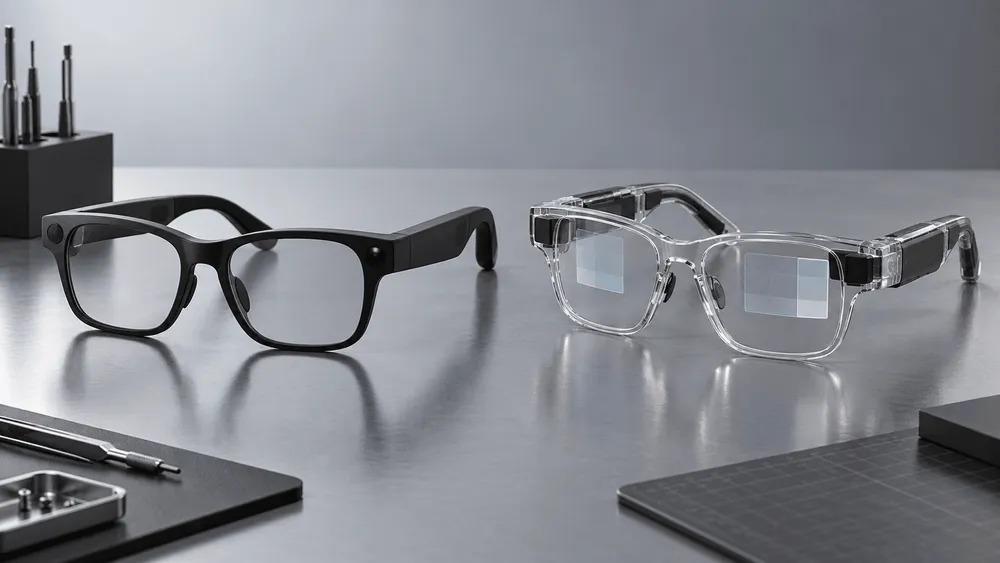
The category the company calls display-less AI glasses — AI glasses without any image projected onto the lens — grew 258% year over year and 22% from H2 2025. Products like Ray-Ban Meta, which carry a camera, microphone, and speaker but don't display text or images in the wearer's field of view, fall into this bucket. These are devices that move voice AI, photography, calling, and music onto glasses — a fundamentally different engineering burden from products that project movies or notifications onto the lens.
Meanwhile, AR & AI glasses — AI glasses with an AR display that overlay information onto the view through the lens — grew 449% year over year and 18% from H2 2025. Many of these use waveguide lenses, optical components that guide light within a thin, transparent substrate. Counterpoint cites high prices, immature technology, and bulky form factors as constraints on adoption.
Of all AI glasses shipped in H1 2026, 96% were display-less, leaving only 4% with a display. Even though the display-equipped category grew 449% year over year, the size of that growth rate doesn't mean the market ranking has flipped. That 4% figure is simply the disclosed 96% for display-less models subtracted from the total 100% in the same survey — a difference between two published whole numbers. The absolute shipment volume of display-equipped models has not been disclosed, and the precise composition ratio before rounding is unknown.
Meta's 94% isn't determined by the product alone
Meta accounted for 94% of shipments in the display-less category. This 94% figure has a different denominator from the 96% share that display-less models hold within total AI glasses. Meta's own shipments in this category grew 260% year over year and 22% from H2 2025.
Counterpoint attributes this growth to new variants of Ray-Ban Meta, the cheaper Meta Glasses, expansion into new markets, and in-store promotion. In other words, this is not a ranking based purely on comparing AI models or camera performance. For a product worn on the face, frame selection, support for prescription lenses, stores where customers can try them on, and the distribution channels used for selling eyewear all shape shipment volume. The combination of Meta and EssilorLuxottica has tied software together with eyewear distribution into a single product lineup.
Support for this scale also appears in a partner company's earnings materials. According to EssilorLuxottica's full-year 2025 results, annual sales of Ray-Ban Meta and Oakley Meta combined exceeded 7 million units. The company states that its AI glasses business, jointly run with Meta, contributed to accelerated revenue growth in the second half of the year. However, this is a manufacturer-disclosed sales figure for its own products, not the same metric as the market shipment data tracked by Counterpoint.
The 94% figure demonstrates strong market dominance, but it doesn't show the proportion of users who wear the devices every day. Shipment volume represents units that moved into distribution channels and should be distinguished from units actually sold at retail net of returns, and from the number of people who continue using the product. To judge whether the market has truly taken root, actual sales and usage frequency need to be examined on top of shipment figures.
Why market research numbers diverge
Other research firms have also reported rapid growth in AI glasses, but their numbers don't line up directly. Omdia estimated total AI glasses shipments for full-year 2025 at 8.7 million units, up 322% year over year. It reported that Meta accounted for 7.4 million units, or 85.2%, and that display-equipped models totaled 730,000 units, or 8.4% of the total. This can't be interpreted as meaning the display-less share fell or rose compared with Counterpoint's 96% figure for H1 2026, because the time periods, classifications, and survey methodologies all differ.
IDC's Q2 2026 tally has an even broader denominator. Combined shipments of XR headsets and glasses grew 35.3% year over year, broken down into 70.3% display-less glasses, 14.3% display-equipped glasses, and 15.4% headsets. Meta's 68.7% share is also calculated against this broader population.
| Survey/Company | Period | Scope Counted | Key Published Figures | Why Direct Comparison Isn't Possible |
|---|---|---|---|---|
| Counterpoint | H1 2026 | AI glasses per company definition | +263% YoY, 96% display-less | Absolute unit volume not disclosed |
| Omdia | Full-year 2025 | AI glasses per company definition | 8.7 million units, 8.4% display-equipped | Different period and classification |
| IDC | Q2 2026 | XR headsets and glasses | +35.3% YoY, 70.3% display-less glasses | Includes headsets |
| EssilorLuxottica | Full-year 2025 | Own Meta co-branded products | Sold over 7 million units | Company-reported sales figures, not a market estimate |
What these figures share in common only goes as far as the direction: glasses-form AI devices without a display have become the volume leader. Before turning differences in composition ratios into a story of winners and losers, it's worth checking each survey's time period, product classification, and whether it measures shipments or sales. Adding figures with different denominators together, or plotting them on a single trend line, can look precise while distorting the actual picture of the market.
In Japan, price and recording notifications are the test of adoption
In Japan, sales of Ray-Ban Meta (2nd generation) and Oakley Meta began on May 21, 2026. According to Meta's domestic announcement, the tax-included starting prices are 73,700 yen for Ray-Ban Meta, 82,500 yen for Ray-Ban Meta Optics (prescription lenses sold separately), 77,220 yen for Oakley Meta HSTN, and 96,580 yen for Oakley Meta Vanguard. A surge in global shipments doesn't necessarily mean these devices are easy to try out at an affordable price in Japan.
Alongside price, another barrier is how the camera is perceived by people around the wearer. Counterpoint lists privacy concerns over the camera, together with rising component costs such as for memory, as a near-term headwind. Compared with a smartphone, it's harder to tell which direction glasses are pointed when recording, and since wearers move through everyday spaces while wearing them, buyer convenience alone can't satisfy the conditions for widespread adoption.
Meta explains that a white LED on the front blinks while photos or videos are being recorded, and that starting with the second generation, the camera is disabled if the LED is detected as covered. The company also says it is working on updates to detect physical tampering. However, this is a description of the design provided by the manufacturer, not the result of third-party testing proving that all forms of tampering can be prevented. Both whether users understand the feature and whether bystanders can recognize that recording is underway need to be verified.
The next wall for the 4% with displays
Among display-equipped models, China accounted for 45% of H1 2026 shipments, surpassing North America's roughly 41%. Counterpoint attributes the lead of Chinese companies to a supply chain that spans microdisplays, waveguides, manufacturing, and acoustic components, combined with the speed of shipping products early and iterating quickly. At this stage, the view is that it's not just the size of demand but the supply capability to actually ship products that is shifting market share.
Even so, it's still too early to say that display-equipped models have become the volume mainstream. The absolute unit volume from the prior year that underpinned the high growth rate hasn't been disclosed, and a single market statistic can't capture how much progress has been made on price, weight, power consumption, or visibility. Meanwhile, the display-less category built a large market first, simply by putting a voice AI interface and a camera onto glasses. Rather than converging toward the same destination, the two product categories are likely, for the time being, to keep growing through different use cases and different conditions for acceptance.
If the absolute shipment volume of display-equipped models is disclosed, if price and weight come down, and if it can be confirmed that these devices continue to be used daily after purchase, then the 449% growth figure will shift from being a rebound off a small base to becoming the foundation for the next generation of products. Until those conditions are met, the star of the AI glasses market isn't glasses that add imagery to the field of view — it's devices that add voice AI and photography to everyday eyewear.