

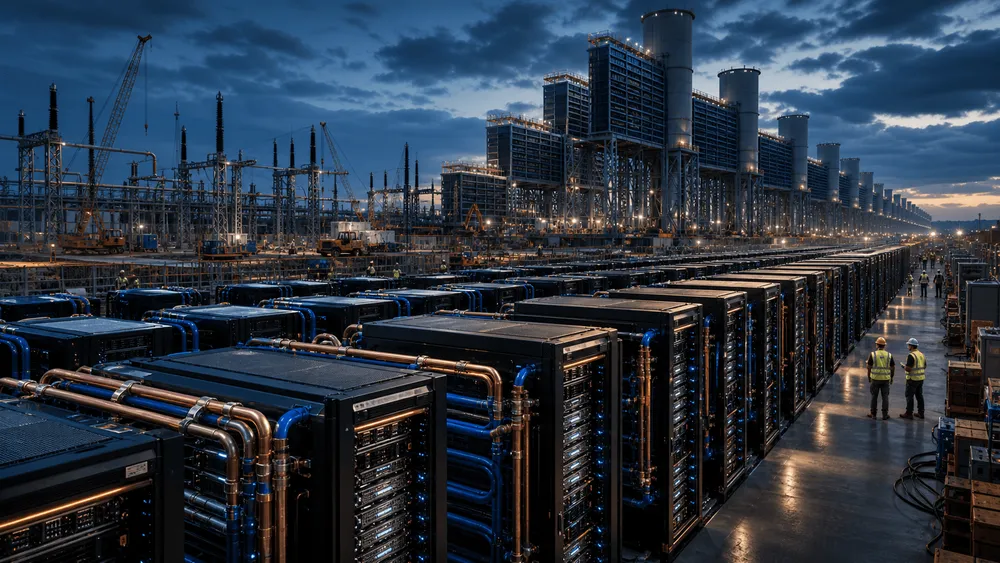
On August 3, 2026, TrendForce published a forecast projecting that global AI server shipments will grow approximately 31% year-over-year. This represents an upward revision of roughly 3 percentage points from the previous forecast of 28% growth. Combined capital expenditure from nine major cloud service providers (CSPs), including Google and Amazon, is expected to exceed $886.7 billion, with simultaneous growth anticipated in both NVIDIA's rack-scale products and each cloud provider's proprietary chips. However, capital expenditure growth is expected to reach approximately 90%, far outpacing the growth in shipment volumes. The generative AI investment race is expanding to encompass the power, cooling, and networking that drive racks, making it impossible to gauge either the scale of investment or its ripple effects across the supply chain by server unit counts alone.
Five North American Companies' Investment Plans Supporting Over $886.7 Billion
The five North American companies are Google, Amazon, and Meta, joined by Microsoft and Oracle. The Chinese contingent consists of four companies: ByteDance, Tencent, Alibaba, and Baidu. Combined capital expenditure for 2026 is projected to exceed $886.7 billion, with the five North American hyperscalers accounting for approximately 90% of this total. While these figures represent TrendForce's forecasts rather than actual results, the outlines of a sharp increase are also visible in the plans each company has disclosed.
Alphabet projects 2026 capital expenditure of $175-185 billion. Actual 2025 spending was $91.4 billion. According to the company, approximately 60% of 2025 investment went toward equipment such as servers, while approximately 40% went toward data centers and network equipment, with 2026 expected to follow a nearly identical composition. More than half of machine learning compute resources are slated to be allocated to Google Cloud.
Amazon plans approximately $200 billion in company-wide capital expenditure, while Microsoft plans approximately $190 billion on a calendar-year basis. Meta also projects $125-145 billion, including finance lease principal payments. Simply summing these four companies alone yields a range of $690-720 billion. However, Amazon's figure includes non-AI businesses, and Meta's includes lease payments, meaning the definitions are not aligned. These are not figures that directly correspond to TrendForce's estimates, but rather serve as a benchmark for gauging the scale of investment.
Even as capital expenditure grows by approximately 90%, the AI server shipment forecast remains at approximately 31% growth. This gap relates to the fact that the same capital expenditure category includes both long-lived assets like buildings and power receiving equipment, and equipment with shorter replacement cycles like GPUs and CPUs. Alphabet's 60-40 breakdown demonstrates that a substantial portion of AI investment is not counted as server units at all.
NVIDIA Racks and Proprietary ASICs Growing Simultaneously
What directly drove up the shipment forecast is demand for NVIDIA's GB/VR rack-scale products from hyperscalers and mid-tier data center operators. TrendForce believes AWS will deploy GB300 as its primary GPU server platform in 2026. Meta is also expected to center its infrastructure around NVIDIA's GB/VR and AMD Helios rack-scale systems.
With rack-scale products, delivering accelerators alone does not make them operational. Vera Rubin, which NVIDIA announced entering mass production in March 2026, combines Rubin GPUs and Vera CPUs alongside NVLink 6 switches, networking, and storage processing components into a single integrated platform. Sustained operation of these high-density compute systems also requires liquid cooling. This is why growing server demand cascades into orders for high-speed interconnects, memory, and cooling infrastructure.
Meanwhile, Google and AWS are expected to ramp up production of next-generation proprietary ASICs in the second half of 2026. Google has already announced its 8th-generation TPUs: TPU 8t for training and TPU 8i for inference. TPU 8t is designed to combine 9,600 chips with 2 petabytes of shared HBM into a single Superpod, extracting performance from the entire system—including interconnects and memory—rather than from individual chips alone.
The rise of proprietary ASICs does not mean NVIDIA products will be replaced during 2026. Under TrendForce's forecast, AWS will increase its own ASICs even as it deploys GB300, and Google will use both TPUs and NVIDIA GPUs in parallel. CSPs are allocating GPUs and proprietary chips according to use case, aiming to reduce inference costs while compensating for compute resource shortages.
Four Chinese Companies Rush to Build Domestic AI Infrastructure
The four Chinese companies are ByteDance, Tencent, Alibaba, and Baidu. TrendForce forecasts their combined capital expenditure will grow by over 80% in 2026. ByteDance, expected to see the largest growth, is concentrating investment in large-scale AI data centers, proprietary ASICs, and GPU clusters. To support large language model (LLM) services, all four companies are also accelerating adoption of Chinese-made AI solutions.
The difference from their North American counterparts lies in the need to simultaneously meet compute demand while expanding domestically sourced combinations of hardware and software. That said, TrendForce's public materials do not disclose shipment figures or composition ratios by Chinese accelerator manufacturer. An 80%+ increase in capital expenditure does not necessarily translate into an equivalent percentage increase in AI server shipments.
Still, the increased spending by these four Chinese companies demonstrates that AI infrastructure investment is not confined to North America. TrendForce lists AI servers and liquid cooling equipment alongside high-speed interconnects, power infrastructure, and memory as investment targets. The wave of investment is spreading well beyond accelerators alone.
Supply Conditions That Will Determine the 2027 Forecast of Approximately $1.3 Trillion
TrendForce forecasts that combined capital expenditure from the nine companies will reach approximately $1.3 trillion in 2027, growing by a further approximately 50% year-over-year. While the growth rate will slow due to the larger comparison base, investment amounts are expected to set new records. The company projects continued development in inference processing, AI agents, and proprietary ASICs. Investment targets will expand to include advanced packaging and high-speed interconnects, with power, liquid cooling, and memory also included.
Funding alone does not increase compute capacity. Alphabet has indicated that supply constraints will persist throughout 2026, and Microsoft has similarly stated that constraints will continue at least through the end of that year. Microsoft's $190 billion plan includes approximately $25 billion attributable to rising component prices. Investment amounts are swelling due to both increased installation volumes and rising prices.
What will validate the approximately 31% shipment forecast is whether procurement of GB300 and Vera Rubin-based racks proceeds smoothly, and whether Google and AWS can ramp up proprietary ASIC production as planned in the second half of 2026. Progressing toward the roughly $1.3 trillion market beyond that will require power receiving capacity and cooling infrastructure to keep pace with the growth in high-density racks. Rather than capital expenditure figures alone, the actual growth in operational servers and data center capacity coming online will determine the next forecast revision.