

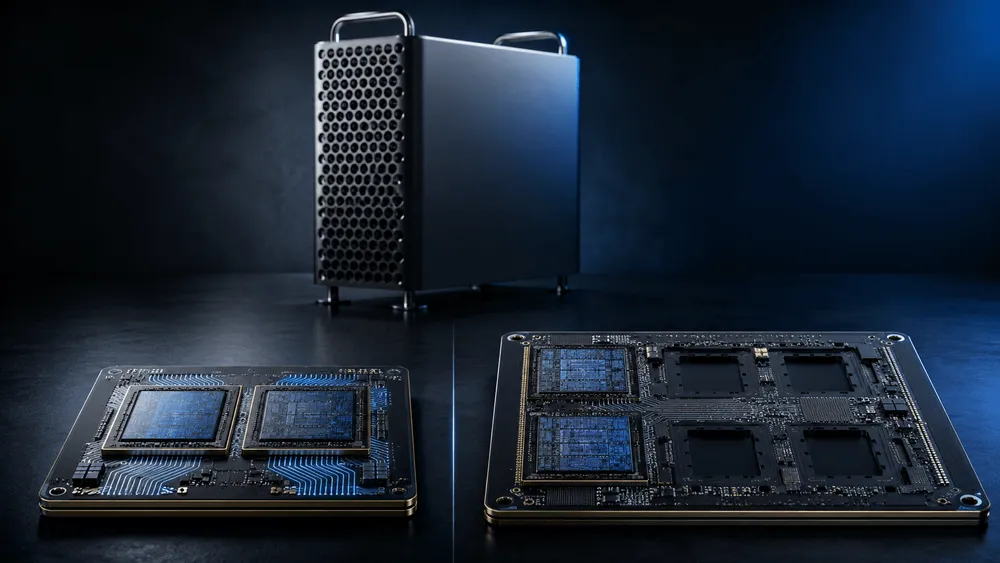
It appears Apple developed—more than once—a powerful chip intended exclusively for the Mac Pro. According to Bloomberg's Mark Gurman, the plans called for flagship M2-generation and M3-generation SoCs that would double the CPU and GPU core counts compared to the corresponding Ultra chips of the same generation. Gurman refers to these as "M2 Extreme" and "M3 Extreme," though these are not official product names Apple has disclosed. Neither reached the market, reportedly because the high manufacturing cost couldn't be recovered given the Mac Pro's limited demand.
The significance of this abandoned plan becomes clearer when you line up the products that actually shipped. The 2023 Mac Pro used the same M2 Ultra as the smaller Mac Studio, and the 2025 M3 Ultra went only into the Mac Studio. Then in March 2026, Apple discontinued the Mac Pro and confirmed to 9to5Mac that it has no plans to offer a future version of the product. Had Extreme materialized, it could have created a clear distinction in the published core counts between the two machines. However, there is no confirmation from Apple that the cancellation of Extreme was the reason behind the Mac Pro's discontinuation.
What "2x the Ultra" actually means
The "2x" figure reported by Bloomberg refers specifically to the core count of the CPU and GPU. It does not include clock speeds or memory bandwidth. Nor does it mean that power consumption or real-world application performance would uniformly double as well.
| Generation | Maximum shipped Ultra configuration | Scale implied by applying the reported figures to the max configuration |
|---|---|---|
| M2 | 24-core CPU / 76-core GPU | 48-core CPU / 152-core GPU |
| M3 | 32-core CPU / 80-core GPU | 64-core CPU / 160-core GPU |
The M2-generation figures of 48 CPU cores and 152 GPU cores align with what Gurman reported back in 2022 regarding plans for a flagship Mac Pro chip. At the time, the explanation was that the design would combine the equivalent of four M2 Max chips into a single system. The M3-generation figures of 64/160 are merely a mechanical doubling of the M3 Ultra's published maximum values, serving as a rough indicator of the design's scale—not a confirmed product specification.
Adding cores doesn't help if the workload can't be sufficiently parallelized to use the extra capacity. If multiple compute blocks are waiting on the same data, memory bandwidth becomes the bottleneck, and cross-die communication and thermal design also affect performance. Benchmarks, TDP, and memory configuration for the unreleased chip have never been disclosed or confirmed. So while it's fair to say "the design targeted double the maximum core count," it would be going too far to claim it "was supposed to deliver double the performance of the Mac Studio"—that's the confirmable boundary here.
Two-die UltraFusion, and the wiring complexity beyond it
The Ultra chips that did ship are already massive multi-die SoCs. The M2 Ultra connects two M2 Max dies via a silicon interposer, integrating 134 billion transistors. The connection uses over 10,000 signal traces, with die-to-die bandwidth exceeding 2.5TB/s. Because it appears as a single chip to software, developers don't need to rewrite code with the two dies in mind.
The M3 Ultra inherits this basic structure, connecting two M3 Max dies with over 10,000 signal traces as well. It has 184 billion transistors, memory bandwidth exceeding 800GB/s, and unified memory reaching up to 512GB. UltraFusion—which Apple has actually shipped—is the mechanism that combines two dies into a single logical SoC.
Scaling up to the equivalent of four Max chips, as reported for the 2022-era M2 Extreme, requires more than simply adding compute cores. The wiring that delivers data to each die, and the distances to memory, would need to be redesigned entirely. Power delivery and heat dissipation would also need to be reworked across the whole package. As the number of dies increases, wire lengths differ between adjacent dies and those farther apart.
US Patent 12,237,269, assigned to Apple, concretely illustrates this design challenge. It describes arranging multiple logic dies side by side for power and thermal reasons, routing short- and long-distance inter-die wiring across different metal layers, and configurations involving I/O dies or crossbar dies. This is neither a schematic for Extreme nor evidence that it was ever productized. Still, it's a primary source showing that scaling logic and memory independently requires wiring design that goes well beyond simply duplicating cores. The manufacturing complexity and cost that Bloomberg reported are consistent with these packaging-level challenges.
Two chassis, the same M2 Ultra
The solution Apple settled on in 2023 wasn't putting Extreme into the Mac Pro—it was sharing the completed M2 Ultra with the Mac Studio. Both machines have the same published maximums: 24 CPU cores, 76 GPU cores, 192GB of unified memory, 800GB/s of memory bandwidth, and the ability to play back up to 22 streams of 8K ProRes 422. The Mac Pro's larger chassis did not translate into a higher-tier SoC configuration.
What the Mac Pro offered instead was built-in PCIe expansion. Six of its seven slots were open, and Apple cited DSP, SDI I/O, networking, and storage cards as example use cases. However, the physical slot width and available bandwidth aren't the same thing. The M2 Ultra outputs 32 lanes of PCIe Gen 4 to the system; 8 lanes go to the internal SSD, and 24 lanes reach the expansion slots via a PCIe switch—further split into two pools of 16 and 8 lanes.
In other words, the value of the 2023 Mac Pro lay not in faster CPU or GPU performance than the Mac Studio, but in fitting dedicated cards into the chassis and making them usable from macOS. This difference matters greatly in certain fields—video, audio, high-speed networking—but it doesn't do much to spread the development cost of a dedicated SoC across a larger sales volume.
Gurman also reported this time that Apple had tested other configurations, including a specialized "J170" Mac Pro that would use an Intel processor, and "J190," an M3 Ultra machine alongside the 2025 Mac Studio. Neither shipped, and the intended use case for J170 hasn't been disclosed. All this report tells us is that plans for an Intel version and an M3 Ultra version reportedly existed—the purpose behind adopting them, and how far into development they got, remain unknown.
What the Mac Studio kept, and what the Mac Pro lost
The M3 Ultra—with up to 32 CPU cores, 80 GPU cores, and 512GB of unified memory—found its home in the compact Mac Studio. It inherited the role of high-performance desktop, but not the Mac Pro's six open PCIe slots. Since Apple discontinued the Mac Pro in March 2026, users who need internal expansion are left with practical options like migrating to Thunderbolt-connected peripherals, using a separate compute environment alongside their Mac, or holding onto an existing Mac Pro.
What this product history reveals isn't really about the size of the tower chassis—it's about the economics of dedicated silicon. As long as the Mac Pro shared the same Ultra chip as the Mac Studio, the two machines shared the same published ceiling. Creating real differentiation would have required the engineering to implement double the cores in Extreme—and, beyond that, the conditions to make that expensive package viable on a small number of sales. Bloomberg cites cost and demand as the reasons Extreme was cancelled, and the product line was subsequently consolidated into the Mac Studio. The two events line up chronologically, but this report alone doesn't establish that Extreme's cancellation was the sole cause of the Mac Pro's discontinuation.