

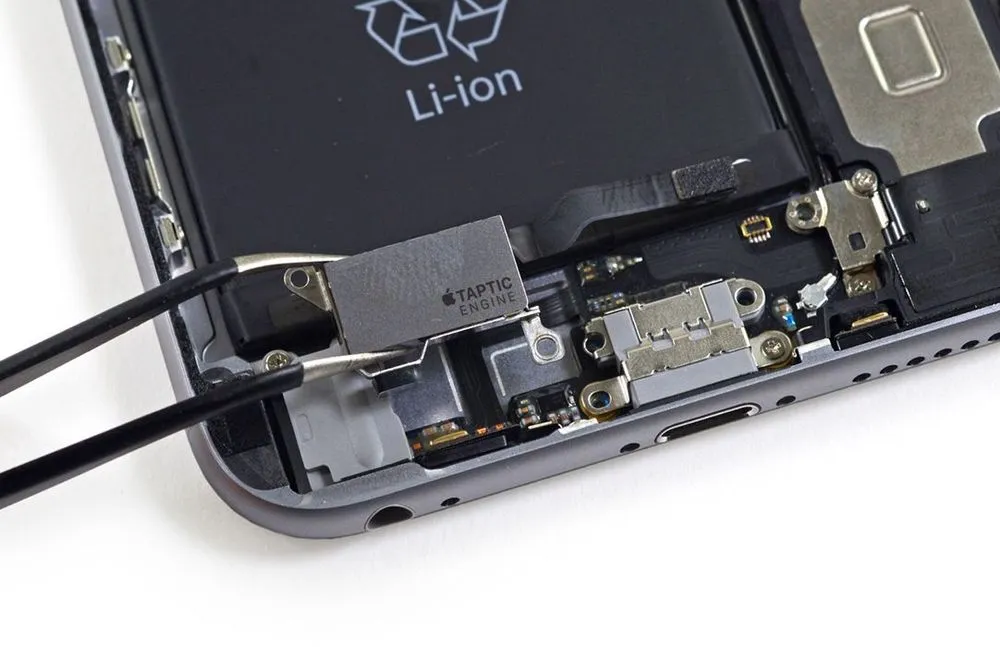
On September 25, 2026, a jury in the U.S. District Court for the Southern District of California found that Apple's Taptic Engine infringed three claims of patents held by Taction Technology. It set damages at $5,721,961,750. The dispute centers on the component that produces haptics (tactile feedback) in the iPhone and Apple Watch.
That figure of more than $5.7 billion is not necessarily what Apple will end up paying. Separating what the six-page jury verdict form found from what remains to be resolved shows what this enormous verdict actually means.
Four findings from the jury, but no breakdown of the $5.7 billion
The jury verdict form presents infringement, willfulness, patent invalidity and damages as separate questions.
The jury found that Apple infringed claims 17 and 19 of U.S. Patent No. 10,659,885 and claim 16 of No. 10,820,117. It did not find that Apple's infringement of either patent was willful.
Asked whether Apple had proved by "clear and convincing evidence" that the three claims were invalid, the jury answered "No" for each.
| Issue in the verdict | Jury's answer | What it means |
|---|---|---|
| Whether Apple infringed the three patent claims | Found for all three | The jury found Apple infringed |
| Whether the infringement was willful | Rejected for both patents | The jury found infringement but not that it was willful |
| Whether Apple proved the patents invalid | Rejected for all three | Apple's invalidity arguments did not succeed at this trial |
| Damages to Taction Technology | $5,721,961,750 | A lump sum with no breakdown by product, patent or period |
In short, the jury found infringement of all three claims, rejected willfulness, rejected Apple's invalidity arguments, and set damages at $5,721,961,750.
The verdict form, however, contains no breakdown by product, patent or period.
The "Yes" and "No" answers on the form also do not simply show which party won. A "Yes" on infringement favors Taction Technology, and so does a "No" on whether Apple proved invalidity. A "No" on willfulness, by contrast, favors Apple.
Reading the verdict as a plain win or loss can therefore obscure what each finding means.
The same goes for the damages figure. The verdict form records only the total the jury awarded. It does not say how much harm came from which product in which sales period, or how the amount was divided between the two patents.
The publicly available verdict form alone does not allow anyone to work backward to a per-unit royalty or the number of units covered.
The question isn't whether it vibrates, but how magnetic fluid and damping work
The two patents in dispute do not broadly cover the vibration function of smartphones as such.
The shared specification describes a tactile transducer, a device that converts electrical signals into tactile vibration, producing low-frequency vibration that people can feel by touch. The three claims at issue specify in detail the components of that device and its operating conditions.
Claim 17 of No. 10,659,885 includes a housing, a coil, multiple magnets, a moving inertial mass, a leaf spring and magnetic fluid. The magnetic fluid dampens mechanical resonance in the range of 40 to 200 Hz. Claim 19 adds the requirement of an elongated oval coil with substantially flat sides.
Claim 16 of No. 10,820,117 also covers a planar-motion device that uses magnetic fluid to dampen resonance. This claim, however, also specifies more concrete shapes, including a substantially flat rectangular leaf spring, a portion projecting inward from it, the ratios of the housing's thickness, width and length, and pockets that hold the magnets.
The issue, then, was not whether the Taptic Engine vibrates.
The question was whether Apple's device meets the elements of each claim, including magnetic fluid and leaf springs, and produces output with damped resonance in the normal operating frequency range.
Applying the "preponderance of the evidence" standard used in civil cases, the jury concluded that Taction Technology had proved infringement.
Apple sees it differently.
In a motion filed before the verdict, the company argued that the Taptic Engine is an undamped linear resonant actuator that relies on resonance and therefore falls outside Taction Technology's patent claims.
In a statement to AppleInsider, Apple also said the Taptic Engine is fundamentally different from Taction Technology's technology and does not use it, and that it intends to appeal.
These are Apple's arguments and differ from what this jury found.
The appeals court that reversed Apple's 2023 win did not itself find infringement
Apple had won once before in this case, in the district court.
In August 2023, the district court excluded the opinion of Taction Technology's expert on infringement and granted summary judgment that Apple did not infringe.
It had also interpreted the claim language "highly damped output" to require damping by mechanical means and a Q factor below 1.5.
But the August 13, 2025 decision of the U.S. Court of Appeals for the Federal Circuit reversed both rulings.
The appeals court held that the district court abused its discretion by imposing an additional requirement, one not found in the local patent rules, that the party explain "how" the accused product infringes, and by excluding the expert's opinion on that basis. It also found no basis for limiting the claims to "mechanical damping" and a "Q factor below 1.5."
The appeals court itself did not, however, find that Apple infringed.
Taction Technology's infringement theory was that combining closed-loop control with magnetic fluid produces roughly flat output across the normal operating frequency range.
What the appeals court took issue with was the district court's procedure, which removed that theory and the expert testimony from consideration. It remanded the case so the district court could hear the infringement question anew.
The line that undamped linear resonant actuators fall outside the claims was left intact.
So the outcome changed between 2023 and 2026 not because the appeals court shifted the factual findings against Apple.
What changed was which evidence could be put before the jury and how narrowly the patent claims would be construed, which allowed a jury to decide infringement afresh. At that trial, the jury sided with Taction Technology.
The $5.7 billion is not final; the basis for the damages is the next battleground
The $5,721,961,750 is the amount the jury entered on its verdict form. It is not a finalized sum that Apple must ultimately pay.
On September 23, 2026, before the jury returned its verdict, Apple filed a motion under Rule 50(a) of the Federal Rules of Civil Procedure.
Apple argued that the evidence Taction Technology presented was insufficient for a reasonable jury to find infringement or damages, and sought JMOL (judgment as a matter of law), in which the court rules on the law without waiting for the jury.
Apple's objections to the damages go beyond the scale of $5 billion.
It argued that the actual royalty rates and number of covered products in the Corsair license agreement, which Taction Technology used as a comparison, were never shown to the jury.
Apple also argued that the damages calculation did not properly separate the value of the patented technology itself from the value of the whole product, the iPhone or Apple Watch.
It further challenged whether test results on the Apple Watch can be applied to other products, and whether there was enough evidence to apply the doctrine of equivalents to products that use only a single magnet.
All of this is, for now, Apple's argument, not a conclusion the court has accepted.
Rule 50 of the Federal Rules of Civil Procedure allows a court to decide as a matter of law when there is no legally sufficient evidentiary basis for a jury to reach its decision.
A motion filed before the verdict is also a prerequisite for renewing the JMOL request after the verdict.
The district court can now respect the jury's factual findings while reviewing whether the evidence supporting its conclusions meets the legal standard. Apple's stated appeal would follow.
How much of the $5.7 billion verdict survives will depend on those future court rulings.
How will the district court handle the post-verdict motions? How will the final judgment explain the basis for the damages? What allocation among products, sales periods and the value of the patented technology itself will be accepted?
Only as those proceedings unfold will it become clear how close the jury's $5.7 billion verdict comes to what Apple actually has to pay.