

Many readers have likely hesitated to switch to the latest iPhone through monthly installment payments, deterred by strict credit checks and the difficulty of seeing the total cost upfront. On July 28, 2026, Apple launched a new device leasing program called "Apple Upgrade" in the US in partnership with Klarna Inc., ending new enrollments for the "iPhone Upgrade Program," which had run for over a decade since its launch in September 2015. On the same day, Apple's PR told The Verge that this lease would not apply the controversial "mechanism that restricts app functionality upon missed payments," which had been discovered through code analysis of the iOS 27 beta and had stirred controversy. But that single statement specifically denies only one mechanism—the so-called "Restricted Mode."
The Klarna Lease Replaces the "Program to Buy"
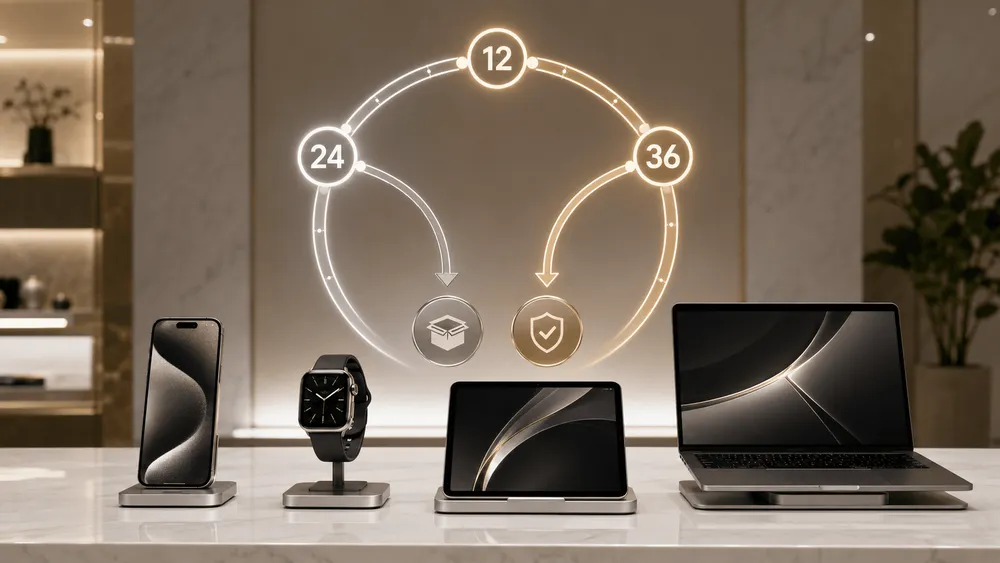
Apple Upgrade is US-only, with Klarna handling credit assessment and collections, covering iPhone, Apple Watch, Mac, and iPad. Contract terms are 12 or 24 months for iPhone and Apple Watch, and 24 or 36 months for Mac and iPad. Pricing starts, at the lowest tier, at $17.99/month for the iPhone 17e, $11.99/month for the iPad mini (36 months), $15.99/month for the iPad Air, $24.99/month for the MacBook Air (36 months), and $11.99/month for the Apple Watch Series 11 (24 months). In yen terms, $17.99 is roughly ¥2,950 and $11.99 is roughly ¥1,970 (estimated at an exchange rate of ¥164 to the dollar as of July 28, 2026).
Excluded devices are also clearly defined. The iPhone 16 and 16 Plus, Apple Watch SE, the base iPad (A16 model), Mac mini, and Studio Display are not eligible for the lease, and educational discount pricing does not apply to this program either. Accepted payment methods are debit cards and most credit cards, but some card issuers—including AmEx, UnionPay, Chase, and Capital One—are excluded, and prepaid cards cannot be used. Trade-in credit is applied only at the start of a contract and is spread across monthly payments; it cannot be used when upgrading to a new device mid-contract.
At the end of a contract, users have three options: "upgrade to a new device," "buy out the device by paying the difference between what's been paid and the retail price," or "return the device." Returns require the device to be in good condition, with damage fees applying otherwise, and taxes and fees may apply separately regardless of which option is chosen. The credit check is described as a soft credit inquiry that does not affect one's credit score. Up to this point, the experience appears similar to the old iPhone Upgrade Program, but there is one decisive difference. The old iPhone Upgrade Program was a purchase financed through installment payments backed by Citizens One Bank, and under its terms, users owned the device from the moment the contract began—ownership would transfer to Apple or a trade-in vendor only if the user chose to trade in the device when upgrading. With Apple Upgrade, this starting point is reversed: unless a user chooses the buyout option and pays in full, ownership of the device rests with Klarna from the very beginning.
What Is Restricted Mode, and What Did Apple Deny?
Code analysis of the iOS 27 beta had uncovered a system called "App Managed Features," which includes a daemon named appmanagedfeaturesd. This system, referred to as Restricted Mode, allows a financial company's app to register a device and, if payments become overdue, shut down all functions except basic ones like Phone, App Store, Clock, Settings, and Wallet. Since the discovery in the iOS 27 beta, concerns had spread that this feature might be used for leasing programs like Apple Upgrade.
Apple spokesperson Brian Bumbery told The Verge on July 28: "There will be no restricted mode and/or there will be no limitations put on device functionality due to missed payments or default with the Apple Upgrade program." This statement explicitly links the Apple Upgrade contract to Restricted Mode by name and clearly denies its application. However, Bumbery did not explain what Restricted Mode was originally designed for.
The Other Lock Apple Didn't Mention: Partner Finance Lock
Separate from Restricted Mode, iOS 27 has been confirmed to contain another authentication mechanism called "Partner Finance Lock," which retains financial lock information even after a device is reset. As this publication reported on July 23, rather than restricting device functionality, this mechanism prevents reactivation after a factory reset, blocking resale or parting out the device—a control method distinct from Restricted Mode. While Bumbery's statement broadly denies functional restrictions across the entire Apple Upgrade contract, it never once touches on the name "Partner Finance Lock" itself—the mechanism that identifies a device even after reset and prevents its reactivation.
The explanation that Restricted Mode won't be applied is itself specific, and media outlets have reported it as such. This isn't to say that explanation is incorrect. But neither Apple's own press release nor this PR comment addresses how Partner Finance Lock is handled, even while explaining the benefits of the lease. On the issue of device control upon missed payments, what Apple has publicly denied is the specifically named "Restricted Mode"—how the other mechanism, which prevents reuse after a factory reset, relates to this lease cannot be determined from the published materials.
The Cost Behind the $32.99 Sticker Price: AppleCare+ Unbundling
In a specific example cited by Macworld, leasing a 256GB iPhone 17 through Apple Upgrade costs $32.99/month on a 12-month contract—but this figure does not include AppleCare+. Adding AppleCare+ separately adds $11.99/month, bringing the actual total to $44.98/month. Macworld points out that while the old iPhone Upgrade Program included AppleCare+-equivalent coverage within the monthly price, the new program separates the two, resulting in "a slightly higher payment for equivalent service in most overlapping cases."
Under the old program, warranty costs were bundled into the displayed monthly price, making it difficult for subscribers to grasp the total cost at a glance. Apple Upgrade lowers the displayed price to $32.99 by unbundling AppleCare+ into an optional separate contract, creating a structure where the apparent low price diverges from the actual total cost. The option to skip AppleCare+ remains, but doing so means leasing with narrower coverage than the old program offered.
For users who don't prioritize AppleCare+, or who already protect their devices through homeowner's/renter's insurance or credit card coverage, the displayed price of $32.99 comes close to the actual cost. Conversely, users of the old program who had taken the AppleCare+-inclusive peace of mind for granted may overlook this unbundled cost when switching to Apple Upgrade, ending up with a contract that costs more than expected without realizing it. While this unbundling itself offers the flexibility to choose only the coverage one needs, it introduces a new comparison burden that wasn't necessary under the old program.
Carrier Lock Tightening and Apple Upgrade's "No Restrictions"—What Lies Beyond
Around July 15, 2026, Apple reportedly changed its policy to apply carrier locks until full payment is completed for iPhones purchased through installment plans with T-Mobile and Verizon. This extends a restriction previously applied only to AT&T installment plans to the other two carriers as well, and Apple has not officially explained the reason for this change. On the same theme of controlling device functionality or usage scope until payment is complete, Apple showed contrasting responses within the same month: tightening carrier installment locks on one hand, while denying the application of Restricted Mode to Apple Upgrade, provided through Klarna, on the other.
The denial statement regarding Restricted Mode came out on July 28, the same day Apple Upgrade was announced, during a period when criticism had continued since the code discovery in the iOS 27 beta. Apple itself has not explained this timing. Since Apple Upgrade is currently a US-only program, whether—and if so, when—a similar system might come to Japan remains undetermined.
Apple's own hardware subscription concept, reportedly considered in 2022 and frozen in December 2024, envisioned an annual upgrade model without relying on an external credit provider. The fact that Apple has now revived a similar concept through an external partner, Klarna, suggests a calculation that this approach avoids Apple having to shoulder regulatory concerns alone. Whether Partner Finance Lock applies is a matter that should be spelled out not in a PR comment, but in the formal lease agreement with Klarna. Since Apple Upgrade contract procedures have already begun on Apple's official website, examining the text of that contract is the most concrete way to fill the gap left unaddressed by today's explanation.