

China's Bayan Obo deposit in Inner Mongolia may contain rare earths at depths far greater than previously thought. On July 28, 2026, Yang Li, a geologist at Peking University, told the South China Morning Post that deep potential resources could be several times larger than current estimates. However, this does not mean new reserves have been confirmed. A 2022 resource estimate, a 2024 three-dimensional structural analysis, and a 2025 genesis study have come together to give concrete form to a geological model for tracking the world's largest deposit deeper underground.
333 Million Tons Is Not 'Mineable Reserves'
To properly interpret the Bayan Obo figures, one must distinguish between the amount that may exist underground and the amount that can be economically mined at current prices and with current technology. A 2022 study published in Acta Petrologica Sinica created a 3D model of the carbonatite rock body from 0 to 1,000 meters deep, using geological surveys, geochemistry, and geophysical exploration. Multiplying that volume by a minimum density and a conservative whole-rock rare earth average of 2%—based on past analyses—the study estimated potential resources of approximately 333 million tons in oxide equivalent.
This is not a mineable reserve figure derived from mine design or beneficiation testing. It is a rough model that treats the entire ore body as having the same grade, and does not yet account for rock continuity between drill holes, the breakdown by individual rare earth elements, dilution during mining, or actual recovery rates. According to the U.S. Geological Survey's (USGS) 2026 statistics, China's total reserves stand at 44 million tons. The reason a single deposit's potential resources appear to exceed China's national reserves is that Bayan Obo's 333 million tons counts geological potential, while China's national figure of 44 million tons represents what is currently assessed as mineable given present technology, prices, and operating conditions.
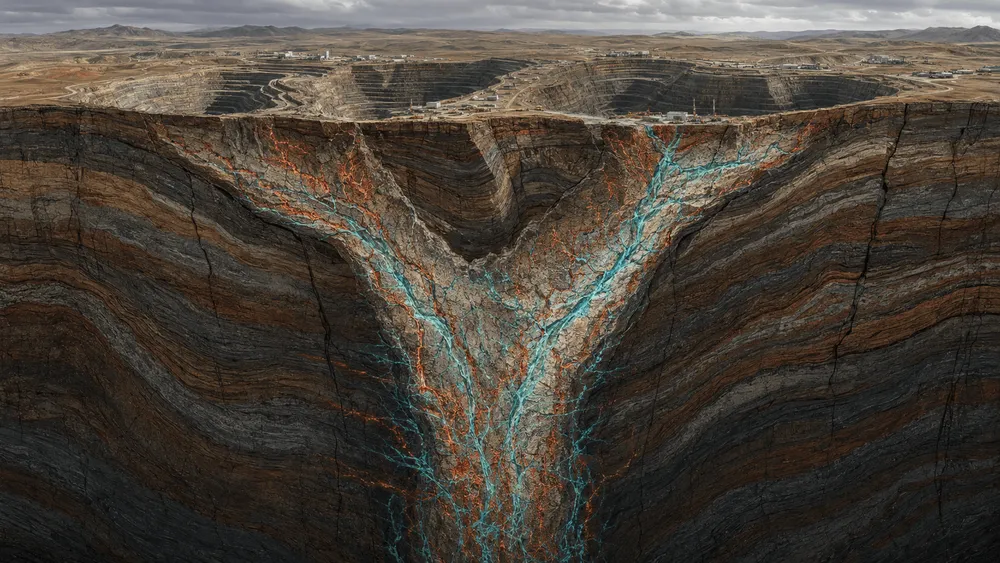
Even so, observational evidence supporting the scale of the rock body is growing. A 2024 paper in Economic Geology concluded that carbonatite bodies that appear as separate north-south formations at the surface actually merge underground into a Y-shape. Drilling data and electromagnetic surveys detecting low resistivity are consistent with this, showing the rock body continuing beyond 1,775.4 meters below the surface. This exceeds the maximum depth assumed by the previous synclinal model by more than double, and could push the world's 2021 potential rare earth oxide volume estimate up by more than 1.78 times.
Yang's latest remarks represent a further extrapolation of this deep structure to even greater depths. The phrase 'several times current estimates' is not a new peer-reviewed figure. Even if deep rock bodies are struck, they only approach becoming reserves once grade and thickness prove continuous and mining costs can be absorbed.
A Model Where Fluids from 430 Million Years Ago Overlapped a Rock Body from 1.32 Billion Years Ago
Regarding why Bayan Obo grew to such an exceptional scale, a 2025 paper in Science Advances proposed two separate carbonatite events. Carbonatites are rare igneous rocks rich in carbonate minerals that tend to concentrate rare earths. Of 676 known carbonatite occurrences worldwide, only 61 have established mineral reserves. Simply having a large rock body does not automatically produce a Bayan Obo.
The first event occurred approximately 1.32 billion years ago. According to the research team, magma from this period erupted near the surface, making it difficult for the process of slow underground crystallization—which separates components and releases rare-earth-rich brines and fluids—to progress. As a result, rare earths became widely and thinly dispersed. However, this older rock body was later deformed by compression and shearing, transforming it into a reactive site where fluids could easily enter through fractures and mineral boundaries.
Approximately 430 million years ago, a separate carbonatite intruded from below. Rare-earth-rich brines and alkaline fluids escaped from this younger, well-differentiated magma. These fluids passed through the already-deformed older rock body, triggering metasomatism—a process that replaced the rock's chemical composition. As a result, rare earth minerals such as bastnaesite and monazite are believed to have precipitated along veins and pre-existing bands.
The dating combines multiple chronometric methods. The research team obtained ages of approximately 430 million years from 75 zircon grains across the mining district. Re-Os dating of pyrite associated with vein-type mineralization yielded 431±3 million years, and Th-Pb dating of monazite and other minerals also clustered around the same period. Calculating the mixing ratio of minerals from the two different eras suggests the younger event supplied 72% of the rare earths, with the research team viewing 70% as a lower bound.
This figure carries an assumption. The calculation sets the thorium ratio between old and young particles at 1:3, meaning the contribution ratio was not measured directly from the ore body itself. Even so, the 2025 study presents an updated model—shifting the explanation for the deposit's massive scale from 'a single large ancient magma concentrated all at once' to 'fluids from roughly 890 million years later used a pre-existing rock body as a reaction vessel.'
New Source or Remobilization of Old Rare Earths?
While the two-stage model is compelling, it has not settled the debate over Bayan Obo's origin. A 2022 paper in Economic Geology analyzed fresh drill cores down to 1,776 meters and reported that fluids from approximately 400 million years ago recrystallized old dolomitic carbonatite. The paper interprets this as a process in which up to 40% of carbon dioxide was locally lost during the reaction, causing existing rare earths in the remaining rock to remobilize and re-concentrate. Under this model, there is no need for a large external influx of rare earths during the younger period.
The 2025 study goes further by identifying the approximately 430-million-year-old carbonatite itself. The Ce/Y ratio—which indicates fractionation between light and heavy rare earth elements—rises sharply during this period. If only light rare earths had been mobilized from old ore, the original rock body should retain relatively concentrated heavy rare earths, but no such residual concentration has been reported. The research team therefore concluded that the young magma introduced new rare earths.
Unresolved questions remain on the geological map. The H8 formation hosting the ore may locally contain mixed sedimentary carbonates, and it remains unclear how much of the banded structure reflects old deformation versus later fluid-driven replacement. How far the approximately 430-million-year-old carbonatite extends underground also requires further mapping and drilling.
This distinction is not merely an academic detail. If the new model is correct, exploration companies would need to look not only for the size of old carbonatite bodies, but also for younger dikes that later intruded the same locations, and for deformed boundaries that allowed fluids to pass through. By narrowing down locations where two events overlap, deposits that show no high-grade ore at the surface could still be targeted at depth.
The 91% in Separation and Refining Matters More Than the ~60% in Mining Share
Deep resources will not immediately strengthen China's advantage. According to USGS, China's mine production in 2025 was 270,000 tons in oxide equivalent. The United States produced 51,000 tons, Australia 29,000 tons, and Myanmar 22,000 tons. China leads even at the ore stage, but supply chain concentration intensifies further downstream.
According to International Energy Agency (IEA) figures, for the four magnet-related elements—neodymium, praseodymium, dysprosium, and terbium—China accounted for approximately 60% of global mining output in 2024. In separation and refining, this rises to approximately 91%, and in permanent magnet manufacturing, it reaches 94%. Even if mines start up outside China, without facilities to separate elements one by one and process them into high-purity metals and alloys for magnets with consistent performance, a supply chain outside China cannot be completed.
Bayan Obo's ore is also not uniform. A 2025 paper in Minerals found that medium and heavy rare earth elements (M+HREE) make up approximately 0.2 wt% of the mixed raw ore, accounting for 3.15% of total rare earths. In current iron beneficiation processes, 96.40% of this ends up in tailings. Even if geologically several million tons of medium and heavy rare earths are anticipated, the fine-grained minerals must be sufficiently crushed for individual separation and connected to economically viable recovery processes.
This gap clearly illustrates why resource quantity cannot simply be equated with supply capacity. As of 2025, the IEA noted that new mines outside China and Myanmar take an average of about eight years to reach production, and that only a handful of countries outside China—Malaysia, the United States, Estonia, among others—handle industrial-scale separation and refining. While Bayan Obo's deep resources could extend China's raw material base over the long term, it is the processing infrastructure already in place today that creates the near-term advantage.
Conditions for Turning a Geological Model into Reserves
The value of the deep potential resources hinges on whether four figures align through future drilling: how far the ore body's thickness and grade remain continuous below 1,000 meters; what percentage of rare earth oxides consists of the four magnet-related elements; what percentage of each element can be recovered after mining and beneficiation; and the per-ton cost including underground mining and waste disposal. Furthermore, even if these figures align, the resource cannot be developed as reserves unless mine plans pass permitting and meet environmental requirements regarding water, waste rock, and radioactive byproducts.
On the demand side, there is little time to spare. The IEA projects demand for the four magnet elements to grow from 91,000 tons in 2024 to 123,000 tons by 2030 and 150,000 tons by 2040. Even as secondary supply, including recycling, increases, the required primary supply is expected to expand from 64,000 tons to 107,000 tons over the same period. While the existence of deep ore bodies increases the options for meeting this demand, converting it into reserves requires proof of mining engineering, separation processes, permitting, and environmental countermeasures.
The new geological picture of Bayan Obo revises the understanding that China's rare earth dominance has relied on a massive ore body found by chance. The 2025 study's explanation is that an old rock body, subsequent deformation, and young fluids overlapped at the same location, producing an extraordinary concentration. Only once drilling beyond 1.8 kilometers underground confirms the ore body's continuity, thickness, and grade—and beneficiation and metallurgical testing prove recovery rates—will this geological scale finally be counted as future supply.