

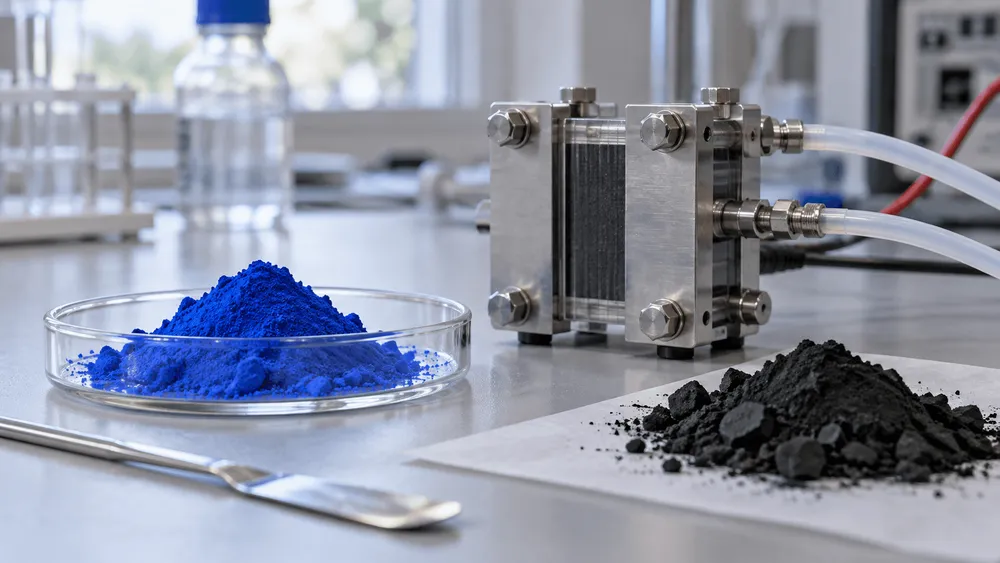
- What happened: A research team including Tohoku University modified the molecular structure of a blue pigment and, using a platinum-free cathode catalyst, achieved a maximum power density of 902 mW/cm².
- Why it matters: Under identical test conditions, two catalysts differed in maximum output by about 21.2%, showing that a difference in molecular structure translated into better fuel cell performance.
- What to watch next: Challenges include reducing the platinum-group metal still used in the anode, performance when running on air, long-term durability, and the supply system for the high-performance catalyst AZ-FO-30.
A research team including Tohoku University and the Israel Institute of Technology (Technion) modified the molecular structure of a blue pigment and, with a platinum-free cathode catalyst, achieved a maximum fuel cell power density of 902 mW/cm². Tohoku University announced the result on September 29, 2026.
The team supported an inexpensive iron-containing pigment on conductive carbon and evaluated its performance in an anion exchange membrane (AEM) fuel cell. Pigment-based fuel cell catalysts have been studied for some time, but this study went further: it linked the performance gains from molecular design to the output of an actual fuel cell and to continuous operation.
However, the anode of the test cell uses a platinum-group metal. The result does not mean platinum-group metals have been eliminated from the entire fuel cell; rather, the oxygen-side cathode catalyst achieved high performance without platinum.
Turning a blue pigment's molecular design into higher fuel cell output
At a fuel cell's cathode, an "oxygen reduction reaction" takes place in which oxygen accepts electrons. This reaction does not proceed easily on its own, so a catalyst is needed to obtain high output.
The catalyst widely used for this purpose is fine platinum particles supported on carbon. Platinum has high catalytic activity, but it is expensive and its supply is limited.
AEM fuel cells, which operate in an alkaline environment, are being studied as a design in which materials other than platinum can be more easily used as cathode catalysts than in fuel cells operating in an acidic environment.
The team chose iron azaphthalocyanine-type molecules, a blue pigment based on a metal complex. The iron atom at the center takes part in the oxygen reduction reaction, and the catalyst's properties can be tuned by changing the molecular structure surrounding it.
The pigment itself is not used as fuel. It serves as a catalyst that promotes the oxygen-side reaction when electricity is drawn from hydrogen and oxygen.
In the two molecules synthesized here, some of the benzene rings around ordinary iron phthalocyanine were replaced with nitrogen-containing rings.
The catalyst made by supporting FeAzPc-4N on conductive Ketjenblack is called "AZ-FT-30," and the one supporting FeAzPc-8N8Me, which contains more nitrogen, is called "AZ-FO-30."
The molecule used in AZ-FO-30 also contains methyl groups, however. The performance gap between the two catalysts therefore cannot be explained simply as the effect of having more nitrogen atoms.
The state in which the molecules are arranged on the carbon surface also affects catalytic performance.
Electron microscopy and elemental analysis confirmed that the iron-containing molecules were dispersed on the carbon surface at the atomic and molecular level, without clumping into large particles. Combining them with conductive carbon puts the designed molecules in a state where they can readily be used for the oxygen reduction reaction.
The idea of combining a pigment with carbon is not new to this study.
In a 2021 research announcement, Tohoku University reported a catalyst preparation method that used inexpensive carbon black and did not require a high-temperature firing step.
Unlike catalysts whose active-site structure must be inferred after high-temperature carbonization, this approach designs the molecule itself, which makes it easier to investigate the relationship between structure and performance. This study linked differences in molecular design to differences in the output of actual fuel cells.
Theoretical calculations were also used to examine that relationship.
In density functional theory (DFT) calculations, the iron–oxygen distance when OH, an intermediate in the reaction, was adsorbed became shorter in the order of ordinary iron phthalocyanine, AZ-FT-30, and AZ-FO-30.
A calculation model with one added water molecule showed the same trend, and the results indicated that OH binds more strongly to the iron active site in AZ-FO-30. This trend also matched the order of catalytic activity confirmed in experiments.
However, this is an explanation of the reaction mechanism based on calculation, not a direct measurement of the iron–oxygen bond distance inside an operating fuel cell.
The test conditions behind the 902 mW/cm² peak
In fuel cell tests at 80°C, AZ-FT-30 recorded a maximum power density of 744 mW/cm² and AZ-FO-30 recorded 902 mW/cm².
According to Tohoku University's detailed announcement, the electrochemical surface area was nearly the same for the two: 155.8 m²/g for AZ-FT-30 and 157.5 m²/g for AZ-FO-30.
The team believes the performance improvement did not come simply from a larger surface area available for the reaction; rather, differences in catalytic activity arising from the molecular structure itself were reflected in cell performance.
| Item compared | AZ-FT-30 | AZ-FO-30 |
|---|---|---|
| Pigment molecule | FeAzPc-4N | FeAzPc-8N8Me |
| Carbon support | Ketjenblack | Ketjenblack |
| Electrochemical surface area | 155.8 m²/g | 157.5 m²/g |
| Maximum power density | 744 mW/cm² | 902 mW/cm² |
Under the same cell test conditions, the maximum power density of AZ-FO-30 exceeded that of AZ-FT-30 by about 21.2%. This figure was calculated from the measured values published in September 2026 as (902÷744−1)×100.
According to the experimental methods and cell evaluation in the paper, both catalysts were tested at 80°C with hydrogen and oxygen supplied, and the cathode and anode were operated at a pressure 100 kPa above atmospheric pressure.
The cathode carried 1.5 mg/cm² of catalyst and carbon combined, and the anode carried 0.6 mg/cm² of platinum and ruthenium combined. These conditions were also the same for both.
The roughly 21.2% difference is therefore a comparison of maximum output for two catalysts under the same conditions within the same study. It does not indicate the performance gap when air is used, or after long-term operation.
The test used a small cell with an effective electrode area of 2.25 cm², and oxygen gas rather than air was supplied to the cathode.
Even if surrounding air were taken in directly, as in an actual device, the same 902 mW/cm² output would not necessarily be obtained. Test conditions, including temperature, pressure, and oxygen concentration, are a premise of this figure.
In addition, a PtRu/C catalyst, with platinum and ruthenium supported on carbon, was used in the anode.
What was replaced with a platinum-free catalyst here is the cathode, which handles the oxygen reduction reaction. This is not a fuel cell with platinum-group metals also eliminated from the hydrogen-side anode.
This distinction matters when considering how far dependence on platinum-group metals and manufacturing costs can be reduced across the whole fuel cell.
The paper's claim of top-level performance also rests on a literature comparison of AEM fuel cells using metal phthalocyanine-based catalysts in the cathode, run on hydrogen and oxygen.
It does not mean a world record for fuel cells overall, or among all non-platinum catalysts. It should be understood as a result that substantially raised fuel cell output within the class of molecular catalysts based on metal phthalocyanines.
A 35-hour continuous run shows how far practical use remains
For a cell using the high-performing AZ-FO-30 in the cathode, the team also conducted a 35-hour continuous operation test at a constant current density of 400 mA/cm².
Over that period, voltage fell by about 12%, an average decline of 2.4 mV/h.
One notable aspect of this work is that it went beyond measuring maximum output to check how much performance changes when a fuel cell incorporating a molecular catalyst is run for a period of time.
However, this does not mean the 902 mW/cm² maximum output was maintained for 35 hours.
A test to measure maximum output and a durability test that measures voltage decline while passing a constant current are separate tests. Moreover, the result is a voltage drop of about 12% over 35 hours; the lifetime of a fuel cell for long-term use cannot be estimated from this result alone.
Even if the catalyst molecule itself is highly active, an actual fuel cell must transport oxygen to the catalyst and move the ions needed for the reaction. The amount of water present in the catalyst layer also affects performance.
Tohoku University cites improving the ion conductivity and gas transport performance of the catalyst layer as a future challenge. It aims to optimize the electrode structure, including water management, to achieve both high output and long-term durability.
In other words, future evaluation will broaden beyond the oxygen reduction activity of the molecule alone to whether high performance can be maintained when it is combined with electrodes and membranes.
Output when using air, longer continuous operation, and conditions involving repeated starts and stops are items that will need to be confirmed to judge practical viability. The 35-hour test does not show that such conditions have been cleared.
The results were published online on September 26 in the peer-reviewed journal ACS Catalysis as a joint study by Professor Hiroshi Yabu, Professor Dario R. Dekel, and others.
What has been shown is the result of a study examining the relationship between molecular structure design and fuel cell performance; it is not an announcement that a commercial fuel cell has been completed.
Research-grade catalyst now on sale; supply of the high-performance material is the next stage
AZ-FT-30 is manufactured by AZUL Energy and has been sold as a research reagent through FUJIFILM Wako Pure Chemical since July 3, 2026.
In AZUL Energy's sales launch announcement, the product is named "AZUL Catalyst (AZ-FT)" and is offered as a research catalyst for electrochemical reactions.
This marks a shift from supply through joint research and individual contracts to a form that researchers can purchase through a reagent catalog.
Reagent sales like this support the spread of research, as they make it easier for other institutions to try the material.
However, the AZ-FT-30 already on sale and the AZ-FO-30 that recorded 902 mW/cm² here are different materials.
AZ-FO-30, which showed the highest performance in this study, is not already on the market in the same form. Nor should being able to buy a research reagent be confused with adoption in commercial fuel cells or the start of mass production.
Being able to use inexpensive iron and carbon leads to a material design that reduces dependence on platinum.
On the other hand, the cost of a whole fuel cell is affected not only by the platinum-group catalyst remaining in the anode but also by the manufacturing costs of the electrolyte membrane and electrodes and by performance decline during operation. That the catalyst material itself is inexpensive does not determine how much the cost of a completed fuel cell system will fall.
The question is whether development can move from the stage of designing high-performance molecules to one in which fuel cells running on air also maintain high output and limit degradation through long-term operation and repeated starts and stops.
That will shape future development.
If both the molecular design that enhances the cathode reaction and an electrode structure that remains stable over long periods can be achieved, catalysts based on this blue pigment could move a step closer, from laboratory performance comparisons to practical use, as a fuel cell material that reduces platinum use.