

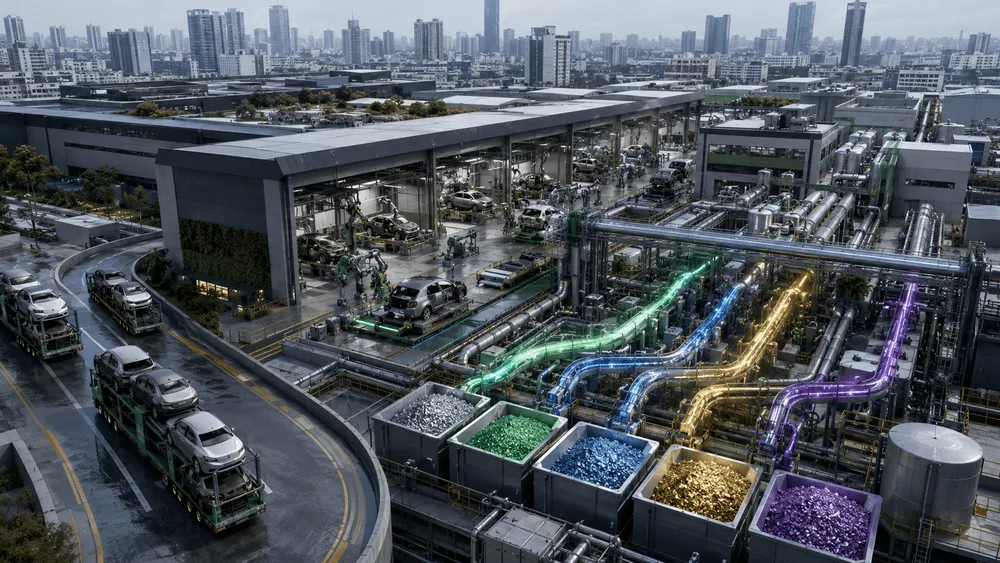
Electric vehicles (EVs) that finish their service life in China could become a mine supporting new vehicles in 2050. However, this effect does not apply equally to every material. A model published in Joule by a research team from Nanjing University, Tsinghua University, the National Institute for Environmental Studies, and others found that under conditions combining technologies in stages, fully collecting scrapped vehicles and replacement batteries, and improving processing efficiency, recycled materials would cover 89% of China's domestic EV lithium demand, while nickel would reach only 35% and manganese only 37%. The success of this circulation depends not only on in-plant processing efficiency but also on whether scrapped vehicles can be channeled into formal routes and which materials next-generation vehicles will use.
2050 resupply potential diverges between 89% and 35%
The research team incorporated EV adoption, scrappage, in-use battery replacement, and recovery performance for China from 2010 to 2050 into a single urban metabolism model. They divided the pace of technological shift in batteries and drive motors into four scenarios and calculated demand and waste flows for 13 elements. On the battery side, they tracked 8 elements from lithium to graphite; on the motor side, copper and 4 rare earth elements.
Here, "resupply potential" refers to the amount of material recovered from retired EVs and replacement batteries that can be returned to new batteries and motors that year, divided by that same year's manufacturing demand for EV components within China. It is neither China's mineral self-sufficiency rate nor the yield rate of recycling plants. Assuming staged technology combinations, full collection, and improved processing efficiency, the 2050 results diverge as follows.
| Material | Resupply Potential Relative to 2050 Domestic EV Component Manufacturing Demand in China | Interpretation |
|---|---|---|
| Lithium | 89% | Domestic circulation could reach the majority of demand |
| Nickel | 35% | Even with full collection, reliance on primary resources remains |
| Manganese | 37% | Recovery volume fails to keep pace with future demand growth |
| Cobalt | Potential to exceed demand | Low-cobalt shift shrinks new demand |
| Neodymium, Dysprosium | Potential to exceed demand | Strongly dependent on shifts in motor technology |
In the model, the 2050 input flow reaches 5.1 TWh for batteries and 11 TW for motors. This is not the cumulative capacity installed in the existing vehicle fleet, but a forecast of the product flow entering that year. On the waste side, volumes surge sharply from the 2030s onward, and batteries replaced during vehicle use also become a major supply source. Counting scrapped vehicles alone fails to capture the full volume of batteries that come back.
There is a long time lag between when a new vehicle enters the market and when its materials return through battery replacement or scrappage. For this reason, even for materials with a high resupply ratio in 2050, the surging demand from current sales cannot be immediately offset by scrapped-vehicle resources. The value of this research lies not in announcing when mining will become unnecessary, but in showing separately which materials are approaching domestic circulation and when.
Why cobalt is oversupplied while nickel falls short
The resupply ratio rises as collection volume increases. However, in this research, the denominator—demand—also shifts significantly due to technological transition. As the shift toward low-cobalt batteries progresses, the cobalt required for new batteries decreases. Meanwhile, past high-cobalt batteries reach their disposal period, which can create situations where recovered cobalt exceeds that year's demand.
Opposite forces act on nickel and manganese. On pathways where future batteries use larger amounts of both elements, even as recovered volumes from retired batteries increase, they fail to keep pace with growing manufacturing demand. This is why, even under conditions where lithium reaches 89%, a gap remains with nickel at 35% and manganese at 37%. Cobalt's "surplus" is not simply a number reflecting the success of the recycling industry—it also incorporates the effect of shrinking demand.
Rare earths used in motors are even more strongly technology-dependent. The value and destination of recycled materials shift depending on the spread of motors that reduce neodymium and dysprosium use, designs that substitute cerium for some expensive rare earths, and rare-earth-free motor designs. Even with a well-established battery collection network alone, if there is no pathway to disassemble motors, sort magnets, and return them to products at equivalent quality, this supply source will be missed.
In-process recovery of 98% and full collection are different figures
China's technical standards already demand a high level. Under the industry norms revised by the Ministry of Industry and Information Technology (MIIT) in 2024, certified recycling companies must achieve an electrode powder recovery rate of 98% or higher after crushing and separation, and a lithium recovery rate of 90% or higher in the smelting process. Nickel, cobalt, and manganese must also reach 98% or higher. Lithium was raised from the previous standard of 85% or higher.
However, these figures represent the process efficiency of extracting materials from batteries once they arrive at the plant. What percentage of scrapped vehicles and replacement batteries actually reach that plant must be measured separately. The figure in the Joule paper includes a sensitivity case in which collection rises from 40% to 100% over 10 years. The 89% figure for lithium was obtained under this full-collection condition.
The actual collection network has significant leakage. A separate study published in Engineering in April 2026 estimated that over 70% of China's retired EV batteries flow to unregulated, informal collectors. Low barriers to entry and high profit margins allow informal operators to outbid certified companies for retired batteries. The figure of over 70% is an estimate of distribution destinations from a separate study—it is neither the complement of the 40% collection rate assumed by Joule, nor a direct measurement of the formal collection rate. Even if in-plant process recovery rates reach 90–98%, circulation volume will not increase unless the material reaches the entry point.
Can digital IDs block informal routes?
On April 1, 2026, the Chinese government implemented new Interim Measures for the Administration of Recycling and Comprehensive Utilization of Retired Power Batteries from New Energy Vehicles (新能源汽车废旧动力电池回收和综合利用管理暂行办法). Each battery pack is assigned a unique digital ID, tracked on a national platform from manufacturing through vehicle installation, and further through collection and recycling after replacement or scrapping. Battery manufacturers and automakers are required to establish collection points corresponding to their sales regions and bear collection responsibility. The measures also prohibit repair shops and vehicle dismantlers from handing over removed batteries to unauthorized parties.
The system also addresses loopholes at the time of scrapping. If a battery is missing from a scrapped EV, it is, in principle, treated as a "vehicle deficiency." This makes it easier to trace the practice of removing only high-value batteries first and sending just the vehicle body into formal dismantling.
According to MIIT, China's new energy vehicle sales in 2025 reached 16.49 million units, accounting for 47.9% of all new vehicle sales. That same year, over 400,000 tons of retired power batteries underwent comprehensive utilization, up 32.9% from the previous year. Annual generation is expected to exceed 1 million tons by 2030. The collection network has already been expanded across 31 provincial-level regions, and 148 core enterprises have been cultivated—but the increasing volumes ahead will directly test the effectiveness of the tracking system.
Systems for using recycled materials are the final connection point
Even with tracking and collection in place, demand to return recovered materials into new batteries and motors does not automatically arise. The Joule paper proposes, in addition to formal collection, closed-loop battery recycling, and rare earth recovery from motors, strengthening systems that mandate a certain proportion of recycled material use in new products. China's 2026 system has concretized a mechanism for managing "where materials flow," but "how much is returned to new products" remains a policy challenge going forward.
The timeline also differs by material. For cobalt and some rare earths, shrinking demand pushes up the resupply ratio, while nickel and manganese require primary resources even under full collection. Therefore, a plan to uniformly replace mine development with recycling does not hold up. Before annual retired battery volumes exceed 1 million tons in 2030, progress cannot be confirmed without measuring both the ratio of materials returning to formal routes via digital IDs and the ratio of recycled materials entering new products. Approaching 89% of China's domestic EV lithium demand—premised on combined technologies, full collection, and improved processing efficiency—requires actually raising both of these ratios.