

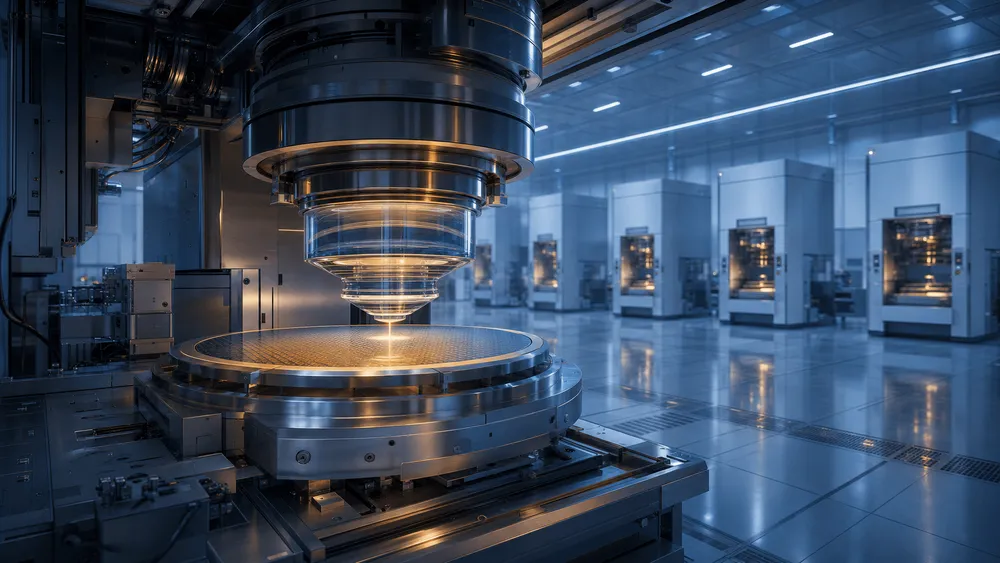
China's domestically made immersion deep ultraviolet (DUV) lithography systems have moved from the prototype stage to production at a scale of about five units a year. The Information reported on July 27, 2026, that a state-linked company in Shanghai has begun manufacturing. But there is a long customer-fab qualification process standing between starting to build a machine and reliably mass-producing semiconductors with it. Neither the manufacturer's name nor the performance specifications have been disclosed, and what has moved forward here is not the completion of an ASML replacement but the first iteration toward commercialization.
What Moved at Five Units a Year Was Equipment Manufacturing
Citing two people familiar with the matter, The Information reported that an unnamed state-linked company in Shanghai is manufacturing immersion DUV lithography systems. The 2026 production plan calls for roughly five units, which are expected to be delivered within the year to Semiconductor Manufacturing International Corporation (SMIC), Hua Hong Semiconductor, and ChangXin Memory Technologies (CXMT). The plan is to increase output to about 20 units by 2027. The company is said to have assembled its development team from multiple Chinese firms, including Shanghai Yuliangsheng Technology, so the manufacturer cannot be definitively identified as Yuliangsheng.
What has changed is the shift from sending prototype machines out for evaluation to supplying equipment to multiple customers at once. According to The Information, the unnamed company sent prototype machines to some semiconductor makers in 2025, and based on the evaluation results moved to production in 2026. With customers now spanning three companies, defects and improvement requests will come back from different manufacturing floors handling both logic and memory. This creates a loop for iteratively improving domestic equipment that reaches right up to the threshold of commercial production lines.
That said, what is described here as "starting production" refers to the equipment maker's side of things. The Information itself notes that moving Chinese-made equipment into a customer's mass-production line could take several months or more. The five units planned for 2026 should be understood not as the scale of a completed industrial base, but as an initial lot for advancing customer qualification and refinement in parallel.
Published Specifications Alone Cannot Measure the Immersion Machine's Real Capability
In September 2024, China's Ministry of Industry and Information Technology listed a fluorinated argon (ArF) lithography system for 300mm wafers on its catalog of major first-set, first-batch technical equipment eligible for state support in adoption. The listed specifications state a light source wavelength of 193nm, resolution of 65nm or finer, and overlay accuracy of 8nm or better. However, it does not disclose the manufacturer's name or whether an immersion method is used. Throughput and uptime are also unknown. There is no public documentation linking the equipment on this catalog to the immersion DUV system reported this time as being the same product.
The benchmark for comparison, ASML's TWINSCAN NXT:2000i, is an immersion system for mass production on 300mm wafers. Per its official specifications, it uses the same 193nm ArF light source, with a numerical aperture (NA) of 1.35, resolution of 40nm or 38nm depending on illumination conditions, and a product-level machine-to-machine overlay accuracy of 2.5nm. Immersion lithography fills the space between the projection lens and the wafer with water to raise the NA, allowing finer images to be formed even at the same wavelength.
| Public Information | China MIIT's ArF Category | ASML NXT:2000i | Chinese-Made Immersion DUV Reported This Time |
|---|---|---|---|
| Supported Wafer | 300mm | 300mm | Undisclosed |
| Light Source Wavelength | 193nm | 193nm | Undisclosed |
| Resolution | 65nm or finer | 40nm or 38nm | Undisclosed |
| Overlay Accuracy | 8nm or better | 2.5nm | Undisclosed |
| Immersion Method | Not stated | Used | Reportedly used |
What this table shows is that China having a policy target for ArF lithography systems is a separate matter from being able to confirm this product's actual performance. The more times the same layer is exposed in an advanced process, the more positional misalignment accumulates with each pass. Whether Chinese-made equipment can actually reduce dependence on ASML will be determined not by the label "immersion" but by whether overlay accuracy can be sustained over long operating periods.
Qualification Continues at Customer Fabs
ASML's annual report describes a two-stage acceptance process: the Factory Acceptance Test (FAT) conducted before shipment, and the Site Acceptance Test (SAT) conducted after installation at the customer's fab—confirming contracted specifications at the factory and then re-testing performance at the installation site. For technology without an established track record, revenue is not recognized until installation and SAT are complete and the customer has accepted the equipment. There is no guarantee that Chinese-made equipment follows the same contractual procedure, but this illustrates why qualification sits between shipment and operation when lithography equipment is introduced into a production line.
The Information reports that customers will also verify the precision, reliability, and compatibility with other manufacturing equipment of this Chinese-made system. Currently it falls short of ASML equipment in performance and manufacturing quality, and qualification is expected to take several months, possibly longer. Delivery to SMIC, Hua Hong, and CXMT is not the goal. It only becomes production capacity once each company integrates the equipment into its existing processes, confirms that specifications hold up under continuous operation, and confirms wafers can flow through at an acceptable yield.
Unresolved issues also remain in the supply chain. While most components have become Chinese-made, some critical parts are still sourced from Japan, and delays among domestic Chinese suppliers reportedly constrained 2026 production. The ratio of domestic components is a separate condition from whether the necessary parts can be reliably assembled on schedule. The plan to roughly quadruple output from about five units to about 20 depends not only on the maturity of the equipment design but also on whether component makers can consistently deliver the same quality repeatedly.
Immersion DUV can both expand capacity for mature processes and, through multi-patterning that repeatedly exposes the same layer, advance miniaturization. However, more exposure passes mean more process steps and cost, and positional misalignment puts pressure on yield. Being capable of single-pass exposure for mature nodes is not the same as being able to economically mass-produce leading-edge chips.
5 Units vs. 131 Units: The Scale Barrier Comes Before Regulatory Response
ASML's 2025 sales figures show 131 units of ArF immersion systems sold alone. Even accounting for the different years being compared, that is more than an order of magnitude greater than China's planned roughly five units for 2026. Moreover, ASML has operated for years a system for assembling, installing, and maintaining large volumes of equipment while sustaining exposure precision. This is why success with an initial lot does not immediately translate into displacement in the Chinese market.
Still, the stronger export controls become, the greater the incentive to nurture domestic equipment. On April 22, 2026, the US House Foreign Affairs Committee advanced the MATCH Act (H.R. 8170), which aligns semiconductor manufacturing equipment regulations with allied countries, out of committee. The amendment names DUV light sources and similar items as candidates for critical supply chokepoints, and establishes a framework requiring authorization even for maintenance of equipment already installed at covered facilities. As of July 28, 2026, this is not yet enacted law, but because both new equipment and maintenance could become policy targets, Chinese companies have an incentive to build domestically replaceable equipment and service networks.
For the roughly 20 units planned for 2027 to become reality, the initial machines from 2026 will need to demonstrate precision and uptime at customer fabs, and the lagging domestic suppliers will need to catch up with the increased production volume. If both conditions are met, China's immersion DUV will progress from a policy target to sustained industrial capability. If not, this round of "mass production" will remain confined to a verification lot of about five units.